Renault Clio V6 (2005) - buying guide
A true pocket supercar, the mid-engined Renaultsport Clio V6 can no be yours for hot hatch money.
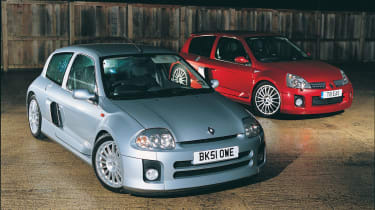
Every time you see a Clio V6 on the road you can’t help but stop and stare. Whether it’s the curvy original or the taut mk2, it makes no difference; the sheer, squat aggressiveness of the thing, the hungry-looking scoops and intake vents and those massively extended wheelarches simply demand attention. You smile at the madness of it all – and the fact that a humble Clio could be endowed with the kind of road presence only the most outlandish supercars can match.
It’s hard to imagine any manufacturer other than Renault, with a back catalogue that includes the 5 Turbo and Spider, producing something as gloriously nutty as the V6. What other car maker would re-engineer a class-leading hot hatch and turn it into a mid-engined, rear-wheel-drive modern incarnation of a Group B rally car? We’re just grateful that such a big player can produce something quite so feral as the V6. And the news gets even better because today you can pick up a pristine mk1 for as little as £13,000 privately and an early mk2 (properly known as the V6 255) for around 17 grand. In other words, if you’re in the market for a regular front-wheel-drive hot hatch, a secondhand V6 is now a viable alternative.
It is important to understand, however, that the changes between mk1 and mk2 run much more than skin deep; the driving experiences are significantly different, and this is explained in more detail later in the feature. In short, the first V6 had dynamic properties not dissimilar to those of an early 911, by which we mean tricky and occasionally heart-in-the-mouth handling that might take years of ownership to fully master. By the time the 255 was launched, the boffins at Renaultsport had not only got a handle on the original’s sometimes wayward dynamics, they had developed it into a car that could upstage a Ferrari and give a Lamborghini and a Porsche a real scare (evo Car of the Year 2003, issue 063).
We ran a 255 for a year and its custodian, John Barker, described it as by some margin the best long-term test car he’s ever had. evo contributor John Hayman has actually bought a 255, while fellow Fast Fleeter Tony Bailey had a mk1. It’s fair to say, then, that the Clio V6 is a firm evo favourite and we have a detailed knowledge of the reality of owning and living with this pocket supercar. If you want to cut a dash for less than £20K and become fully immersed in a stimulating and cerebral driving experience, the Clio V6 takes some beating.
EvolutionThere are some press launches that are more keenly anticipated than others, and then there are those that every motoring hack selfishly and vocally volunteers themselves for. The V6 had been keenly awaited since the concept wowed the crowds at the 1998 Paris motor show and expectations rose still further with the first viewing of the production version at the same show two years later. Shortly after that, co-editor Meaden won the evo scramble for the press invite and flew to Nice before anyone else had a chance to whip it from his grasp. Once there he was greeted by the amazing sight of two lines of silver V6s and, having snatched a set of keys from the nearest press person, he disappeared up the fearsome Col de Turini.
Apart from the race car, this was the first time the world at large had had the chance to sample a Clio with a 3-litre V6 engine in the space traditionally used for rear seats and a boot. The same basic unit could be found in the Laguna, but in the Clio it had an increased compression ratio (11.4 to 1), bigger inlet ports, a lighter flywheel and a higher, 7100rpm rev limit. It developed 230bhp at 6000rpm and 221lb ft of torque at 3750rpm. This was enough to propel it to 60mph from rest in 5.8sec, which was swift, but only a second-and-a-bit quicker than the 172, which cost £15,995. The V6 would set you back another ten grand, but to keep making comparisons between the two was to miss the point; the V6 was a completely different car, from its 17in OZ alloys upwards.
Take the dimensions, for example. The V6 was a massive 171mm wider, 66mm lower and 38mm longer in the wheelbase. And while the interior may have been familiar to Clio owners (as long as you didn’t look over your shoulder), it came with a six-speed gearbox. Then there were the 330mm vented discs and AP callipers.
In total, 1630 mk1s (300 for the UK) had been produced by the time the new model went on sale in August 2003. The 255’s run will continue until July this year and this time it won’t be replaced.
The obvious styling variations on the mk2 were complemented by extensive chassis revisions, which saw 23mm added to the length of the wheelbase and 33mm to the width of the front track. The rear subframe gained in rigidity and the trailing arms were 10mm longer, while roll stiffness at the front was more than doubled and the bump stops were longer and less abrupt in their action.
The engine was also breathed on, with the valves and ports being gas-flowed and fitted with stronger valve springs and a less restrictive air filter. The result was an engine that revved higher and developed an extra 25bhp, although torque remained the same.
Driving one today
There has probably never been such a marked contrast between two versions of the same car; despite their similarity in appearance and make-up, the original car is vastly different to the later V6 255. The mk1 was thrilling and occasionally terrifying, and it hasn’t mellowed with age.
Don’t get us wrong, we’re still fans of this Gallic handful; it feels very special and demands that you get involved every time you drive it. Yet if you relax your guard, particularly in the wet, the V6 will bite.
Drive the mk1 V6 today and it doesn’t feel as quick as you might expect; 230bhp sounds enough in a car that looks small, but this one weighs 1335kg. Fret not, however, because the engine has great flexibility and sounds fantastic, especially when you’re on a hard charge. It has the kind of sumptuous, big-chested bellow that wouldn’t be out of place in a supercar. The ride still surprises with its suppleness despite the low-profile rubber and limited suspension travel, and while the rear feels a little soft, it squats under power to create superb traction. The gearbox feels a little loose and not as positive as you’d hope, but the brakes are massively strong and the pedal has all the tactility you could wish for.
In tight turns on a dry road, the level of grip is huge and it’s very difficult to break traction. However, if the road is damp your hold on the tarmac disappears in an instant. Ex-Clio V6 owner Tony Bailey described it as feeling ‘like the wheels had been replaced by castors’. And there’s something else. High-speed cornering, even in the dry, should be approached with care. If you have to lift off or adjust your line, you’d better be ready, as momentum will send the rear arcing wide in an instant and you’ll have just one brief moment to catch it. When it happens your heart will thump hard for the next few minutes and your veins will be flooded with adrenalin. It’s certainly not an ideal trackday car, but on the road you can learn its ways, revel in its character and thrive on the strong points.
Climb aboard the 255 and the differences are immediately apparent. The interior is marginally improved, but it’s in the hidden areas where the magic lies. The detailed suspension workover doesn’t so much tame the unruly talents of the mk1 as completely revolutionise them. Roll and lift-off oversteer, along with the wet weather edginess, are banished, allowing the charisma to come to the fore. The steering also gains in weight and, more importantly, feel.
If your budget won’t stretch quite far enough, the original, pugnacious V6 makes an intriguing hot hatch alternative. But the 255 is a five-star car in every way. The extra power is certainly a boon, but the newer car is so much more than that. You could own one for ten years and still be discovering new facets to its character, still be enjoying the learning process. The V6 255 delivers on every level.