Genesis G70 review – do the 3-series and C-class have a new rival to worry about?
With its flawed execution there’s still some way to go for the G70, but it’s a fresh take on a classic recipe and on the right track
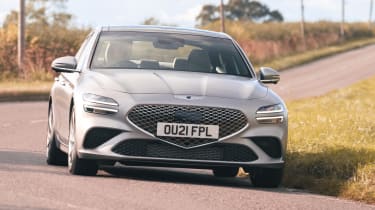
‘So who makes Genesis?’ It’s a question you’re asked often when stopped at fuel stations, in car parks or by inquisitive neighbours when a G70 is in your possession. The badge sort of looks like it’s from an Aston Martin, they say, but the design is totally different. So when there’s a collective ‘huh…’ after you tell them it’s made by Hyundai, what they probably don’t know is that the people behind Genesis are some of the most ambitious, innovative and asset-rich of them all.
The G70 is the latest member of a range that’s been rolled out since mid-2020, a compact executive designed to rival the BMW 3-series, Mercedes C-class and Audi A4 in both saloon and rakish shooting brake forms. The latter is bespoke to Europe – an appeal to local tastes – and is a particularly striking addition to the range that Genesis knows will likely only have niche appeal, and speaks more of its dedication to its exploits than a chase for outright sales.
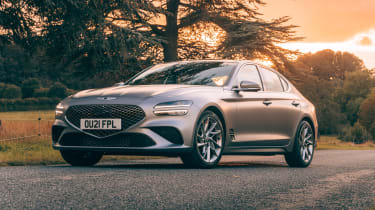
The fundamentals seem to hit the right notes, though. Both saloon and shooting brake sit on a rear-wheel-drive chassis, come with a petrol or diesel four-cylinder engine and an optional Sport Line trim that doesn’t just slick the visuals but also packs in a set of Michelin Pilot Sport 4 S tyres, a limited-slip differential and some chunky Brembo brakes.
More reviews
Group tests
- Ravage Alpine A110: France's perfect sports car made even more perfect
- Alpine A390 v Hyundai Ioniq 5 N – are these EV crossovers fun as well as fast?
- Ariel Atom 4R v Ariel Nomad 2 – is grip more fun than slip?
- Ariel Atom 4R v Caterham Seven ‘evo25’: power-to-weight heroes go head-to-head
- Audi Quattro, RS2 and RS3: five-cylinder icons head-to-head
- Who makes the best GT car? Aston Martin v Bentley v Maserati
- BMW 230i M Sport v Volkswagen Golf GTI Clubsport
- Caterham Super Seven 600 v Super Seven 2000
- Great Ferrari hypercars driven: 288 GTO, F40, F50 and Enzo head-to-head
- Hardcore Ferrari V8 specials go head-to-head
In-depth reviews
- Abarth 600e review – electric hot hatch with surprising character
- Alfa Romeo Junior review – small Italian crossover to rival Ford's Puma
- Alpine A110 R (2023 - 2026) review – the flawed but fantastic Porsche Cayman GT4 alternative
- Alpine A390 review – France's flawed rival to the Porsche Macan
- Alpine A110 review – the sports car Lotus should be building
Long term tests
- How lowering the roof on the Abarth 695C is a threat to my driving licence
- Alpina B10: Alpina B10: end of term report
- Alpina B10
- My £200k Aston Martin DBX707 comes with a built-in shower I didn't ask for
- My Audi S8 can’t make me hate it, even if its safety systems are often terrible
- Why you've probably been driving the Audi TT RS wrong this whole time
- Living with this £40k Caterham Seven even makes the KFC drive-thru memorable
- Caterham Seven evo Edition revealed – bespoke 420R joins the Fast Fleet
- It has a VW Golf R engine, but the Cupra Leon is quietly old-school
- Cupra Ateca VZN Fast Fleet test – four months with Cupra's hot crossover
Reviews
- Abarth 695 (2012-2024) review – why we’ll miss Italy’s Mini Cooper S rival
- Abarth 500e 2023 review
- AC Cobra 289 review – British sports car with an American V8 heart built to fight Ferrari
- AC Cobra 378 Superblower MkIV 2021 review – another V8 Cobra, but with a GM heart this time
- Acura Integra Type S 2024 review – a Honda Civic Type R with added restraint
- Alfa Romeo 33 Stradale 2025 review – a rare Italian jewel beyond compare
- Alfa Romeo Tonale 2023 review – 276bhp Speciale version tested
But the proof is in the product, and the G70 will be hitting a marketplace that’s never been tougher to crack. The new 3-series and C-class are better than ever, and while the push by Genesis isn’t limited to this compact executive model, to succeed it will require a good hard go in this lucrative, but high-pressure segment.
Genesis G70 in detail
- Engine, gearbox and technical highlights – Two four-cylinder options – one petrol, one diesel – with the petrol available in two outputs.
- Performance and 0-62mph time – These are not quick cars, even if the 241bhp variant posts a 6.1sec 0-62mph time on paper.
- Ride and handling – Somewhat imprecise steering and a suspension set-up that needs refining doesn’t really show off the rear-drive chassis.
- MPG and running costs – Has that odd ability to use an astonishing amount of fuel to not go that quickly.
- Interior and tech – Fairly simple design built with excellent materials. Not quite as solid feeling as a 3-series, but then few are.
- Design – Looks distinctive and brave on the road, which some might find too much, but it’s superbly executed.
Prices, specs and rivals
While cash prices mean little in 2022 in the compact exec class, the G70’s pricing is on a par with that of most rivals, starting at £33,400 for the entry 194bhp/260lb ft Premium Line petrol saloon. Specification is good, with a decent widescreen satnav, faux leather upholstery, 18-inch alloy wheels and LED headlights headlining the standard equipment. Swapping the petrol for the 197bhp/324lb ft 2.2-litre diesel adds an extra £2800 to the price.
An extra £2650 will upgrade you to Luxury Line trim, which throws in real leather seats that are also heated, a heated steering wheel, electric tailgate, adaptive dampers and a different wheel design. It also upgrades the powertrain to the 197bhp diesel for no extra cost. An upgrade to the 241bhp/260lb ft petrol is another £2800.
The Sport Line trim has the same powertrain range as the Luxury Line, and for an additional £1180 darkens down the brightwork, plus upgrades the wheels and tyres to a 19-inch set of five-spoke wheels and Michelin Pilot Sport 4 S rubber (Continentals are otherwise standard). There’s also a set of bigger four-pot Brembo brakes up front, a limited-slip differential at the rear and aluminium pedals.
From here there are further option packages including an Innovation Pack that bundles a set of clever 3D dials, surround-view parking cameras and adaptive headlights, and a Comfort Pack that includes adaptive seats and an upgraded Nappa leather trim option on the seats and door cards.
All in, a 241bhp Sport Line G70 will be pushing £48,000 when fully specified, but then a BMW 330i M Sport Pro or Mercedes C300 AMG Line Premium Plus with all the boxes ticked are both pushing £50k anyway.
Speaking of those rivals, there is something to be said of how far the compact executive class has moved on in the last few decades, as both the current G20 BMW 3-series and W206 Mercedes C-class are quite frankly brilliant cars that have a huge spread of capability – they’re both superbly built, quick, efficient, and good to drive, yet fantastically comfortable.
Instead, the G70’s abilities are in line with those of more eccentric rivals such as the Alfa Romeo Giulia, Jaguar XE and Volvo S60 – three cars that all lack the completeness of the Germans, but counter with their agile chassis, suave design and ultimate pillow-soft comfort respectively. So the question is, what does the G70 bring to the table?