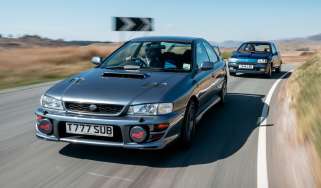
In fact, in the crucial departments - handling and performance - the new car seemed to have gone backwards or stood still. Maybe it takes more than a couple of days to get used to, we wrote.
A gleaming maroon-coloured WRX saloon, fresh from the international launch in Scotland, arrived at evo's offices just before Christmas 2000 and was soon hard at work. By the time Richard Meaden was penning the first running report, the mileage was over 5300 and it had featured in the cover story that month, introducing EPR, the evo Performance Rating. More of that anon.
The WRX was destined for a high-mileage life in the hands of evo staff photographer Andy Morgan, a task for which it was well-armed given the general improvements over the previous model - principally increased refinement and a better quality interior. Those at evo who hadn't much Impreza experience, Morgan included, found it a rapid, capable and characterful car. In the context of Mondeos and Vectras, it is.
Morgan's first month saw him cover 3500 miles, a large chunk of which were accounted for by a dash from the flats of East Anglia to the flats of Belgium. He'd been warned about the treacherous nature of sodden Belgian autoroutes but was rather alarmed when the WRX skipped two lanes sideways in a monsoon-like downpour. All-weather stability is a fabled Impreza asset, so he knew something was amiss and close inspection revealed that the inside edges of both front tyres (the bits that do the work in the wet) were shiny bald.
Although the WRX had just been through the EPR test, if anything the track work should have done for the outer edges of the Bridgestones - the WRX had understeered its way to a dry handling circuit lap-time fractionally slower than the Clio 172's. In other areas, too, the new Impreza had covered itself in something less savoury than glory, confirming our feelings that the edge of the previous model had been dulled.
It wasn't only the WRX's pride that was dented - we'd clipped a cone in the slalom test and it had dinged a front wing. Subaru UK offered to fix it and attend to the WRX's other needs - its 7500-mile service, a replacement for the stone-chipped front screen, and a pair of new front tyres.
At Morgan's monthly rate, the WRX was going to need a service every two and a half months. And at an average of 22.6mpg, the miles in between were quite pricey, too. Good job he was enjoying them thoroughly, then. Everyone, even passengers who rode in the WRX had something to say about its looks, but once inside they were all mightily impressed by the Impreza's dynamics: the pace of its rumbling, wooshing, turbo flat-four, its effortless grip and poise, and its fantastically supple and well controlled ride. No question: Impreza travel is first-class for a sports saloon.
What they couldn't feel, of course, was the steering - the primary link between car and driver. After its 7500-mile service and new tyres, the steering of our WRX just wasn't right. Not in the sense that it wasn't as lucid and crisp as the previous model's (that's how the WRX is), more that it relayed odd reactions from the front wheels in response to cambers, truck grooves in the slow lane and suchlike. It felt like the geometry was out and the rapidly disappearing tread from the outer edges of the new front tyres seemed to confirm it.
By the time the 15,000-mile service was due, the wiry carcass on both was showing through in places. It looked like they'd been mercilessly ragged around a circuit for a few days but in reality almost all the miles the car had covered were on motorways or trunk roads.
Subaru dealers the Welch Group, of Great Shelford, near Cambridge, replaced all four tyres and then checked the geometry but, oddly, said they could find nothing out of tolerance. Nonetheless, driving away, our Impreza's steering felt as good as it ever had and remained so for the life of that set of tyres (some 12,000 miles), right up to the last month of our tenure with the WRX, when all four Bridgestones were evenly worn.
It had required new front discs and pads at around 25,000 miles and these took a bit of a pasting when associate editor Tomalin and publisher Pattison used the Scoob for a track day at the Bedford Autodrome. The WRX acquitted itself well, in fact, but by that time we'd tried Prodrive's hotter, and officially sanctioned, version. The UK300 restored the WRX's voice and pace, gave it more grip and stronger braking and a World Rally Car nose-job. For us, this was how the standard car should have been - only without the hefty price tag. Independent specialist Scoobysport managed much the same with its interpretation, showing that the WRX does have the potential to recapture its former glory.
Thing is, the appeal of the previous Impreza Turbo was that it delivered straight out of the box. When Subaru created the WRX it wanted to make it more appealing to a wider audience by softening its character a little to make it more habitable and refined. Over 10 months we used it as its designers and engineers envisaged, racking up a huge mileage, mostly cruising, with some B-road work and the occasional track day foray thrown in. It never let us down and for the most part they were thoroughly enjoyable and comfortable miles. We can only assume our experience of unusual front tyre wear was an isolated incident because we've not heard complaints from any other owners.
Yet even setting aside the tyre saga, our enduring impression of the WRX is that what it has lost in terms of raw driver appeal isn't countered by gains elsewhere. Yes, it will cover vast distances in class-standard comfort, but it still has the thirst and short service intervals of the thrilling 4wd super saloon it used to be. It doesn't quite add up.
More CAR REVIEWS


Bookmark this post with: