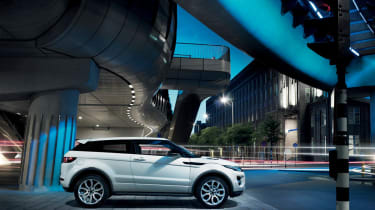
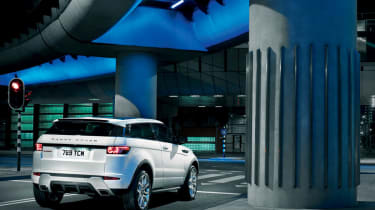
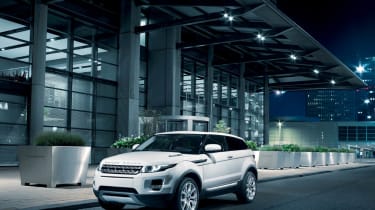
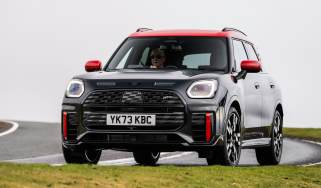
The Range Rover Evoque will make its first public appearance at the Paris motor show next week, although you won’t be able to buy one until summer next year.
Every Evoque at the show will be painted white, making a deliberate link back to the original, all-white LRX concept which the production Evoque so closely resembles.
In translating show car into showroom model, Land Rover’s designers and engineers have had to make some changes amounting to an extra 20mm of height on the bonnet line to aid pedestrian safety, a commensurate increase in roof height, a fractional decrease in width, and the addition of door handles. Otherwise, the Evoque is faithful to the concept that spawned it.
Under the skin, the new car is based on the Freelander and will be built in the same plant at Halewood on Merseyside. However, whilst the Evoque shares its basic genes with the smallest Land Rover, the company says up to 70 percent of the underpinnings have been modified, either as a result of a desire to stay faithful to the look of the concept car or to chase a more dynamic driving experience.
As a result, the track has grown by 20mm and key components including suspension knuckles and control arms are now made of aluminium, to the benefit of unsprung weight and therefore agility. Tellingly, the dynamic benchmarks for the Evoque extended beyond high riding rivals to include cars such as the BMW 1-series.
This will be the first Land Rover product to use electric rather than hydraulic power steering, the first to offer magnetorheological dampers and, in a move that may trouble purists, the first to be available without four-wheel drive.
The decision to sell a front-wheel-drive Evoque will allow Land Rover to boast a headline economy figure of 58mpg and CO2 emissions below 130g/km, though it’s claimed even some four-wheel-drive models will be capable of hitting 50 miles per gallon too. A standard stop/start system and extensive use of aluminium and plastic in the body that makes this car up to 150kg lighter than an equivalent Freelander also help in the quest for efficiency.
The greatest economy will come from a pair of diesel models using a tweaked version of the 2.2-litre engine from the Freelander in either 148bhp or 187bhp tune. The diesels will be available with manual or auto gearboxes, both with six speeds, whilst the sole petrol engine – a 237bhp, 2-litre, turbocharged, direct injection four cylinder from Ford’s new ‘Ecoboost’ family – will come connected only to a paddle shift auto. It’s no coincidence that the countries where petrol powered Land Rovers are popular are also those that favour automatics, most notably China and the United States. There is currently no plan to offer the petrol unit with a manual ‘box, though Land Rover engineers reckon it would be easy to do, if the demand was there.
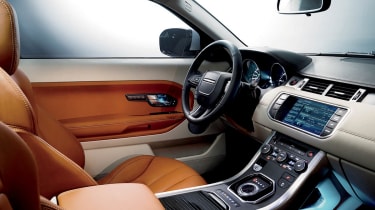
Exact prices haven’t been announced but Land Rover say the Evoque will start at ‘from £30,000’ for a front-wheel drive model in ‘Pure’ trim. Above that will sit ‘Prestige’ and ‘Dynamic’ models, the latter being the sportiest trim level with 20-inch wheels, different bumpers and body colour rather than dark trim on the lower half of its flanks. All levels of Evoque will offer customisation options that will be familiar to anyone who’s ever ordered a Mini including different coloured roofs and multiple interior trim choices.
The Evoque has already attracted a great deal of attention after a press event in July during which Victoria Beckham was announced as Land Rover’s new ‘Creative Design Executive’. The company’s Design Director, Gerry McGovern, describes her association with Land Rover as a ‘catalyst for change’ and is at great pains to stress that the link-up is not a publicity stunt with 80 per cent of her time allotted to the design studio rather than stepping out for a photo call.
True to this claim, the former Spice Girl will not be appearing on the Land Rover stand at the Paris Motor Show. Instead, next week will be all about the car.
More FEATURES


Bookmark this post with: