Caterham Superlight R500 (2008)
Is the new Superlight R500 just too hardcore for the road?

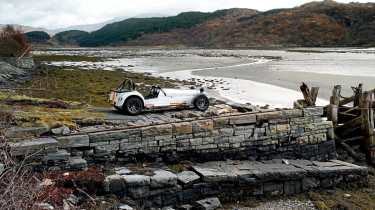
Caterham's design team have never been short of imagination and their latest R500 once again has raised the performance bar. Gone is the K-series, replaced by a 2-litre four-cylinder Ford Duratec unit rated at a mighty 263bhp. With a special lightweight chassis, thinner-gauge aluminium for the body panels and carbonfibre for the dash, nose cone and front and rear wings, the new Superlight R500 weighs just 506kg, giving a power-to-weight ratio of 528bhp per ton. For reference, that’s 7bhp per ton up on a Bugatti Veyron.
Bigger news – as if it’s needed – is that for the first time Caterham will be offering a sequential six-speed dog ’box on the options list. It seems inconceivable, but the R500 has just got even more hardcore. Too hardcore for the road? Maybe…
WE NEED A GREAT location to uncover the truth. Is the Superlight R500 a £36,995 (plus £2950 for the ’box) trackday irrelevance, or the ultimate expression of road-going minimalism? To discover the truth, I find myself ignoring severe weather warnings in the time-honoured and deeply flawed evo tradition and pointing the two red stripes that lick the R500 from nose to tail north from Glasgow to Glencoe and beyond.
To be honest, this isn’t normally Caterham country. The A82 through Glencoe is straight and fast, running along the floor of the glaciated valley with just the occasional fast sweep, but the R500 shrugs off the ragged surface and settles to a cruising speed fast enough to have my Arai bobbing around like the head of a Thunderbirds puppet. Besides, I’m still high on the afterglow of what went before. The A82 might be lazily draped along the valley floor now, but maybe 15 miles back it was bucking and swooping and narrow. Here the R500 had been mighty…
The Seven is pure function. That’s why it’s so enduring, so timeless. However, my first impression of the R500 is that maybe Caterham is trying too hard to make it seem ‘new’. It still looks as pared-back as ever, but some of the ‘interior’ detailing is unnecessary. The dash now has aluminium control buttons where before it had simple plastic toggle switches. There’s no key, rather an immobiliser fob and a starter button. On the tiny steering wheel are buttons for the indicators, TVR-style. I understand this is an expensive car, but for me the trinkets don’t add value. The R500 should be a crazy engine cradled in a lightweight, perfectly balanced chassis. Nothing less, nothing more. Having said that, the little carbon winglets at the front – which channel air over the low-drag wishbones, and in combination with the ‘cats tongue’ outlet in the top of the nose cone reduce lift at speed – are very cool. Function dictating form, you see.Some things are eternal though, and squeezing down into the thin carbon seat, compressed between transmission tunnel and sill, looking over the long, heavily louvered bonnet, carbon cycle wings hanging above wishbones and giving you yet more information about what the front wheels are doing, you feel immediately at one with the Seven.
Waggle the fob below the dash to your right, press the starter button, and the new Stack display flickers to life. Press once again and, after a slight delay, the starter engages and the engine catches with a boom! It doesn’t crackle with the venom of the old K-series, but it still sends sharp stabs of rage from the side-exit exhaust when you blip the throttle, and the noise is still pure race car.
Now there’s another layer of mechanical noise, too: the chatter and clatter of that Quaife sequential gearbox. Pull the lever towards you and the ’box clunks into first, signified by ‘Gear 1’ on the multi-function display. The clutch is weighty and short but easy to modulate, and the 2-litre engine has a brawny and smooth torque curve – very different from the spiky old R500 – so it’s easy to get the new R500 rolling.
It’s cold and the road is glistening, so it seems prudent to short-shift through second and into third. The gearbox action is short and precise. Steering wheel dead straight and nail the throttle. Bam! The engine snaps to attention, the revs rising rapidly, power building quickly through 3500-4000rpm and then starting to climb hard towards the real fireworks. At 5500rpm the tyres start to slip and shimmy, at 6500rpm it needs a lift and a twist of opposite lock and the noise and power jump into fast-forward. Now the road is rushing towards you in great chunks and the final rush to 8500rpm is mind-scrambling in its intensity.
It’s not over yet. Full-bore upshifts can be executed without the clutch and with barely a lift of your right foot. Just load pressure onto the lever and, just as the last shift-light burns red, a tiny reduction in throttle and a firmer tug backwards slots fourth and the acceleration continues without interruption. Anything beyond the road’s edge is invisible, even the mountains rising up in the distance above Glencoe. Right now I’m scrapping with the road, flicking the R500 into corners and then trying not to unleash too much power too early, thinking hard about every braking input (there’s no ABS to lean on, of course), yo-yoing up and down the thumping power-curve and just occasionally dialling-in a correction as the tail steps out under power, just occasionally riding out the slide for the length of a gear because the R500 wants me to.
That might sound a bit irresponsible, but it isn’t. The Caterham is so narrow that you need never cross a white line, so fast that overtaking is completed as quickly as the decision to squeeze the accelerator. It’s a stark reminder of the benefits of lightweight engineering, and despite celebrating its 50th anniversary last year, the Seven formula seems more intelligent than ever. The motoring landscape is changing rapidly, but whatever the future holds, pure driving enjoyment will still be a strong currency – and in order to cut CO2 emissions and keep the fun-factor, manufacturers must address ballooning weight. Maybe the next R500 will run on biofuel like the Koenigsegg CCRX (I’m bloody sure it won’t be a diesel), but I’m certain that there will be another R500, and for that we should all be grateful.
My immediate future is a more pressing concern right now, though, and by ‘immediate’ I mean the road ahead. In slippery conditions the R500 demands respect. It’s brilliantly controllable, but it also has much, much more power than grip, and even when you’re pointing straight it’s not always possible to just mash the throttle to its stop. Let your mind wander and the R500 can easily bite, the frights usually coming when you think a corner is over and you want to feel the full force of that engine again. But as Glencoe opens up ahead of me, trees melting away from the road’s edge, dry-stone walls no longer hemming me in, I can relax and enjoy the view, enjoy that sensation of heading into the elements in this tiny missile, engine gargling cold air and super-unleaded.
Beyond the awe-inspiring Glencoe is Ben Nevis, at its peak as white as the Caterham, and even more treacherous on a cold April day. But we’re going to push on past The Ben, not only to escape the nondescript misery of Fort William, but also because the A830 that runs out to Mallaig and the A861 that forks away to Roshven are two of the best roads in Britain. The A830 is wide and clear-sighted in parts, narrow, bumpy and blind in others. With surface changes coming thick and fast, corners tumbling through jagged rocks and then sweeping alongside lochs so close that road and water nearly touch, it is a relentless challenge and perfect fodder for the R500. Turn left at the Inn at Lochailort and the rollercoaster starts to rise and fall, hanging above Loch Ailort and in the shadow of Rois Bheinn. Epic is the only word that fits. We’ll drive until the loch runs into sea at the Sound of Arisaig and the road stops dead.
NOTHING AROUND, SO a chance to try another Caterham first: launch control. It’s a bit of a gimmick obviously, but it’s bloody good fun and Caterham claims this £350 option will help the R500 leap to 60mph in 2.88sec. The final version of launch control will have a choice of settings for different conditions, but to engage this pre-production system I simply have to select first then press and hold a small black button on the dash. Now when I floor the throttle the revs are held at 4500rpm, engine spluttering and crackling like Massa’s F1 car on the limiter at the exit of every corner in ’07. Take a deep breath, brace yourself and release the clutch. Torque thumps to the rear tyres. They spin-up, but still seem to dig into the surface, and with a good armful of correction the R500 screams through first, second and is into third before you’ve remembered to suck in some cold air yourself. It’s a mark of the R500’s raw power that even into fourth and fifth the acceleration isn’t dimmed, and I’ve no doubt it would easily pull to its limiter in sixth should you find yourself on a limit-free road. And not a very long one, at that.
The way the R500 just puts on speed is shocking, and it’s when I stick with it into fourth that things become overwhelming, the wind smashing over the carbon wind deflector and into my visor, the engine still shrieking over the rush of air and the road seeming to jump at me in fast strides as my eyes struggle to deal with the acceleration. The speed at which you can attack corners is astonishing too. There’s no weight transfer to speak of, so the tyres are always working at their optimum and you never, ever find the limit of the front end on the road. You hardly seem to use the brakes either, because the combination of poor aerodynamics and high speeds means you can easily alter the car’s pace with just the throttle.
It’s incredibly easy to fall into a hypnotic rhythm with the R500, scaling the power- curve and descending again on the way into corners, bit-by-bit using more revs, feeling that unbelievable zing at the top end, edging the car sideways when the road opens out and occasionally indulging in another manic two- or three-gear lunge just to make sure all that power is still present and correct.
The chassis wriggles and writhes underneath you, the R500 skipping over big ridges and pummelling over ragged sequences, but it never gets unsettled and the ride isn’t stiff like, say, a Mitsubishi Evo’s – the beauty of light weight is that the chassis can be supple but still easily control the mass it supports. Building a car light really is the most virtuous of circles.
Left at the Inn again and the road just keeps flowing like chopped-up rapids under the R500’s wheels. The sun is shining now, but I don’t care. I’m in a little bubble of heat and noise and fury, skipping and sliding and buzzing along God’s own road. Right now, though, it’s on loan to the R500 and me. By the time it unravels to its end and the Caterham is parked up in a huge scene, mountains backlit by a fading but warm sun, water sparkling and still, the R500 has given me another life-affirming sequence to cherish for years to come. Thanks for the memories. I’m done.
Extra Info
Engine:
Max power:
Max torque:
Nil to sixty mph:
Price:
Transmission:
Front susp:
Rear susp
Wheels:
Tyres:
Weight:
Power/weight:
evo star rating: