Aston Martin Vantage safety car driven – the road car F1 cars can't overtake
One of the most filmed road cars in the world is the F1 safety car, James Taylor drives the Aston Martin Vantage that currently leaded the F1 grid
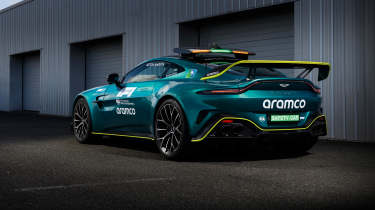
The Aston Martin Vantage has been F1's safety car since the beginning of its involvement in 2021. For the 2024 season, the new third-generation Vantage made its debut. That’s the car examined here, which has now been replaced by the latest Vantage S.
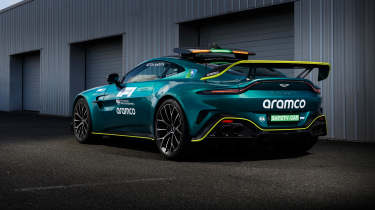
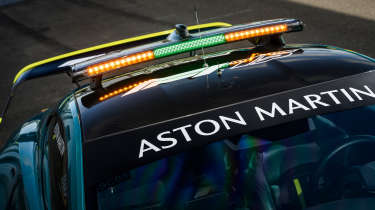
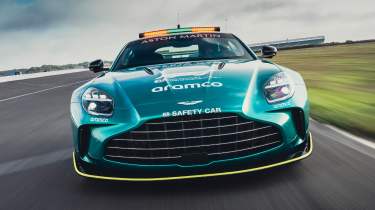
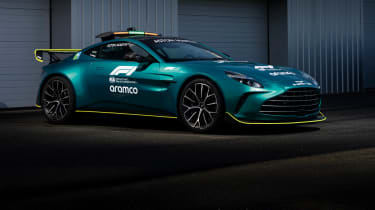
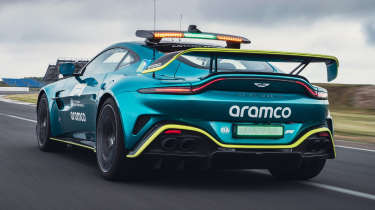
Painted in Aston Martin’s metallic Podium Green with lime highlights and a unique aero kit (including the aerofoil-shaped lightbar on the trailing edge of its roof), it possesses plenty of star quality. Besides the flared front splitter there’s a bespoke rear wing with secondary Gurney surface at its trailing edge. There are underfloor aero surfaces hidden beneath the car, too. There’s also no numberplate in front of the grille to get in the way of cooling, and where the rear numberplate would be is a graphic matrix display.
Lights and aero kit aside, the Vantage is very close to standard. Remarkably so, considering the punishment it gets during race weekends. Power comes from the same 4-litre twin-turbo V8 as the road car, without any special upgrades. The exhaust silencers have been removed, both to reduce heat beneath the boot floor (above which are some important electronic components, more on which later) and provide that thunderous V8 soundtrack that’s often audible on TV coverage.
‘A bit of showbiz,’ smiles its driver, Bernd Mayländer. The affable German is in his 26th season as the F1 safety car driver, and alongside him during Grand Prix weekends is British co-driver Richard Darker.
The car’s suspension geometry is ever so slightly altered to better suit track work, and the track rod ends have been given reinforced collars. Whereas the previous-gen Vantage needed some work to enhance its brakes and cooling for safety car duties, Aston Martin director of performance Simon Newton says the current car hasn’t required any upgrades other than some modified brake ducting. Naturally the safety car has the ceramic brake option, but they’re standard road car brakes, not special motorsport discs.

A supplementary cooler has been fitted for the differential but that’s only for extreme temperatures in very hot climates, such as in the Middle East. Finally, whereas the roadgoing Vantage wears specially optimised Michelin Pilot Sport S 5 tyres, the safety car carries tyres from a different brand: Pirelli P Zeros, in deference to Pirelli’s F1 tyre supply deal.
From the 2025 Dutch Grand Prix in August onwards, the safety car was upgraded to the new Vantage S spec – a model variant yet to reach customers. The S version’s power is increased by 5bhp to 671bhp, with torque remaining a healthy 590lb ft.
S or otherwise, the current Vantage has proven in multiple evo tests that it’s a stonkingly quick road car but one that also possesses impressive track capability. With a third more power, it offers a sizeable step in performance from the previous-gen Vantage, which copped some flak when drivers complained it was too slow at the 2022 Australian Grand Prix. Still, at least they weren’t following a Fiat Tempra.
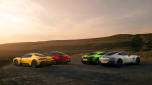
Aston Martin also supplies the F1 medical car, a DBX707. Fitted with individual bucket seats, it carries a payload of emergency medical equipment in the boot plus two doctors alongside driver Karl Reindler: one full-time FIA doctor and one local medic, to liaise fluently with medical staff and hospitals.
Aston Martin has three safety cars and three medical cars, with two of each sent to each race, together with a team of mechanics to look after them. Incidentally, the Mercedes-Benz equivalents at the other 12 races are an Mercedes-AMG GT Black Series as the safety car, and an AMG GT63 S 4‑Door as the medical car.
The cockpit
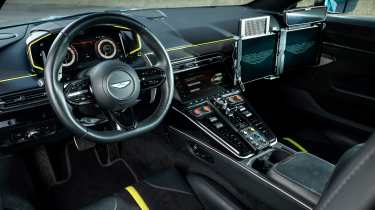
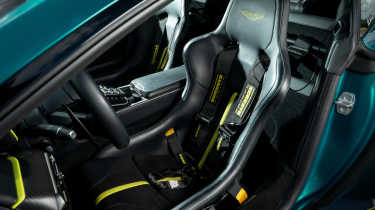
Inside the Vantage is an incongruous mixture of high-end luxury and motorsport function. There’s a pair of great-looking leather- and suede-trimmed Pole Position bucket seats with embroidered Aston Martin logos in the headrests above the five-point harnesses. Likewise, there’s both a plumbed-in fire extinguisher and bright Lime Essence green highlight strips around the carbonfibre dashboard trim and instrument panel cowling, and down the centre of the seats.
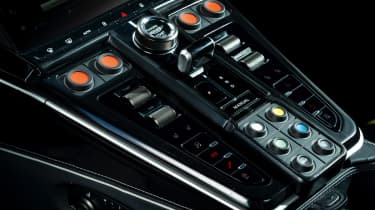
The broad centre console is the same as in the road car but features some intriguing new colour-coded buttons. White is for the standby lights, which show the car is ready to deploy. Should they get the confirmation call to head out onto the track, it’s time to press the yellow button to activate the orange strobe lights.
The green button triggers an overtake graphic on the roof and the matrix display on the rear numberplate board, to permit certain cars to go past. The blue button activates a siren to alert people in the pitlane or danger areas on the circuit that the safety car is on the move.
On the passenger side are two monitor screens that are operated by co-driver Darker. During a race, the left-hand screen shows a live feed of the action, and the right a GPS map with live timings and the position of each car on the track.
It breaks the track into sectors, and if a car is stopped, the sector with its location will turn yellow. In the case of a big accident, the screens even inform the safety and medical car crews how much g-force has been registered by each driver involved, giving the safety teams an instant idea of how serious or otherwise an accident may be.
A miniature light panel above the left screen is linked to the marshals’ posts and shows the flag or light being displayed at each post; a single- or double-waved yellow flag, for example. There’s also a rear-view camera, to allow the crew to see the low-lying F1 cars behind as clearly as possible.
Radio and comms
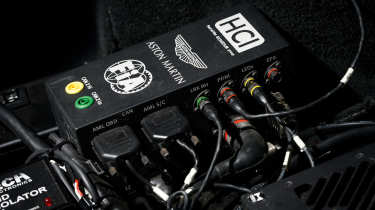
At the top of the centre console is a quartet of red buttons. These are for the two-way radios used to communicate with race control. The switches closest to the seats are for the main radio; the switches closer to the centre are for the back-up radio, installed just in case. Although Mayländer can speak on the radio too, the majority of communications are handled by Darker.
An antenna poking from the Vantage’s nearside rear haunch connects the car to the race control mothership. Beneath it, inside the boot, is a collection of complex-looking electronic gubbins: control units for the radio systems and intercoms, telemetry units, computers for the onboard camera and timing gear, the marshalling system unit, the car data logger and a Wi-Fi router to connect everything, along with a physical fuse and relays box.
Working life
It’s a good job the Vantage’s interior is comfortable because its crew spend as long as seven hours sitting in it during a race weekend, engine running, ready to go. That’s because it’s not just F1 that the safety car has to cover: it’s on standby for all of the support races, too, from Friday through to Sunday. That includes Formula 2, Formula 3, F1 Academy and Porsche Supercup.
At least ten minutes before a race starts, Mayländer and Darker are strapped into the car with the engine running (the air-con, too, at hot races). If they’re scrambled, it’s not a case of driving flat-out; apart from controlling the pace to create a gap for marshals or recovery vehicles to safely go out onto the track, Mayländer may also slow down in order to restart the race sooner, bunching the pack to allow recovery crews to get clear and allow racing to recommence at the start of the next lap.
On the other hand, when it’s safe to do so, he needs to lap as quickly as possible to avoid the F1 cars’ tyre pressures and temperatures dropping dangerously low. He needs to push the Vantage close to its limits without exceeding them, and all in a very public arena. Sometimes, via race control, the drivers will ask him to speed up; sometimes, particularly in heavy rain, they might even ask him to slow down. ‘You always walk a little taller when that happens,’ he smiles.
While out on track, he and Darker are constantly in communication with race control, feeding back information about debris on the track, or track conditions during bad weather. Part of the Vantage’s skillset is to be a communicative car for Mayländer to get a good feel for the circuit’s grip levels, standing water and so on. Having raced with great success in the past in single-seaters, sports and GT cars and the DTM, he’s well aware that what he sees in the air-conditioned Vantage with its set of windscreen wipers is different from the wall of spray a mid-pack F1 driver is faced with.
At some circuits, it’s rare for the car to be scrambled at all. Others, such as Singapore, have seen safety car action practically every year since 2009. In 2024, Aston Martin took part in 12 Grands Prix weekends with the safety and medical cars.
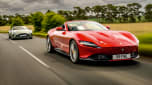
During F1 races the Vantage was deployed seven times, leading a total of 20 laps. In additional support series races, it was scrambled a further 40 times, leading 107 laps. By the end of this 2025 season it will have taken part in 12 weekends again; at the halfway point it had already been deployed eight times, leading the F1 field for 34 laps (and, including the additional series, 114 laps in total).
At the end of each day, the Vantage and DBX are given a fresh set of tyres and a thorough check-over. And a spare car for each remains prepped on standby for emergencies.
The cars also lap the circuit at high speed in dedicated sessions on the Friday to check the comms systems and to get a feel for the track and tyre wear, and for the FIA to keep an eye on their pace too – the medical car, for example, needs to be quick enough to clear the track before the F1 field completes the first lap. I ask Reindler if he’s able to push close to ten-tenths with people and equipment on board. ‘More like eleven-tenths on that first lap, actually,’ he says. The DBX is then immediately parked up, hot brakes and turbos and all, to sit on standby for the rest of the race.
Driving it
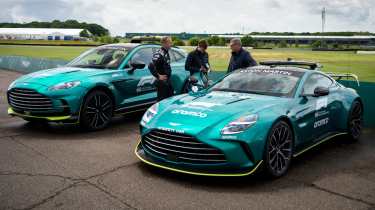
Before driving the Vantage at Aston Martin’s test track, the twisty Stowe complex at Silverstone, we first take a passenger lap with Bernd. His body language is supremely relaxed at the Vantage’s wheel; it’s clearly a car he knows very well and enjoys driving.
Unchanged from the regular Vantage is the ten-stage traction control system, managed via the tactile twist collar around the starter button. Even Bernd says he leaves the system on at some circuits – particularly Monaco. I don’t blame him.
Nonetheless, traction is fully off for our passenger ride, and Bernd neatly balances the car on the throttle while chatting away as if he’s on the way to the shops. He asks if I brake with my left foot or my right; he says that since breaking his right heel (he’s missed only four Grands Prix in the last 26 years, that injury accounting for three of them), it feels more natural for him to brake with his left.
It’s fun to sit in the passenger seat watching Bernd at work, mixing calmness, smoothness and plenty of speed too. Especially as I don’t need to worry about speaking to race control or manning the data screens ahead of me.
Bernd vacates the car with a cheery goodbye. I’m very conscious this car is due at another Grand Prix in a matter of days, but the Aston crew are keen for me to drive it too, and are as encouraging as ever for it to be exercised enthusiastically.
> Aston Martin DB12 Volante v Maserati GranCabrio Trofeo – open-top GTs go head-to-head
The Vantage is keen too: just as on the regular Michelins, there’s great response from the front end and it turns in nicely. The geometry changes feel subtle; there’s not a huge difference in response and feedback compared with the regular car. There is more volume, however: the free-breathing exhausts sound fantastic, with an addictive blast of V8 bombast every time you push the throttle to the stop.
Which is something it’s easy to do frequently, because despite having more than 650bhp coursing through the rear tyres, the Vantage is a predictable, enjoyable car with a lovely balance. It will understeer if you’re heavy-handed on corner entry, but overall its balance is neutral with a likeable leaning toward oversteer.
With the dampers in Track mode they’re stiff enough to find bumps even around relatively smooth Stowe, and ripples in the surface readily make their way through to the driving seat. But as Mayländer showed, that gives the Vantage plenty of stability under braking. It’s every bit as much fun here as it was on eCoty 2024 at Navarra – only with an even better exhaust note.
Strictly speaking, it’s irrelevant whether the safety car is fun to drive or not. It’s there to do a job after all. But I’m grinning from ear to ear. And the communication and drivability that make the Vantage so enjoyable are also useful for Bernd when he’s reporting track conditions back to race control.
My only regret: that I didn’t turn on the lights and siren!
You can order a copy of the December 2025 edition from the evo shop now.