Genesis G70 review - engine, gearbox and technical highlights
The two four-cylinder engines are a bit underwhelming, and we won't be getting the V6
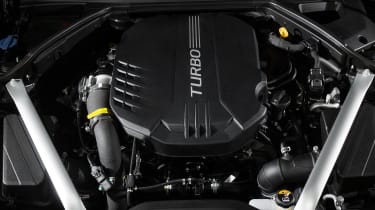
As mentioned, there are only two powertrains available in the G70 – one 2-litre petrol and one 2.2-litre diesel. Both are four cylinders, and neither produces particularly spectacular results. The petrol is the familiar ‘Theta’ engine as found in various Hyundai/Kia models, including the Hyundai i30 N. Here, it comes in 194bhp and 241bhp forms, and despite its fantastic performance in the Hyundai, its effect in the Genesis is rather different.
From a useability perspective, the petrol engine has been tuned to deliver high torque at low engine speeds, providing an effortless feeling that’s aided by the smooth-shifting eight-speed auto. Get greedy with the throttle and utilise the full rev band, however, and things get a bit breathless and strained. Regardless of the chosen driver mode engine response isn’t great, feeling a tad mushy and slow, and almost as if the crankshaft is made of lead.
The diesel is a 2.2-litre CRDi unit that does the business across many EU-specification Hyundais and Kias. Its 197bhp output is more on the pace, and 324lb ft of torque makes short work of the 1773kg kerb weight. Overseas models also have the option of a range-topping 3.3-litre turbocharged V6 that produces 367bhp, but Genesis won’t offer it in the UK or Europe due to a perceived lack of demand (and its thirst).
Unlike larger Genesis models, the G70 doesn’t sit on a bespoke platform, instead utilising the same rear-wheel-drive chassis as the Kia Stinger. As with that car, there’s nothing overtly unusual about the layout or its suspension, pairing a MacPherson strut front end with double ball-jointed lower arms, and a five-point multi-link rear. Passive dampers are fitted to the entry-level model, but both Luxury Line and Sport Line cars are fitted with adaptive dampers selectable through four driver modes.