Hyundai Ioniq 6 to target Tesla Model 3 as sleek EV saloon
Hyundai’s sleek new saloon goes upmarket as it builds on its EV offensive

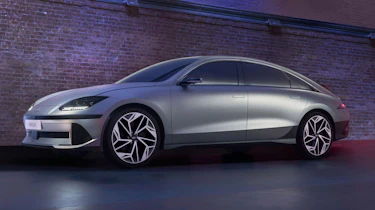
This is the Ioniq 6, a new all-electric saloon from Hyundai that will rival the Tesla Model 3, BMW i4 and Polestar 2 when it reaches customers next year. The striking saloon finds its design inspiration in the Prophecy concept car revealed in early 2020, differing markedly from the wildly successful Ioniq 5 with a curvaceous design that’s totally distinct from the angular SUV.
Despite their visual differences, the two all-electric models share most of their underpinnings, including the cutting edge E-GMP platform, 800V electrical system and lithium ion battery packs. Dimensionally, the Ioniq 6 is 220mm longer than the 5, but the wheelbase is actually 50mm shorter, giving the car a more fluid and saloon-car like look. By reducing this wheel-at-each corner stance, Hyundai’s designers were able to accentuate the car’s sleek silhouette, something exaggerated by the flowing roofline and sloping windows.
The body itself is extremely curved, but the volumes are very constrained and lack the three-dimensionality or muscularity of most modern cars as the curves generally exist in only one plane. This is a technical way of saying the design is curved, but not organic-looking. Beyond the quality of the surfacing, the rest of the design is very distinctive, dominated in fact by the tail which falls away from the nose to create an almost Porsche 911-like tail. Except unlike a 911, where the window line continues upwards to maintain a certain level of wedge, the Ioniq 6’s windowline follows the body lines and falls away as it reaches the complex rear.
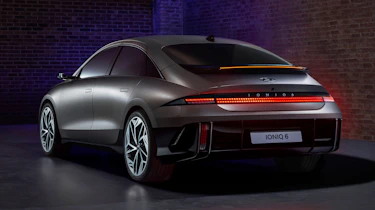
Here, the lighting is split into three elements – there’s a full-width light bar, here made up from the same geometric block design as taken from the Ioniq 5 sat in a perspex-like clear housing, a slim third brake light that sits on a static rear ducktail, and finally two vertical stripes that house the reverse lights and reflectors. The effect is more complicated than the minimalist Prophecy concept, but remains very distinctive.
The nose is a little more conventional, with small LED lighting units sat above a collection of complex looking openings and shapes that house the various driver-aid sensors, active intakes and air curtains. One thing that has been referenced from the Prophecy concept is its translucent coverings for some of the technical elements on the exterior. Things like the rear-view and side mirror cameras have a translucent casing, so too the third-brake light element on the rear wing. This is a direct reference to the translucent wing that was fitted to the concept, but wasn’t able to make production.
The interior has the same basic layout as the Ioniq 5, but uses the elements in a more intimate space. The centre console is now both fixed, and larger, while the dual screens and their surround is both more ornate and set into a more complex dash design. Part of this is the integration of the door mirror camera display screens that sit within a section of the lower dash that swoops up to sit in a similar position to a normal door mirror.
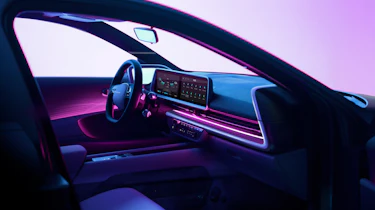
The materials are also more opulent than in the 5, but maintain a similarly contemporary feeling, negating the use of old-fashioned materials like leather or wood. Textured soft-touch plastics glow with integrated lighting that’s designed to reflect off the surfaces, rather than be seen directly, help give the Ioniq 6’s interior an ambiance that’s different to most of its rivals, while not treading too far from an ergonomic layout it knows works.
Under the skin, Hyundai will likely offer the Ioniq 6 with similar technical elements to the Ioniq 5 and related Kia EV6. This means two battery sizes will be available – 58kWh and 77.4kWh – with either single or dual motor options. It remains unclear whether the Kia EV6 GT’s 576bhp high performance setup will be made available down the line, but we do know that Hyundai is hard at work integrating that powertrain setup in a forthcoming Ioniq 5 N, so we wouldn’t put it past the ambitious N team to already be working its magic on the 6.
For now, the highest performing model will likely be the 301bhp dual-motor model that currently tops the Ioniq 5 range, which is also capable of a range of somewhere around 320 miles. Pricing also remains a mystery at this stage, but we suggest a starting price of around £40,000, which sits just above the equivalent Ioniq 5. Customer deliveries are expected to commence from early 2023.