New Porsche 911 Turbo S review – McLaren Artura performance with four seats
The 911 Turbo S despite its newfound electrification, is as it always was: a well-rounded supercar slayer

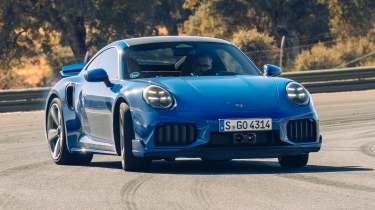
There’s a growing feeling that the 911 Turbo is getting right back to its core values. It started moving that way in 2020 with the first 992-generation Turbo S, after a number of years when the Turbo was quite hardcore, a quasi-GT2 if you will, the product of a company rattled by the arrival of the Nissan GT‑R.
When the GT‑R landed in 2008 it offered similar specification, performance and practicality to the Turbo for half the price – and provocatively set a Nürburgring lap time for the Germans to chase. And chase they did. But the monster under Porsche’s bed is no more, vanquished not by the Turbo but something more mundane: more stringent European drive-by noise regulations.
The 911 Turbo’s pivot back to its traditional values continues with the 992.2 model, a designation that suggests a routine, mid-life revision but is anything but. Essentially, Porsche has fitted the hybrid running gear of the 911 GTS but uprated to Turbo S levels, lifting power to 701bhp and creating the most powerful production 911 ever.
So out goes the 3.8-litre engine of the previous Turbo and in comes the GTS’s 3.6, but with a pair of smaller, electrically assisted ‘eTurbos’ rather than one big one, further enhancing response. Regardless of engine load, the moment the throttle opens, the eTurbos’ integral motors, sitting on the shaft between compressor wheel and turbine, spin up to deliver boost, preventing lag. Then, on a closed throttle, they are driven by excess exhaust gases and act as wastegates and generators, feeding power back into the hybrid battery.
More reviews
> Porsche 911 Carrera GTS 2025 review – hybrid done the right way
As in the GTS, there’s an electric motor incorporated into the PDK gearbox, putting energy directly into the four-wheel-drive system, with up to 370lb ft of torque delivered to the water-cooled differential of the front axle. Unlike its obvious rivals, the Mercedes-AMG GT E Performance and McLaren Artura, the 911 offers no EV-only mode: the hybrid system is there purely to enhance performance.
At 1725kg, the new model is 85kg heavier than the previous one but has a slightly better power-to-weight ratio and gets to 62mph in 2.5sec, two tenths quicker. However, 0-125mph takes 8.4sec, four tenths longer, and the top speed is 200mph, which is more than enough, of course, but the last model went to 205mph.
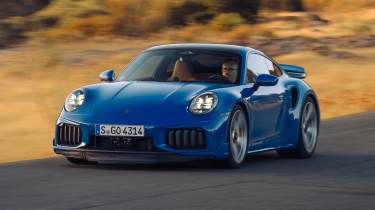
The curious aspect to this is that the new Turbo S has a more comprehensive active aero package that is said to give ten per cent less drag in its most aerodynamic trim. Selecting Sport Plus extends the front splitter (carried over from the previous model) and activates the extendable and tiltable rear wing. As before, the air intakes either side of the main front aperture adjust depending on the cooling demand, while at the rear the charge-coolers vent into the rear diffuser, so technically the new Turbo S has a blown diffuser.
In addition, there are now diffuser flaps ahead of the front wheel-wells that have a secondary function, deploying to reduce spray onto the front brakes in wet weather. And speaking of brakes, the standard-fit carbon-ceramic set-up now features bigger rear discs, up from 390 to 410mm diameter, purely on account of the car’s extra mass.
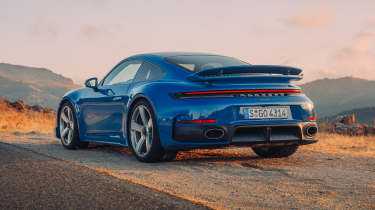
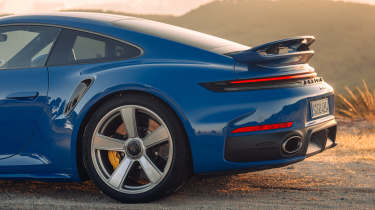
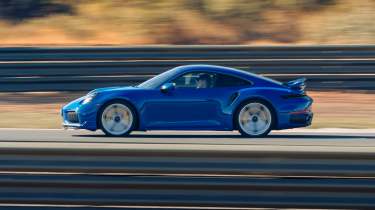
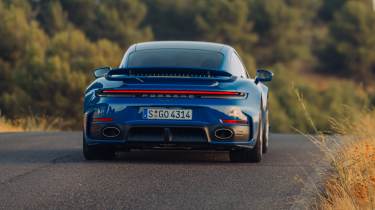
Our test car is finished in Lugano Blue – one of about a dozen no-cost-option colours – paired with five-spoke Sport Classic alloys, which are a sub-£500 alternative to the standard-fit and familiar ‘Turbo S’ multi-spokes. Although they are the same size – 20 inches front and 21 rear – they make the car look smaller than it is.
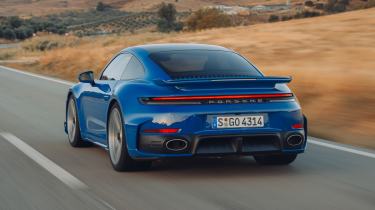
That’s not the case from the rear, however, where the full-width light strip and added rear arch vents visually widen the car, though it’s actually no wider. It’s on Pirelli P Zero Rs, the same 255/35 R20 size at the front but up a section to 325/30 R21 at the rear. A Goodyear (probably the Eagle F1 SuperSport) will also be available.
Standard kit includes 18-way electric adjustable seats, Sport Chrono, a Bose sound system and matrix LED headlamps. The latter are earning their keep on our pre-sunrise departure from the hotel; the schedule asks that we arrive at Circuit Ascari at 9am for a 9.30am track briefing, but as this is the only road driving we get with the coupe – the return leg is in the Cabriolet – I’m keen to maximise wheel-time.
Initial impressions are that the engine has a quite hollow, jangly flat-six note, and that the ride is a little robust at low speeds but, as with most current 911s, as soon as there’s a little speed under the wheels it smooths out. A benefit of the 400V electrical architecture is that it ramps up the performance of certain systems, including the optional nose-lift, although if the front spoiler isn’t extended, the Turbo S has no issue with even big speed-humps.
Beyond the city limits and heading up into the Andalusian hills, the roads are admittedly smooth but there’s noticeably little road noise. Traditionally, the bugbear of 911 refinement was the low rumble of the wide rear tyres, and given these are the widest yet, the ride is commendably quiet on most surfaces.
The ride quality itself is good too, not overly controlled in Normal mode, and it should work on the UK’s more challenging surfaces thanks to the standard active anti-roll bars. These are part of the ‘ehPDCC’: electro-hydraulic Porsche Dynamic Chassis Control. Again, this uses the 400V system to manage the anti-roll bars, not just in roll but also to decouple them in a straight line to allow the wheels on the left and right of the car to articulate independently. There was an opportunity to eliminate roll entirely but this felt ‘synthetic’, so it is limited to 0.5 degrees per g.
Steer left and right quickly and you can feel the roll resistance, but you quickly acclimatise to it and along a flowing road the Turbo S simply seems to tack crisply into the turns, finding strong grip. It’s not just the anti-roll bars of course; there are active dampers and rear steering (delivering counter-steer at low speeds for agility and parallel steer at high speeds for stability), plus torque distribution via the four-wheel drive.
So it’s all about integrating and blending the various systems and their influences to deliver not just something that is effective but which feels natural, something that the driver feels a part of. I’d say in general driving it’s mission accomplished. The Turbo S’s steering isn’t the most tactile, but the ease, accuracy and poise with which it gets down a tricky road is just what you want from a 911 Turbo.
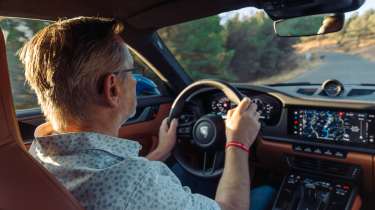
It helps that the seats are quietly very supportive and comfortable, and with their various electric adjustment abilities, along with electric reach and rake adjustment for the steering wheel, most should be able to tailor their ideal driving position. You’ll want to feel settled and secure when you get the pedal to the floor, too.
On a light load the flat-six retains that slightly hollow, jangly tone and, left to its own devices, the PDK gearbox will shuffle up into the long-striding eighth gear and settle there. Give the accelerator a decent squeeze and once the ’box has found the right gear the power is delivered as a strong, smooth, consistent shove, as you’d expect given that the torque curve is like Table Mountain, peaking early and staying there, all 590lb ft of it, all the way from 2300 to 6000rpm.
> Used Porsche 911 (991, 2011 - 2018) review – should you buy the unloved 911?
Even hauling hard the engine note isn’t especially engaging, but you can shift up to Sport or Sport Plus or simply press the exhaust loud button. I appreciate that refinement is a part of the Turbo’s DNA but the uplift in volume is modest. That said, I think the shift in character, the added depth and richness, suits the car perfectly. It is a little odd at idle though, off-beat like a cylinder has dropped.
In search of character in the delivery and the lag-free response the engineers claim for the combination of the 3.6-litre flat-six, electric motor and pair of eTurbos, I select third gear, take a breath and pin the throttle. Is it lag-free? No.
The ultimate measure of response is an EV, something like a Tesla or Taycan, which are instantly, uncomfortably responsive, especially for an unsuspecting passenger. Is it responsive? Very much so, and if you keep your foot in there’s a thrilling rush as the rev-counter needle swings for the red line.
Just as much fun, though, is selecting a high gear and opening the throttle wide, because then you really appreciate how quickly the eTurbos start delivering boost. It feels out of sync, in a good way, like you’re getting something for nothing – 5-litre response from a 3.6 – before the exhaust gas boost builds and you’re being flung down the road.
Happily, there’s superb brake feel and performance from the PCCB carbon-ceramic discs: it’s exactly right whether you’re brushing the pedal to skim off a little speed or in the meat of the travel, hauling down hard for a corner.
Select Sport Plus and you get the deeper exhaust note, firmer dampers, enhanced engine and gearbox response and a dashboard warning too: ‘Beware extended spoiler for ground clearance.’ Maybe that’s when you need the super-fast nose lift.
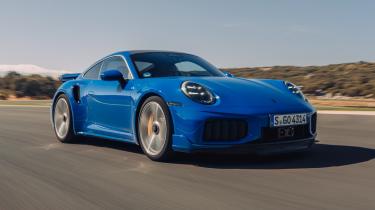
You can feel the firmer damping: it brings a keener feel for a very small loss in comfort. I only had the chance to chuck the car at one tight corner and it pushed wide on the way in and waggled its hips on the exit, but the P Zero Rs had yet to reach their prime temperatures. Not an issue a little later at Ascari.
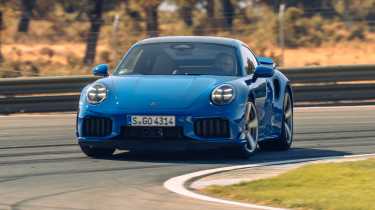
A race track isn’t the natural habitat for a Turbo S, but with the chassis tech beneath it and Sport Plus selected (ESP on), the 992.2 should give a decent account of itself while giving the opportunity to properly wring out that 700bhp flat-six. Chasing a previous-generation 992.1 Turbo S, it feels fast, which you might expect, even though the width of Ascari tends to denude the speed.
You can also feel the mass, especially at speed but also in the way it loads the front and pushes it wide if you don’t let the car rotate enough on the brakes before getting on the gas. I like how the stability control doesn’t intervene immediately but gives pointers on how to work the car.
In a couple of spots you can feel the rear drop into a late corner compression and that’s when you hit the throttle, rocketing away with all the engine’s might hooked up. Respect the weight and it feels tidy, capable. That said, running through the same tight turn for the cornering shots, the outcome was quite different each time, dependent on exactly when I hit the throttle.
At the launch of the 997 Turbo back in the summer of 2006, I got a ride on a closed 2km stretch of narrow Iberian country road alongside Walter Röhrl. It’s seared into my memory. The pace, the calmness, the accuracy of Walter, dressed in his civvies, seemingly expending little effort, chatting amiably as the world went by the side windows at 140mph, a soup of colour.
Until a few years ago he was a fixture on Porsche launches and setting lap times at the Ring, but that role has passed to Jörg Bergmeister, a racer with a remarkable record in ALMS in a GT3 RSR and before that in the Porsche Carrera Cup and Supercup.
My passenger lap of Ascari with him in the Turbo S is a different world, by turns thrilling and terrifying, principally for the lateness and abruptness of the braking and the astonishing speed he carries to the apex.
Then, with the car still rotating as it arrives late and hot, at the apex of the tighter corners Jörg picks up the throttle and the rotation turns into power oversteer that lasts until the next upshift, his laughter rising above the sound of the engine and tyres. It’s remarkable just what the new Turbo S can do, and I’m not at all surprised that, despite the extra weight, Jörg lapped the Ring in 7:03.92, about 14 seconds faster than in the 992.1 model.
This isn’t a definitive drive of the Turbo S. I’d like longer in the car on more varied roads, more crowned and crumbly ones like we have in the UK. That said, the new Turbo S does feel like the 911 for all seasons, a car that blends supercar performance with all-weather usability, everyday practicality and long-distance comfort. (The Cabriolet, incidentally, is a little heavier but feels solid and dynamically performs just as well.)
Price specs and rivals
The new Porsche 911 Turbo S starts from £199,100 in coupe form, with the cabriolet available from £209,100 before any options. That's punchy pricing considering the latest Aston Martin Vantage is available for c/£30k less than the Turbo S coupe, even if it lacks any electrification and is a little down on power.
> £200k is a lot for a new 911 Turbo so here are some used options
If you don’t need the rear seats, £200k will also buy you the hybrid McLaren Artura, a genuine supercar that weighs under 1500kg and is a supremely able and comfortable tourer with a great ride and superb steering.
An alternative from Mercedes-AMG goes the other way, the AMG GT E-Performance offering arguably less focus and dynamism but also a full hybrid, available from £187,290 before options. The Merc boasts 805bhp and has an EV mode, albeit with a tiny range, but it weighs 2120kg and often feels it. The Turbo S is a heavy 911 but it’s 400kg lighter, and feels it too.
| Engine | 3.6-litre twin-eturbo flat-six |
|---|---|
| Transmission | Eight-speed PDK PTM AWD |
| Power | 701bhp @ 6500-7000rpm |
| Torque | 590lb ft @ 2300-7000rpm |
| Weight | c/1725kg (413bhp/ton) |
| 0-62mph | 2.5sec |
| Top speed | 200mph |
| Price | £199,100 (coupe), £209,100 (cabriolet) |
| On sale | 2026 |