[ evo ]
   LOGIN | REGISTER  Unregistered
SEARCH Web evo  


Car Reviews: evo Car Reviews


Peugeot 907

Rating:

This striking 500bhp 12-pot supercar is not just a concept - it really works
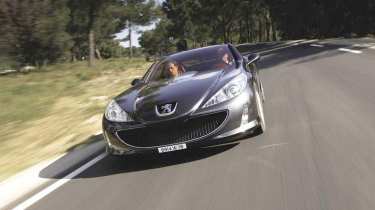
Scene one: Paris show, 2004. Centrepiece of Peugeot's stand is an extraordinary coupe with a long bonnet, a panoramic windscreen stretching back to become the roof, and 12 machined-aluminium intake trumpets each with its own throttle. But surely it's on the wrong stand: this is more Ferrari than even a modern-day Ferrari is, what with those 275 GTB hindquarters and triple-louvre vents.

Then you get the joke. Peugeot's 407 saloon already has the supercar front: a broad, low, leering grin. Now that snout, suitably exaggerated, finds itself fronting a car with the rest of a body to match and named 907. But it's just a stunt; the 907 may have two 3-litre Peugeot V6s spliced together with a double-length, specially-machined crankshaft, but it can't possibly work. Can it?

Scene two: the open ground just outside the entrance to the Paul Ricard circuit. The 907 is idling impatiently, British-made Pectel engine management fumbling to make sense of 12 busy cylinders.

So it does work, judging by the sound and the heady mix of part-burnt hydrocarbons spitting out of the pairs of exhaust pipes just behind each front wheel. We open the bonnet: bits of sand and track debris litter the engine bay and the bonnet's inner panels, because not only does the 907 work, it has worked hard.

How hard? Demo rides at the Bologna motor show and 155mph at the French motor industry's Mortefontaine test track. The 907's creator, Peugeot designer Jean-Christophe Bolle-Reddat, reckons it's good for 180mph, and has had it in a wind tunnel to check it would stay reasonably stuck to the ground. There's a diffuser under the rear deck, and what looks like a movable rear spoiler although it doesn't actually move. Like several other parts of the 907, it's work in progress.

Some more statistics. Usually, a concept supercar's engine exists at best in a computer simulation, more likely in a designer's head. But this one is real, and delivers 500bhp and 443lb ft of torque, all sent through a rear-mounted Sadev racing transaxle with six sequential speeds and dog-clutch engagement. Given the 907's estimated weight of 1400kg, a 0-60mph time of around 4sec is not unfeasible.

What is Peugeot's plan here? Is it going to make more 907s? Maybe a racing version for the FIA GT class where it could compete with Vipers, Corvettes and the Ferrari Maranellos whose visuals it salutes?

Peugeot design director Gérard Welter also runs the WR Le Mans team, and Bolle-Reddat, too, is pretty handy at racecar construction. But this isn't why the 907 exists. It's an image-building exercise for Peugeot, and the last design to come out of its La Garenne styling studio: a fitting closure before the department decamped to Vélizy, already occupied by CitroΫn and now grandly revamped.

The 907 is the designers' dream for a Peugeot supercar, as well as a virtual racing car in concept clothes. It's built around a carbonfibre monocoque, moulded in the UK by the Advanced Composite Group (which could no doubt mould more), with a tubular front frame like an E-type Jaguar's to hold the engine and front suspension. Fabricated double wishbones do duty all round, sprung and damped by Ohlins coil-overs.

The engine and transaxle are solidly linked by a torque tube, like an Aston Martin DB9's, and braking is by carbon-ceramic discs. Bolle-Reddat won't say where these or the six-pot front, four-pot rear callipers came from, but the AP Racing sticker I found in the driver's door is a clue.

From the mechanical to the sensual. Quite apart from the looks, the 907 is a beautifully made object with perfectly-fitting panels and some lush detailing. The rear window is a lift-up hatch, which reveals a highly practical luggage bay and a three-piece fitted luggage set in the interior's tan leather. Machined aluminium forms the instrument bezels, the air-vents in the doors (whose lower edges double as door handles), and most of the knobs and switches. And a trio of PDA screens forms the guts of the instruments. Two are ahead of the driver in the form of a 'virtual' analogue speedo and tacho, with pixel-formed needles pointing at calibrated notches in the aluminium. The images are transposed today, though. Blame an electrical bug.

Right now I'm watching Bolle-Reddat driving up and down a section of the busy N8, for the benefit of the camera. Gently at first, while the 907 gets used to wearing number plates, and then he goes bonkers. The V12's note rises to a fever pitch, punctuated by pauses and pops as each gear shifts, and what the...? Away in the distance the 907 slews savagely one way, then the return fishtail sends it into a full-circle spin shrouded in expensive tyre smoke. This car is clearly destined to lead a charmed life, because it neither hits anything solid nor is collected by a passing truck.

Seems the brakes are neither as progressive nor as balanced as they could be, and the fact that the 907 is now both motionless and in the middle of road is even more worrying. The third PDA screen, which forms the central data display (pressures, voltages, temperatures, even percentage of throttle opening) earlier revealed itself to be under the control of a 'Windows Embedded' operating system, and it crashes if the engine stalls. We have to wait for the reboot.

The priceless Peugeot is still in one piece and its tyres are still round, and now I'm going to drive it. First, belt myself into the Recaro seat, which involves lining up the belt-hole in the seat's side with the clasp buried below. Next, prod the aluminium starter button while holding the 12 throttles slightly open. Clutch down - its travel is short and not heavy - pull the sequential lever back, hear the clunk and move off.

It's best to be firm, quick and definite with this shift and the ceramic, slip-shunning clutch. There's a hiccup as I come back on the power after each upshift (another bug), but there's a whole hydroelectric dam of power here from a gentle burble to the 7500rpm limit that Bolle-Reddat would rather I didn't use today.

And it's getting hot in here. That clear, expansive roof tells my eyes I'm sitting in something entirely open and screenless, but my nerves sense a burgeoning greenhouse effect and there are no visors. Such details do not trouble the concept-car designer.
It's mighty fast, of course (its camshafts are those of a Clio V6, incidentally), and the 12-throttle response is near-telepathic. It rides with the eager, springy fidget of a racing car, its ample tyres bite hard into the warm asphalt, and its steering is as focused as you would expect an off-duty racer's to be. Not much feel, mind - it has power assistance, to slight excess - but cause-and-effect meld together completely plausibly. What fun it would be to enact a powerslide... but Jean-Christophe is nervous enough already and now the transmission solenoids are playing up.

No matter. The 907 works, and it lives. Which, given its near-death experience, is a result in itself.

Bookmark this post with:

 
  More CAR REVIEWS
 

evo Car Reviews


Long Term Tests


Car Group Tests


EMAIL TO A FRIEND   PRINT THIS


ARROW  evo RATING

 
[+]
It's good to know Peugeot is doing it
 
[-]
It's a shame they will never build it


ARROW  evo SPECIFICATIONS

 
Engine: V12, 5892cc, 48v
 
Max power: 500bhp
 
Max torque: 443lb ft
 
0 - 60mph: 4.0sec (claimed)
 
Top Speed: 180mph (claimed)
 
Price: There isn't one
 
On sale: Hardly


Company Website | Media Information | Contact Us | Privacy Policy | Privacy Statement | Subs Info
Our Other Websites: Auto Express | Computer Buyer | Computer Shopper | Custom PC | Den of Geek | Den of Wii | Fortean Times | IT Pro
Know Your Mobile | London is Free | MacUser | Men's Fitness | Micro Mart | Mobile Computer | Octane | PC Pro | The First Post | iGizmo
Know your DSLR
© 2008 Dennis Publishing Limited. All rights reserved. Licensed by Felden