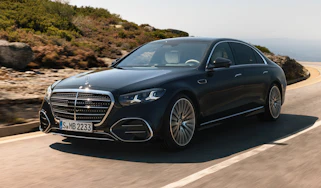
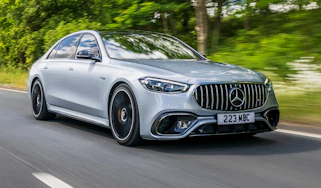
New Mercedes S-class review – should the BMW 7-series be worried?
The latest Mercedes-Benz S-class celebrates 140 years of the brand, and while changes are subtle, they make it one of the finest offerings in a dwindling segment
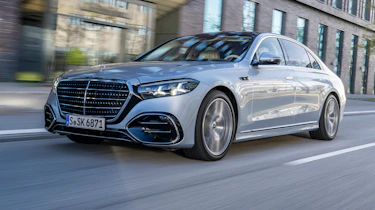
The Mercedes-Benz S-class has been the benchmark for the luxury saloon since its launch, and that’s quite a feat given it’s been around for over half a century. The Volkswagen Golf has proven that class-leading status doesn’t hang around for long if the product isn’t up to standard, but Mercedes has managed to maintain its position well, continuing to lead the segment against the BMW 7-series and the now-departed Audi A8. To mark 140 years of the brand, it's given the S-class a significant update, and we’ve been behind the wheel in Germany.
More than 50 per cent of the car has seen an update according to Mercedes, but you wouldn’t know at a glance. This is very much still the S-class we know and love, only refined and honed to ensure it has what it takes to compete with its key rivals: most notably the recently updated Neue Klasse BMW 7-series. Munich’s offering has caused quite a buzz with a much improved design and some impressive numbers, so has Mercedes done enough to keep up?
> I’ve driven Mercedes’ new shape-shifting V8 engine, and it’s blown my mind
Engine, gearbox and technical highlights
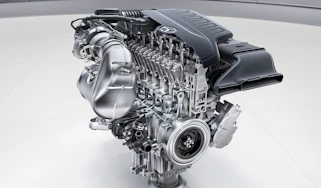
Shockingly for a new car launched in 2026, there’s a new engine on offer, and it’s a V8. The M177 Evo will make its way into a number of fully fledged AMG products in the coming years, but its first use is in the luxury limo we see here. Unlike every other V8 S-class though, this is not a cross-plane crank unit, but instead flat-plane, the kind more often found in supercars from Ferrari and McLaren.
More reviews
Reviews
- Mercedes-AMG S63 E Performance 2025 review – the most powerful S-class, but by no means the best
- Mercedes-AMG S63 Coupé (2014-2021): a lavish grand tourer for as little as £35,000
- Mercedes S560 Cabriolet review – drop-top S-class excels when focused on comfort
- Mercedes-Benz S-class (W222, 2013 - 2020) review - the best executive limo around?
- Mercedes-Benz S-class review - incredible levels of high-tech luxury
The use of a flat-plane crankshaft is Mercedes’s way to retain the V8 while complying with strict new emissions regulations, but it’s done some very clever engineering in order to retain the character of its old V8s regardless. On startup this engine sounds just like a cross plane crank AMG, but it’s not achieving that through the use of speakers. This engine features a unique exhaust crankshaft mounted to a magnetic actuator, which offsets the position of the crankshaft to replicate the uneven exhaust flow of a crossplane crank engine at startup and below 3000rpm. At higher revs, the crankshaft will switch back to its original position to take advantage of the benefits of a flat-plane crank engine, and give you a power output of 530bhp in the process. They’ve even tweaked aero inside the engine, adding a spoiler on the intake valve channel to direct flow around the cylinder and create a swirling effect, improving the efficiency of the burn. Clever.
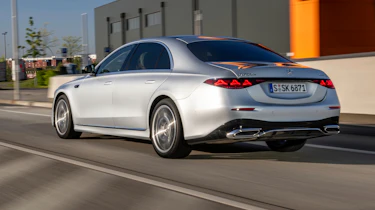
Sadly we won’t receive the S580 V8 S-class in the UK, but first impressions promise a lot for the V8 models we will receive. What we do get are petrol and diesel 3-litre straight-sixes in a variety of configurations, ranging from the 308bhp mild-hybrid S350d to the 429bhp plug-in hybrid petrol S450e, the mild-hybrid S500 petrol with the same 3-litre straight-six in a higher 443bhp state of tune, and the range-topping S580e which pairs that 443bhp straight-six with plug-in hybrid power for 577bhp in total. AMG variants aren’t yet here, but that new 530bhp V8 paired with a plug-in hybrid system sounds like a potent mix.
New hardware goes beyond the V8, with each and every S-class equipped with a watercooled ‘supercomputer’. This single unit is responsible for processing data from every one of the control units in the car, as opposed to having numerous processing points to create latency in the system. This is a powerful system supplied by NVIDIA, gathering data from four radars, numerous cameras and 12 ultrasonic sensors in an effort to provide the car and driver with full situational awareness. It also allows for Level 4 ‘self-driving’ through MB.Drive Assist Pro, which is said to be enabled in Europe next year.
> The new BMW 7-series has a Dolby Atmos cinema and a 'Ceremonial Light Carpet'
Performance, ride and handling
We might not get the V8, but there’s not a single S-class variant with a weak powertrain. Mild-hybrid boost plugs any gaps in the performance of the combustion engines, and if you opt for a plug-in hybrid, you’ll never be wanting for more power from a standstill. C/60 miles of electric range is handy too. Acceleration is as smooth and effortless at low speeds as you’d want in a car of this calibre, with that OM 656 Evo diesel straight-six as silky and torque-rich as it always has been. We don’t get the more powerful S450d in the UK, but even the S350d has 479lb ft of torque to play with for more than enough pull – these models come with the exact same engine hardware, with software responsible for the disparity in power.
The nine-speed automatic gearbox is smooth and melts into the background as if it wasn’t there in most scenarios, but at higher speeds and in less powerful models, it can hunt for gears with less subtlety than you might expect when more power is requested. This isn’t an issue in the 577bhp S580e, or V8-powered S580 for that matter.
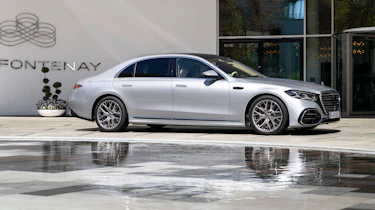
Steering is well measured and reassuringly positive for a car of this size and on standard air suspension, striking a good balance between responsiveness and well-damped controls to give passengers the smooth ride they’re looking for. This is not a car to take out for a spirited drive but if you do find yourself on a fun strip of tarmac, the S-class will flow from point-to-point at impressive pace without losing composure. A tight hairpin won’t even slow your progress, as 4.5 degree rear-wheel steering is standard, with 10 degrees of articulation available as an option.
This feature doesn’t just make it easy to manoeuvre in tight spaces, but also makes it more stable at high speeds. The rear wheels turn with the front wheels in these scenarios, and as I found while making lane changes at its 155mph top speed on the derestricted autobahn, it feels as stable and confidence-inspiring as it does at 70mph.
The chassis setup contributes towards that sense of stability too, and it’s just as you’d expect from an S-class. You don’t get that freakish magic carpet feel of something like a Rolls-Royce, but the S-class is suspended in a way that elevates it above ‘ordinary’ saloons, isolating the cabin from the road with a level of sophistication that makes even a £100,000 price point feel reasonable. Larger imperfections do make their way into the cabin but Mercedes says that its ‘Cloud based damping’ system should improve with time. Other Mercedes-Benz cars will communicate imperfections, allowing the suspension system to react before you reach them, in theory. Option electrohydraulic E‑Active Body Control and the S-class gains even more composure on twistier roads, self-levelling in a similar fashion to the Porsche Panamera – it works well here, but does give you that same disconcerting sense of disconnect from load on the tyres.
Smooth stops are an especially important, but often overlooked, aspect of a luxury saloon, but the S-class gets it right. Even in plug-in hybrid models which blend regenerative braking with friction brakes, the calibration is excellent with an exceedingly smooth action right from the top of the long-travel pedal making harsh response an unlikely occurrence. There’s no learning curve for achieving a smooth stop in the S-class, and unlike some systems calibrated this way, there’s plenty of braking power there for when you need it. Handy, given the S580e weighs over 2600kg.
Interior and tech
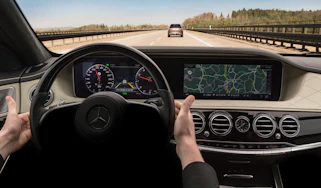
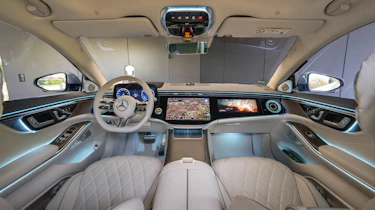
The cabin is where the new S-class falls a bit flat. It’s dominated by what Mercedes believes to be the centrepiece of the facelift, the ‘MBUX Superscreen’, plastering huge 14.4 and 12.3-inch displays across the dashboard behind a single piece of glass. In reality, this cheapens the S-class no end, and provides little to no benefit in the process. The operating system behind it all is quick enough, but a Windows Vista-style design and illogical menu system put this car a step behind alternatives like the BMW 7-series. The 3D effect on the dashboard is a nifty gimmick, but it will never make up for the lack of depth and quality design lost with the use of the ‘Superscreen’.
Thankfully, rear-seat occupants are unlikely to interact with these displays, and what they do have is good. Seats are ultra-comfortable, cooled, heated, massaging and have full lie-flat functionality if that’s what you’re after. They might look completely ordinary but even the seat belts can be heated should you option the thermal comfort package, and you get a pair of quality, weighty dedicated remotes to go with the optional rear-seat entertainment displays (now available with cameras for mobile video conferences). It’s an airy, quiet and comfortable place to spend time, which is precisely what the S-class should provide.
Overall cabin design is pleasant, but nothing we haven’t seen from the S-class in recent years. Providing you avoid the somewhat tacky silver carbonfibre option and instead go for an open pore wood trim, the cabin is a classy place to be (displays aside). However, the plastic door-mounted seats control panels do feel a little cheap and much like the (ludicrously creaky) buttons on the steering wheel, these panels can flex and creak as you make your inputs. It’s elements like this that put a damper on the luxurious, sophisticated feel of the chassis and powertrains.
Price, specs and rivals
The new Mercedes-Benz S-class lineup begins with the S350d in the UK at £103,450, £17,610 more than the ageing Audi A8, and marginally more than the outgoing electric BMW i7. The new BMW 7-series is just months away though, and will likely fall closer to the S-class in terms of its starting price.
Climbing up the S-class range, the S450e L gives you more space, a 321bhp straight-six petrol engine and the flexibility of plug-in hybrid for £114,725. The S500 L gives you the same engine but in a higher 443bhp state of tune and without the hybrid assist for £116,020, and the £122,425 S580e gives you that same engine paired with plug-in hybrid boost for the most power of the current range. As with all Mercedes models, each of these variants is available in varying levels of trim to give you more or less kit out of the box.
BMW offers the 7-series in full-electric i7-form, but Mercedes is still (just) holding onto the EQ range, meaning an electric S-class is still off the cards for now. The closest you’ll get is the EQS from £91,765, which offers competitive range and a similar level of kit as the S-class, but can’t come close in terms of cabin space, dynamics, style and practicality.
Mercedes-Benz S-class S580e specs
| Engine | 3-litre twin-turbocharged straight-six & electric motor |
| Power | 577bhp combined |
| Torque | 553lb ft |
| Weight | 2618kg |
| Power-to-weight | 220bhp/ton |
| 0-62mph | 4.4sec |
| Top speed | 155mph |
| Basic price | £122,425 |