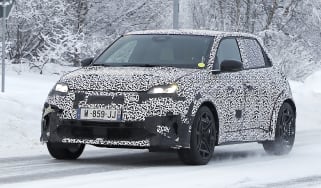
Alpine A290 review – does A110 DNA make this a fun electric hatch?
Renault has stolen a march on its rivals with the R5, so does its Alpine relative go one further and set the electric hot hatch benchmark?
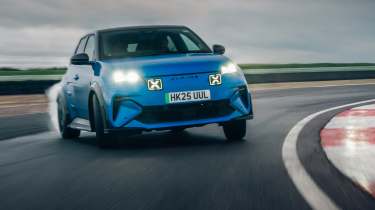
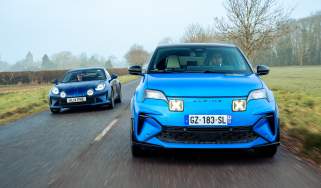
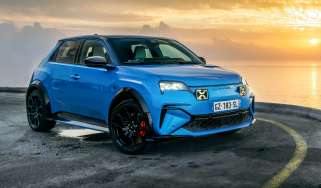
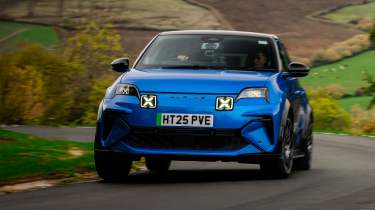
Few new electric cars have been as hotly anticipated as the Alpine A290, the high-performance twin to the Renault 5. In concept, it’s a breath of fresh air for a number of reasons. This is a fast EV that doesn’t cost the earth (£30,245, or £34,245 for the GTS version tested here), doesn’t weigh two tons, isn’t all about outright power, and promises to offer traditional hot hatch thrills in a relatively compact body.
There’s a lot riding on the A290’s success. Alpine needs to become a cost-effective contributor to the wider Renault Group, and the A290 is its first true volume product built with this goal in mind. There are three versions available: a base level A290 GT with the lowest power output, plus a more powerful GT Performance, and the best equipped GTS (sharing the same power as the GT Performance).
> Alpine A390 review – France's flawed rival to the Porsche Macan
Rather than simply being a faster Renault 5, Alpine has engineered the A290 to feel like a true performance product through and through. To that end it has extensive mechanical changes to its suspension and chassis, with the brilliant A110 sports car being used as a benchmark throughout development to make the A290 feel like a true Alpine. It all sounds very promising, but is the A290 an EV with character and involvement to match petrol hot hatches of yesteryear? Read on to find out.
Powertrain and performance
- Choice of 178bhp or 217bhp electric motors
- 52kWh floor-mounted battery
- Throttle response and regen modelled on the A110
More reviews
All A290 variants are powered by the same 52kWh battery. Like the Renault 5, the A290 is front-wheel-drive; an all-wheel-drive version would have inflated the cost and weight too far beyond a viable business case, and changed the car’s character. The battery is mounted within the floor of the A290’s AmpR platform.
The base A290 uses a 178bhp front motor, good for a 0-62mph time of 7.4sec. The GT Performance and GTS, meanwhile, get a more powerful 217bhp motor that cuts the 0-62mph time to 6.4sec.
As well as offering more power, the electric motor’s calibration differs from the R5’s, with the driving modes, regen behaviour and torque management all developed independently from those of the Renault. Initial pick up in the GTS is strong and while acceleration does tail off noticeably as you go faster, there’s enough zip for the A290 to feel quick and urgent below motorway speeds. The progressive throttle map, which has been modelled after the A110’s, allows you to smoothly deploy the full 221lb ft from the motor, without the instant and sometimes disconcerting kick up the road you get in other fast EVs.
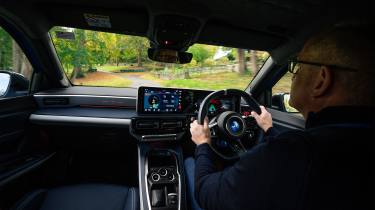
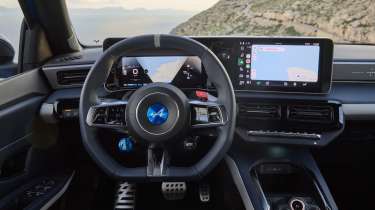
The A290 isn’t completely free of gimmicks, though. On the steering wheel you’ll find a button marked OV for ‘overtake’ – named after the similar switch on the steering wheel in Alpine’s F1 cars. It doesn’t actually give you any extra power – instead it ramps the accelerator map more swiftly to 100 per cent. Push it while your foot is already at the stop, and nothing happens; push it while you’re travelling along on a gentle ‘throttle opening’ and the car shoots forward abruptly (almost disconcertingly so). You have to hold the button down to maintain the OV map; let go and it reverts to its regular setting. Ultimately, if you want full power you might as well use your right foot.
A toggle switch on the steering wheel allows you to select three levels of regen. The lightest is modelled on the engine braking generated from the A110’s turbocharged four-cylinder engine; the heaviest is closer to the one-pedal drive mode seen in other EVs, although far less extreme than most. There is a fourth setting: to switch the regen off completely and, unless you’re travelling downhill, Alpine’s engineers say that’s actually the most energy-efficient mode of all. The lower regen settings help make the driving experience more fluid, allowing you to float into and through corners without the heaving deceleration effect of high regen.
Driver’s note
‘Turn in hard on the brakes and the Alpine’s tail readily swings wide, at which point you can blend in the throttle to straighten the car and power away. There’s some torque steer and the fronts do light up if you’re greedy, but these are all familiar – and involving – components of driving a hot hatch.’
Ride and handling
- Feels compact, stable and grippy, with some old-school torque steer
- Steering is a little too darty and the ride is controlled but sometimes busy
- Impressive balance and feedback become more evident on track
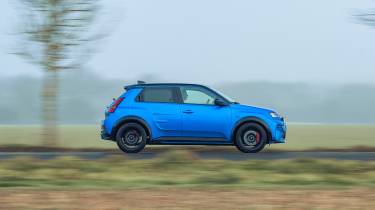
A skateboard-style chassis with the battery pack mounted in the floor, the A290’s AmpR architecture also features a multi-link rear suspension layout rather than the torsion-beam set-up common to many superminis. The A290 also gets a whole new front end with its own aluminium subframe to mount its bespoke springs and dampers to, and hydraulic bump-stops all round. It’s a full 60mm wider than the R5 (which also makes it 60mm wider than an old Clio 197, incidentally) and sits on 19-inch wheels with a choice of two designs, and three specifically designed Michelin Pilot Sport S 5 tyres.
The brakes are also different, with Brembo hardware taken from the A110. Speaking of the A110, achieving that car’s blend of involvement and usability has been one of the goals for the A290, which is evident straight away. It feels grown up, refined and easy to settle into, without any undue harshness. There is an underlying firmness to the ride, particularly over small ridges and bumps, but it is a hot hatch after all, and the payoff is a flat cornering stance and good control over the A290’s body on undulating surfaces. The multi-link rear suspension and hydraulic bump stops contribute to this, making the A290 feel more sophisticated than you’d expect for a supermini.
The brake-by-wire system blends the regular brakes and regenerative braking from the motor. Despite the interplay between the two, pedal feel is consistent and stopping power reassuring.
There are multiple driving modes accessed by a control on the wheel: Normal, Sport, Save (to conserve the battery level as best as possible) and Personal, to mix and match settings for the accelerator map, power steering weight and the piped-in sound which rises with speed (based on frequencies from the electric motor itself, rather than a synthesised engine note). The drive mode switch is shaped like a rotary clickwheel but is actually a push button, which is a little frustrating to operate. You have to cycle through the modes one by one, and if you accidentally double-press you must go back to the beginning.
The A290’s steering is light in the Normal setting, and quite darty off centre. This gives it a feeling of agility but to be smooth, it helps to be calm with your hands. There’s more weight to work against in Sport mode but the feel from the rack is quite muted at road speeds – unless you're putting full power down on a bumpy surface, at which point it gets quite lively, tugging at your hands even in a straight line. For some this will be part of the fun in a hot hatch, but it can make the A290 feel busy.
The A290 is one of the lightest EVs in its class, but still relatively heavy for a small car at 1479kg. Even so, the handling is impressive. It feels grippy and stable, with a four-square stance and neutral handling balance. You can hustle it along without the sense that it’ll bite back, leaning on the resilient front end and bringing the rear gently into play by lifting the throttle into corners. There isn’t the ultimate adjustability or feedback of an old Renault Sport hatch, but there is fun to be had.
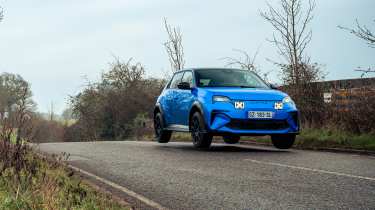
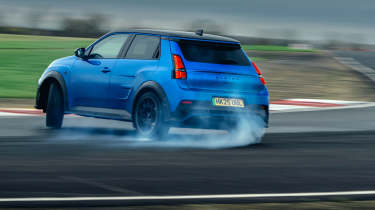
All the more so on track, where the A290’s lateral and longitudinal stability, and braking performance are truly impressive. It can be a playful car, too; accelerate into a corner and lift off the throttle and it pivots into oversteer in the manner of a traditional hot hatch. There is no limited-slip differential, instead the A290 uses torque vectoring by braking – on bumpy, damp roads you don’t always get consistent levels of slip under power, but on a dry circuit it hooks up nicely out of slow hairpins and the nose stays planted, even when a wheel is unloaded over a kerb. If anything, it’s more fun on track than the road – although at full chat you’ll empty the battery after two or three sessions, which kills it as a track day proposition.
In general, the A290’s feels like a warm hatch rather than a truly hot one. It’s less edgy and eager than you might expect for a French hot hatch, and some drivers may crave something a little more exhilarating. There’s nothing wrong with the way the A290 drives: its balance is superb (aided by the low centre of gravity and 53:47 front:rear weight distribution), and Alpine’s approach to make it a car that drives in an uncomplicated way, and largely in the manner of a traditional petrol hatchback, is a likeable one. There’s just something indefinable that’s missing from the experience in terms of excitement and engagement, and it’s not just the presence of a petrol engine, or a more potent power-to-weight ratio. More feedback and a more eager edge to its dynamics would make it that much more involving, which is exactly what Alpine could deliver with a potential A290 S or R.
Driver’s note
‘On the road the A290 is missing the locked-in sense of focus and excitement of, say, an old Renault Sport product. Out track, however, there’s a much more playful side to its character, and it’s more biddable and communicative than something like a Golf GTI.’
Range and charging
Though the A290 has a decently sized 52kWh battery pack, it doesn’t extract as much range from it as you might expect. The official claim for the GTS is 235 miles, but that can fall drastically depending on the conditions, and how much of the performance you’re using. At near freezing temperatures we’ve seen less than 100 miles from an 80 per cent charge, and on track at the Bedford Autodrome, the A290 ate through its battery at a rate of 5 per cent per lap.
100kW charging capability means the battery can be topped up from 15-80 percent in half an hour. The peak charging rate and size of the battery are on par with the Cupra Raval VZ, the A290’s chief electric supermini rival, although in our experience the Raval makes more efficient use of its available energy.
Interior and tech
Away from the driving the A290 surprises with a very well finished interior for a supermini. The seating position is a little high - as is often the case with Renault Sport cars - but the chairs provide great support and are trimmed to a very high standard. Where many manufacturers scrimp and save on the interiors of their electric cars, the A290 has had time and investment lavished on it. However, don’t be fooled by the five door layout, rear seat space is at a premium and on the claustrophobic side.
The dual screen infotainment system is borrowed from the Renault 5, but the A290 gets its own graphics and nifty performance features, in the form of Alpine Telemetrics. This allows you to monitor lap times and temperatures in real time, and also offers challenges to improve your driving techniques – a bit like Gran Turismo licence tests, but in real life.
Price and rivals
The A290 starts from £30,245 for the entry-level 178bhp GT or £34,245 for the GTS. In between, there’s the GT Performance (£32,745). The electric supermini that Alpine is targeting most vigorously is the electric Mini Cooper E, which starts from £26,905 and climbs to £34,905 for the John Cooper Works Electric. Our experience of both cars in isolation suggests the Alpine is more dynamically resolved than the Mini.
From Italy there’s also the Abarth 500e, which starts from £27,995 and rises to £30,995 for the top-spec Turismo. The Abarth generates less power and torque than the Alpine and is less sophisticated to drive – particularly if you leave its droning exterior sound generator switched on.
The Alpine’s closest competitors come from the Volkswagen Group, in the form of the new ID. Polo GTI and the related Cupra Raval VZ. We’ve driven the latter, and while it’s not as polished as the Alpine in some respects, it’s a keen, fun electric supermini, aided by an electronic limited-slip differential that noticeably boosts its capability. At £34,995 it’s similarly priced to the A290 GTS, and offers a stronger 273-mile range.
Alpine A290 GTS specs
| Motor | Single, front-mounted |
| Power | 217bhp/162kW |
| Torque | 221lb ft |
| Weight | 1479kg |
| Tyres as tested | Michelin Pilot Sport 5 S |
| 0-62mph | 6.4sec |
| Top speed | 106mph |
| Basic price | From £30,245 (GTS from £34,245) |