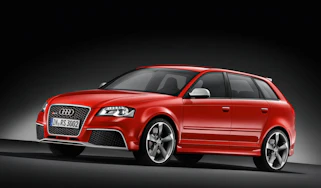
Audi RS3 review – Audi's final five-cylinder goes out on a high
The RS3 has one of the most spectacular engines you'll find in a hot hatch, and the rest is just as good. Is that enough to warrant a £60k+ asking price?
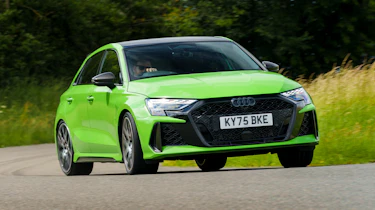
The era of the small, simple, affordable hot hatch is done for now it seems, though a newer breed of supercar-humbling high-performance ‘hyper hatches’ has until recently still been going strong. But the Mercedes-AMG A45 S is now no longer available to order and the venerable Audi RS3 isn’t long for this world either in its five-cylinder form.
It’ll go out with a bang in RS3 Competition Limited form but as we’ve found, putting thousands of miles under the wheels of the current generation, the base RS3 will go out in its finest form ever. The RS3 has been the best-selling RS model globally and in the UK and as such, since the current model’s introduction in 2021, it only needed mild adjustments for its significant 2024 update.
Engine, performance and 0-62mph time
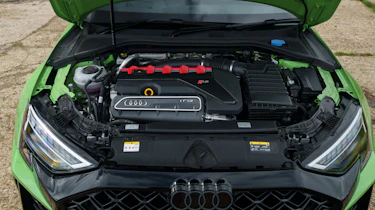
- Enormously charismatic, barrel-chested five-cylinder engine
- Dual-clutch transmission not as responsive as you might expect
- 0-62mph comes up reliably in under four seconds, 174mph top speed
As ever, the latest RS3 is dripping with big numbers. A few of the defining ones remain the same: five cylinders and a single turbo for the 2.5-litre engine that produces 394bhp and 369lb ft are unchanged from its predecessor. Notable is that the RS3 went from using an iron, to an aluminium engine block part-way through the previous generation.
More reviews
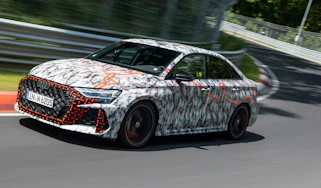
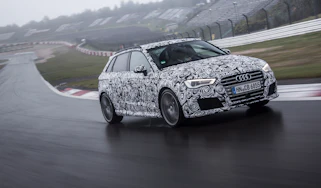
It’s furiously quick, with a 174mph top speed and a sub four-second 0-62mph sprint time, and it’s now five seconds quicker around the Nürburgring, completing the near 13-mile lap in 7 minutes and 33.12 seconds, obliterating the previous record for compact cars held by the BMW M2 by more than five seconds.
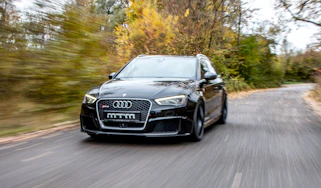
The five-cylinder motor still delivers its rich, broad torrent of boost-fuelled power and torque, firing it along the straights to an addictive, howling soundtrack that has hints of Lamborghini V10 about it. It’s supremely flexible, moreso than the Mercedes-AMG A45 S’s four-cylinder and more charismatic than the BMW’s M240i’s B58. There’s a hearty pull from low revs and delivering a satisfying mid-range sucker punch. It’s easily the most exotic and special engine you’ll find in a modern hot hatch.
The shifts of the seven-speed S‑tronic gearbox aren’t as quick, however; both up- and particularly downshifts suffer a slight delay, so that on some occasions you’ll pull the left paddle twice, thinking the first command for a lower gear didn’t get through.
Driver's note
‘Running the Audi through the revs is like conducting a real accelerative crescendo, the front tyres hunting furrows as the torque load they’re tasked with transmitting builds.’ – Ethan Jupp, evo web editor.
Ride and handling
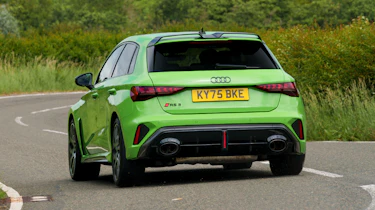
- Surprising compliance from adaptive dampers on UK roads
- ‘Torque-splitter’ rear differential adds throttle adjustability and agility
- Steering doesn’t feel as robust as the rest of the package
Key to the dynamic leap taken by this generation of RS3 is its four-wheel drive system, and the ‘torque splitter’ diff that sits between the rear wheels. The torque splitter uses a clutch-pack on each rear half shaft that can be open, sending no drive, or degrees of lock, sending measured amounts of torque to either rear wheel, independent of the other.
Essentially, the Audi is a front-drive car, its warbling in-line five-cylinder installed transversely, driving the front wheels through an end-on gearbox. Previous designs managed power to the rear axle via a Haldex multi-plate electromechanical clutch-type diff, which could send variable amounts of torque – up to 50 per cent of the engine’s output – to the rear axle. The new design is also very much an ‘on-demand’ system, but it’s a genuine torque-vectoring solution that is more versatile and effective.
With the new rear diff, up to 100 per cent of the available torque can go to a single rear wheel, allowing the RS3’s dynamics to be managed with positive rear-axle inputs. This as opposed to the negative inputs of conventional stability control systems, which use applications of the front and rear brakes to tweak the dynamics. The new system delivers positive torque individually to each rear wheel regardless of if the other is slipping, giving much greater scope to influence the dynamics, also making a ‘drift’ mode possible.
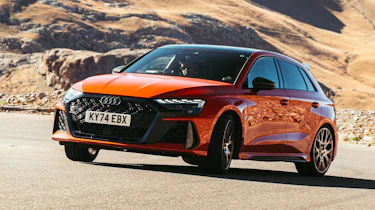
As a result the RS3 has gone from a big-numbers, straight line speed-focused hatch to one that can be manipulated, tweaked and adjusted – one that actually relishes being played with through any given corner. Get on track for a drift day and the RS3 can be made to slide around until its tyres delaminate.
The RS3 comes with a staggered 19-inch setup with wider fronts (265 section) than rears (245 section), again with the goal of reducing understeer. Other dynamic aids include torque vectoring by braking, switchable ESC with a half-way Sport setting and RS-specific suspension and adaptive dampers. These elements are linked together via an electronic driving dynamics controller, which was retuned for the facelift.
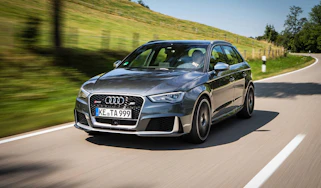
Ceramic brakes are available as an option for £4590, which may be worth considering if you plan to use this monstrously powerful, 1565kg hot hatch on track. In some respects it behaves like a front-drive hot hatch, hunting along bumpy roads with subtle kicks of torque steer. In others it’s more like an old touring car, in the way that it fights for grip and can aggressively hop over the road surface under full power.
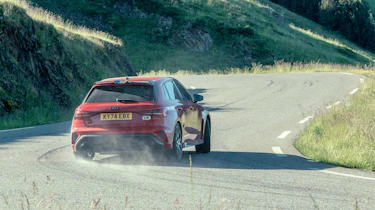
With the dampers set to Comfort there’s plenty of body movement – under acceleration the body squats down hard over the back axle – which almost allows you to play out your Group B Audi Quattro fantasies. The firmer settings give more control, and as you up your commitment, the trick rear diff provides a helping hand. And no, surprisingly, the more aggressive modes don’t compromise its compliance like other recent fast Audis, even on the UK’s cratered and cragged country roads.
At first the rotation you get under power can feel a little alien. The steering in particular doesn’t have the robust weighting or offer the kind of resistance to square with the mechanical grip and monster hardware you know is beneath you. But trust the car, be aggressive and it rewards you with moments of genuine excitement, the rear kicking wide out of slow corners while the front axle simultaneously drags you forwards. In the most aggressive Torque Rear mode, meanwhile, the diff makes the RS3 feel rear-drive in a way that’s completely foreign to older RS3s.
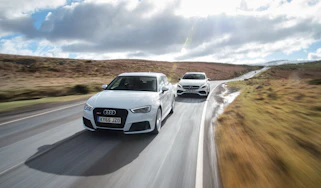
Ultimately, the RS3 isn’t as tactile or immediate as a Civic Type R, or as cohesive and confidence inspiring as a GR Yaris. But exploring its peculiar dynamic makeup is a rewarding process, and the awesome presence and sound of the five-pot motor can’t be denied. On the road, it's more approachable and absorbing to drive than its closest rival, the Mercedes-AMG A45 S.
Driver's note
'It’s a more heavy-set, muscular car to drive than a conventional hot hatch, and not the kind that likes to be driven delicately on three wheels. I think it is missing the feedback and absolute responsiveness of the best, but I love the combination of the hard-hitting engine and playful four-wheel drive system. You can make it do some quite absurd things' – Yousuf Ashraf, evo Senior Staff Writer, who tested the Audi RS3 on the road and track
On track
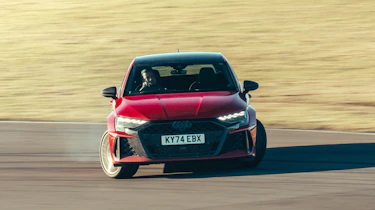
On track you can fully explore the RS3's four-wheel drive system – in particular its Torque Rear mode, in which 100 per cent of the rear axle’s torque can flow to the outside tyre, helping the Audi to get into a powerslide, and maintain it. In which circumstances the RS3 is actually three-wheel drive.
The slightly skaty sensation can feel odd at first but you quickly get used to it, and it unlocks a whole new dynamic dimension. The Torque Splitter makes this RS3 (launched in 2021 and updated last year) a car with a much wider dynamic repertoire and more positive feel than its previous generations. The splitter has recently been fitted to the smaller-engined S3 model, too.
Out of Torque Rear and in its regular modes, the RS3 is a supremely grippy car; so much so that it actually hops at times, like a kart, when thrown into a corner hard. This is a positive, exciting car to drive, one that makes the most of its all-fours traction in its regular modes and offers genuine innovation. Ford’s last Focus RS employed something similar with its GKN-developed clutch-packed rear axle and Drift Mode (which drove the rear wheels slightly faster than the fronts through an offset gear ratio) but the RS3 is easier-going, less fractious company.
Interior and tech
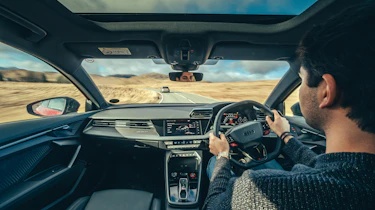
- Carbon-backed seats add a welcome degree of theatre, especially for over £65k
- Cabin is well put-together, though the depth of material quality is a step down from the last RS3
- Intuitive touch controls, UX and a selection of physical controls are good, haptic wheel controls not so much
A new squared-off steering wheel and revised optional carbon-backed bucket seats (£2500) are the main changes for the new RS3’s interior, which retains the same angular, slightly gloomy ambience as the outgoing car. There isn’t much in the way of design flare inside, but the cabin is generally well-built and packed with tech, including a central 10.1-inch infotainment display and a 12.3-inch Virtual Cockpit dash.
Fit and finish is good but there isn’t the deep-seated quality feel you get from older RS3s, with dull plastic finishes and glossy elements that we suspect will be covered in fingerprints and scratches over time. The new square wheel isn’t necessarily an upgrade either, with a more awkward shape and easily mispressed haptic controls on the spokes. The pair of red drive mode shortcut buttons – similar to what you’ll find in an M car – are a nice touch, though.
The digital interfaces are clear and functional, with a highly configurable dash, and Audi has thankfully mated these with a bank of physical climate controls. There are some odd inclusions – the sliding square slab of plastic that is the gear selector, for instance, and the touch-sensitive volume/track dial (what’s wrong with a knob?) – but it’s generally an intuitive and well-designed cabin, if not the most visually interesting.
The difference between the sportback and saloon will be most felt when it comes to practicality, rather than in the RS3’s dynamics. The saloon is very much a saloon, in that it has a small boot aperture, not lifting the rear glass like a four-door coupe. However, what it loses in aperture size, it gains in raw space – 321 litres versus 282 litres in the saloon.
evo Car of the Year 2025 – result
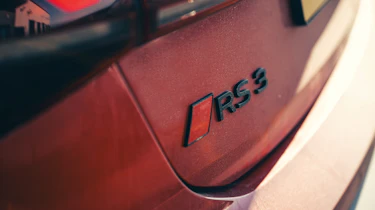
The RS3 placed last out of 12 runners at evo's 2025 Car of the Year test, but being bested by such a talented field of sports and supercars is nothing to be ashamed about. We were still impressed with how well the RS3 performed regardless of which supercar we had just climbed out of, but it lacked the feedback and the absolute responsiveness that mark out a really great hot hatch.
‘It would be unkind and untrue to say that it’s downhill after the start-up, but the burbly way the five-cylinder comes to life is one of the best things about the RS3,’ was judge Henry Catchpole’s take on the hyperhatch. ‘Finding the fun can be a little hard work, but I still enjoyed getting into it every time.’
Another judge, John Barker, found its controls more numb than ideal. ‘After driving a 911 GT3, its steering feels like dragging a spoon through a bucket of freshly mixed plaster’ was his observation. Only three out of seven judges placed it higher than twelfth on their scoresheets. The forthcoming RS3 GT might inject the sharpness and focus needed for a better result.
Price and rivals
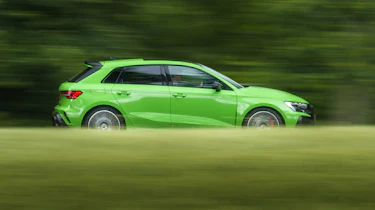
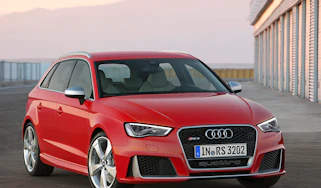
Available as a five-door Sportback (£61,975) or four-door saloon (£62,975), with a few options, the RS3 creeps up towards £70,000 Desirable options like the ceramic brakes cost £4590 at minimum, while the bucket seats are near essential to elevate the experience and are a £2500 option.
Only the £70,000+ Carbon Vorsprung gets Audi’s adaptive suspension as standard, as well as the otherwise £1200 panoramic roof. In Carbon Vorprung spec, the bucket seats are ‘only’ £2000 too. Either way, a well-equipped RS3 is BMW M2 territory price wise, though unlike the Audi, the M2 only comes with two doors and rear-wheel drive.
The RS3’s most direct hyperhatch rival was the Mercedes-AMG A45 S, though that has now left the UK configurator. It’s a thrilling and highly capable car with similar four-wheel drive technology to the Audi, but it’s less feelsome, firmer riding and its powertrain isn’t as special (although its 415bhp four-cylinder engine is still a supreme feat of engineering). We’d also urge you to try both the £10k cheaper BMW M240i coupe and the slightly more expensive M2. Both are excellent performance coupes, the former a bit of a bargain in this space, if not as focused as its big brother or the Audi.
What Toyota’s GR Yaris lacks in headline performance figures (and doors) it makes up for with thrilling cross-country pace and a just-driven-off-the-rally stage vibe – it doesn’t hit the same peaks of excitement as the RS3, but it’s more secure, confidence inspiring and even more satisfying to drive on a gnarly back road.
> For the very latest news, reviews and opinions, sign up to the free evo newsletter
Specs
| Engine | In-line 5-cyl, 2480cc, turbocharged |
|---|---|
| Power | 394bhp @ 5600-7000rpm |
| Torque | 369lb ft @ 2250-5600rpm |
| Weight | 1565kg (256bhp/ton) |
| 0-62mph | 3.8sec |
| Top speed | 155mph (optional 174mph) |
| Basic price | £61,975 |