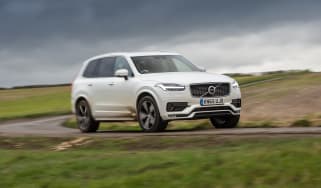
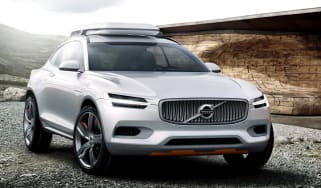
Volvo XC90 review – still the king of the school run or past its best?
Volvo’s star flagship family car has been renewed with more hybrid power, sharper tech and looks and competitive pricing

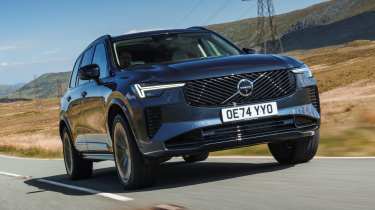
Had things gone differently, the Volvo XC90 would not still be here, or at least not be long for this world. You might not have been aware that it was still around at all. It is in its twelfth year of production after all and kind of blends into the urban landscape like a Costa coffee shop. While the EX90 takes care of the battery-electric vehicle needs, the XC90 provides the comfort of hybridised internal combustion powertrains.
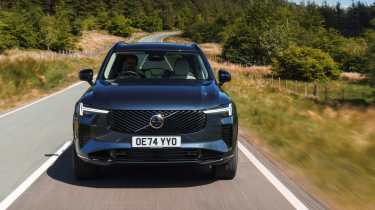
It’s still a crisp, good-looking design, with the latest update providing it with a new grille and revised thor-hammer headlights. However, with the bones of this generation of XC90 now beyond pensionable age in automotive terms, the question is: does a heavy facelift keep the XC90 in touch with BMW’s X5, Audi’s Q7, Mercedes-Benz’s GLE and Land Rover’s Discovery and, of course, the darling of the segment the Defender?
Engines, gearbox and performance
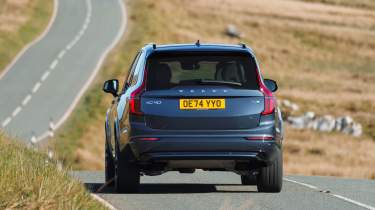
- B5 247bhp and brisk T8 PHEV with 449bhp
- Eight-speed automatic gearbox
- T8 is fast enough, neither is the most efficient
The days of the big brawny five- and six-cylinder diesels in Volvo XC90s are a distant memory. The second-generation model was launched with only four-cylinder engines back in 2015 and the lineup’s changed since then too, with the twin-charged (turbo and supercharged) engines, plus all diesel variants now ditched.
More reviews
The XC90 powertrain lineup has been rationalised down to the B5 mild hybrid with 247bhp and 265lb ft and the T8 flagship plug-in hybrid with a combined 449bhp and 523lb ft – reasonable bumps in output over the pre-facelift ‘Twin engine’ model. The plug-in hybrid features a 143bhp electric motor in that mix, fed by an 18.8kWh battery pack, that gives it a WLTP-certified electric-only range of up to 43 miles. The T8 manages 0-62mph in 5.4sec on the way to a limited 112mph top speed. The B5 is a full 2.3sec slower, however it is worth noting that without the PHEV battery, the B5 is over 200kg lighter.
> Polestar 4 review – a reason to ignore Tesla’s Model Y
In practice, the T8 feels nicely brisk in the rare moments you plumb the XC90 for that performance, though the 2-litre four-cylinder turbocharged engine can sound harsh when doing so. As a combined force the plug-in hybrid powertrain is more than up to almost any task you ask of it, with only the eight-speed transmission occasionally slow on the uptake if you catch it by surprise. All the same, the BMW X5 50e’s B58 straight-six is the nicer motor to rely on and it’s rarer the BMW’s engine has the job of powering the car on its own, given the larger 25.7kWh battery pack of its plug-in hybrid powertrain.
Over the course of around 500 miles of varied driving during our test, the Volvo’s battery delivered around 30 miles of real world electric driving. The Volvo would re-fill battery power at a decent rate over long motorway drives, albeit at the slight expense of cruising MPG. The average MPG return across a number of journeys during a seven day test was between 30 and 35mpg. To get the most out of this powertrain, home charging is a must.
Ride and handling
- Scalable Product Architecture remains in a revised form
- Air suspension an option on higher-spec models
- A relaxing, cossetting driving experience, rather than thrilling
You don’t need to read the technical specification to know the current XC90 is closely related to the previous version. The Scalable Product Architecture provides the bones of both this and, in an obviously much more significantly modified form, the electric EX90.
> Volvo V90 (2016 - 2025) review – Gothenburg’s answer to the Audi A6 estate is dead
Key to how the XC90 drives however is your choice of suspension. The mid-spec Plus Pro XC90 gets an air spring and adaptive damper option that doubles down on the XC90’s existing talent as a comfortable, cossetting cruiser of an SUV. The XC90 is at its best so-equipped, keeping out 90 per cent of the harshest impacts our roads can muster, even on 21-inch wheels. The 22-inch seven double-spoke items do look nicer, but we’d take the 21s in deference to that serene-feeling ride. If you’re buying in the lower half of the XC90 spec food chain, fear not. The standard spring-and-damper set-up is absolutely fine, the air springs just add to the XC90’s natural character.
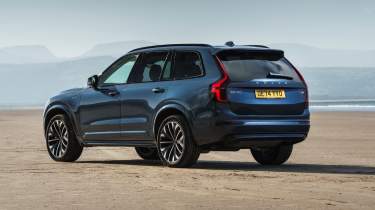
The XC90 is easy, if not involving or hugely communicative to drive. The steering is glassy and light, but intuitive and linear in terms of effort, ratio and weighting buildup as you go through the rack. However, it does go without the slight extra sense of connection you get from a BMW X5, the response of a Porsche Cayenne or the silkiness of a Range Rover Sport. Its light feel and dictable set-up makes it very relaxing around town, however. The XC90 isn’t too bad in terms of manoeuvrability either.
With an emphasis on comfort the XC90 roll is well-managed and the body isn’t unruly, even if it can take a couple of rebounds to recover from undulations, which might unsettle your passengers.
The brakes aren’t quite so uniform. They require awareness that the rate of retardation is variable depending on whether it’s the regenerative or friction braking system doing the work, especially at lower speeds.
Interior and tech
- You can tell it’s an older car made new inside
- Quality, fit and finish are improved
- Airy, spacious and relaxing as ever
Just as on the outside, even with some significant revisions you can tell the new XC90 clothes the bones of an old car with the design, style and technological sensitivity of newer machinery.
Happily, it’s not just the screen that’s gotten bigger and more important to the functionality of the cabin, which itself also feels nicer and is more tightly constructed; this is a luxury family SUV that has a quality appointment that more closely befits its price point. The ventilated nappa leather seats feel softer, the panels are more flush with each other, there are more soft-touch surfaces and fewer harsh edges or tinny-feeling elements.
Familiar from the old XC90 are the steering wheel, which retains its clicky (if not hugely satisfying or intuitive) rocker button controls. Also retained are the driver’s display binnacle (albeit with a new design for the display software itself), door cards and media and climate controls below the central display.
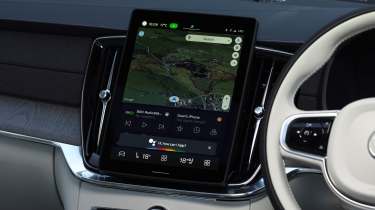
Completely new is the mid-dash design, with a much more modern 11.2-inch portrait infotainment screen and updated vents flanking it. Happily, as with other Volvo and Polestar products, we have a nicely intuitive Google-based software system. The centre console carries over but was upgraded with the previous 2019 facelift, with a smaller crystalline gear selector replacing the old traditional leather-bound appendage. There’s also now a cubby for wireless phone charging.
> BMW X5 Review - still the benchmark SUV
What may be either impressive or definitive proof that cars (especially massive SUVs) don’t need to grow any more, or both, is the fact the XC90 still feels airy, spacious and capacious inside. This is not a car that suffers for its aging platform, alongside rivals that have grown almost into a class above. As it happens, BMW’s X5 dates back almost as far and Audi’s Q7 will be replaced later in 2026. On a long journey to the Scottish borders, our seven-seat XC90 went five-up with adults with weekend luggage (and eveningware) for all, without feeling (too) claustrophobic.
Price and rivals
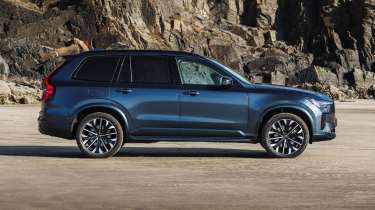
As an older car that’s seen numerous updates, with a slimmed-down lineup of engines, it's fortunate the XC90’s rivals know the same pain. Audi’s Q7 is as old underneath, BMW’s X5 has in its current GO5 form been around since 2018 and a version of the CLAR architecture that underpins it will be the basis for its Neue Klasse replacement. Likewise Mercedes-Benz’s GLE dates back to the late 2010s.
Nonetheless, the XC90 does to an extent feel its age, updated interior and sharpened looks taken as read, especially when it comes to powertrains. Both Audi and BMW offer diesel and six-cylinder engines and the BMW’s PHEV option offers more sophistication and much more range. The BMW is sharper to drive as you’d expect but neither are quite so brow-soothing, or cossetting, in quite such a Range Rover-ish way, as the Volvo, and that has value.
The ‘Core’ XC90, which has a decent equipment lineup that includes matrix LED lights, wireless phone charging, interior ambient lighting and adaptive cruise, starts from £67,150, for the B5-powered model. In Plus Pro spec (with the air suspension), that price rises to £72,270.
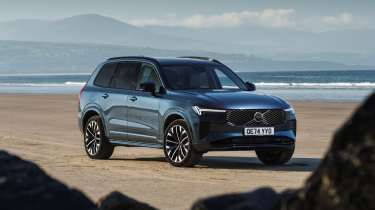
It’s at this level that Land Rover’s Discovery is worth considering, which starts from £64,930, is the XC90’s main rival, which by the way, comes fitted with a 340bhp+ mild hybrid six-cylinder diesel at this price. The bigger seller Defender 110 starts from £62,915, or if you need more seats, the 130, from £84,240. BMW’s X5 is much pricier at base level, starting from £75,860, while the Q7 lineup begins at £73,225. The Mercedes-Benz GLE starts from £78,130 in its basic form.
The T8 PHEV is much more expensive, our upper-mid-spec ‘Ultra’ test car costing £86,560 without options such as the Bowers & Wilkins stereo and massage seats that come with ‘Ultra Pro’ spec that’s a further £3,000. By comparison, an X5 M50e M Sport starts from £83,710. Mercedes-Benz’s GLE350de and GLE 400e (Mercedes offers a diesel PHEV too) in AMG Line premium spec are priced from £83,620, and £85,620 respectively. The Range Rover Sport PHEV also starts in this region, at £87,010. At these prices, the EX90’s rivals can also be had with bigger, stronger multi-cylinder diesel engines, which will be better suited if you do any towing.