Lamborghini Gallardo (2003 - 2013) review – the baby V10 supercar that saved the company
The Gallardo was the car that catapulted Lamborghini into the modern age and a new era of profitability
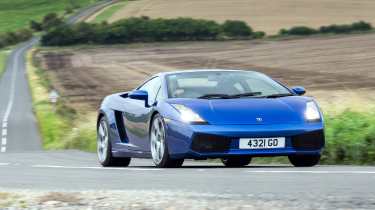
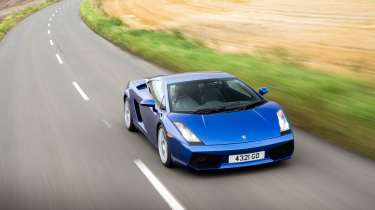
Can it really be over two decades since Lamborghini introduced the Gallardo? Looking at this fabulous Caelum Blue example, it’s hard to believe. With its successor – the Huracán – now replaced by the V8 hybrid Temerario, what better excuse to revisit the car that transformed Lamborghini’s fortunes and took the fight to Ferrari?

Prior to the Gallardo’s launch in 2003, there hadn’t been a new entry-level model since the Jalpa in 1982. Given that the Jalpa was a quick-and-dirty rehash of the 1976 Silhouette, which was itself a restyled two-seater evolution of the 2+2 Urraco launched in 1972, it’s fair to say Sant’Agata’s track record for smaller supercars was one of quirky, eccentric and somewhat makeshift efforts.
Still, it says a lot for the troubled state of the company in the 1980s that the Jalpa was credited with helping to turn its fortunes around, despite selling just 410 units in the space of six years. For context, when the Jalpa went out of production in 1988, Lamborghini was still building the Countach and LM002, cars that seem embedded in the company’s formative days. Both those behemoths would soon cease production, leaving Lamborghini surviving on sales of its then-new flagship, the Diablo, from 1990 all the way to 2001.
Given that Audi acquired the keys to Ferruccio’s kingdom in 1998 it seems equally surprising that the gnarly old Diablo was still haunting the production halls some three years into Ingolstadt’s tenure. Only when the venerable flagship was succeeded by the Murciélago did Lamborghini’s trajectory begin to point skywards. The Gallardo was launched a scant 18 months later, lighting an afterburner that powered the marque’s relentless rise.
More reviews
Reviews
- Lamborghini Gallardo (2003 - 2013) review – the baby V10 supercar that saved the company
- Lamborghini Gallardo Squadra Corse review
- 2013 Lamborghini Gallardo LP560-4 review
- Lamborghini Gallardo LP570-4 Spyder Performante review
- Lamborghini Gallardo LP570-4 Superleggera review
- Lamborghini LP570-4 Superleggera review
- Lamborghini LP550-2 Balboni
- Lamborghini LP560-4 Spyder
- Lamborghini Gallardo LP560-4
It’s worth recalling that this was the era of pre-credit crunch ‘cheap’ money. It’s no coincidence that brands such as Aston Martin and Bentley also launched affordable cars around this time, the (just) sub-£80k Vantage and similarly priced Continental GT being the poster cars for once aristocratic marques embracing enthusiasts who had previously only dreamed of owning such elite and exotic metal.
Fast-forward to 2013 and, when the Gallardo’s decade-long production run came to an end, some 14,022 cars had been built in 32 different variants. Put another way, Gallardos accounted for approximately 50 per cent of all Lamborghinis built since the company began in 1963.
I can still remember the excitement now. With new ownership, a new millennium and two brand new model lines, Lamborghini was re-energised and clearly gunning for Ferrari. The Gallardo’s timing couldn’t have been better; the first attainable Lamborghini in a generation, hitting showrooms at a time when low interest rates and cheap car finance fuelled a supercar boom.
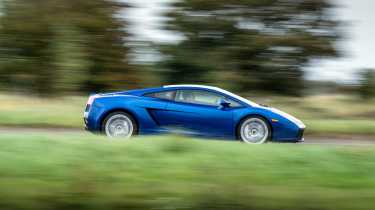
Now as then, the Gallardo’s specification is mouth-watering. A compact (shorter than a contemporary 911!), all-wheel-drive, mid-engined supercar, built around a new aluminium structure and powered by a bespoke 5-litre naturally aspirated V10 engine. Good for the best part of 500bhp and available with a choice of traditional gated stick-shift manual or single-clutch paddleshift, the Gallardo trounced Ferrari’s 360 Modena for raw firepower with an extra two cylinders and 1.4 litres of swept volume for a power and torque advantage of 100bhp and 100lb ft.
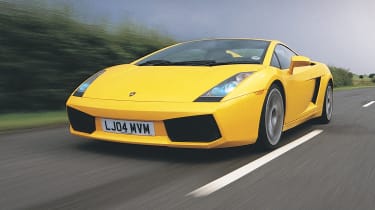
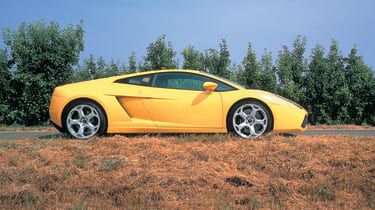
It looked better too, thanks to the immaculate efforts of designer Luc Donckerwolke. In his pomp having recently penned the Murciélago, he took Fabrizio Giugiaro’s excellent Cala concept and contemporised it to striking effect. Tight, chiselled and uncorrupted by protruding wings or spoilers, the Gallardo’s modern, minimalist form was a bold departure from Lambo’s unmistakable Gandini-informed tropes. It has always been a stunning-looking car, but there’s no question an early Gallardo now qualifies as a definitive piece of design and one of the all-time great Lamborghinis.
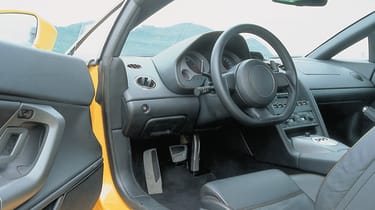
Let’s talk about the doors. For a while prior to the Gallardo’s reveal I remember wondering if it might have a variation on Lambo’s trademark upswept scissors, but in keeping with its mission for added useability the doors were conventional. They open onto a spacious cockpit that’s surprisingly free from look-at-me drama. There’s obvious Audi-sourced switchgear and instrumentation, but the deep dash and almost flat windscreen place you well back from the scuttle in time-honoured supercar fashion. The architecture is dramatic, but the fixtures and fittings are restrained. It’s a timeless combination.
It's worth digressing at this point to tell you a little more about this particular car. With more than 120,000 miles on the odometer, it must be one of the highest mileage Gallardos around. Prior to its purchase by the present owner six or so years ago it had covered a little over 40,000 miles, but daily use soon piled on another 65,000.
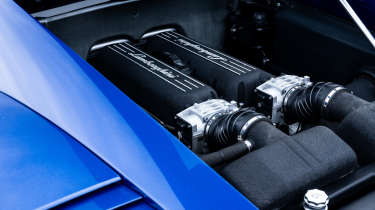
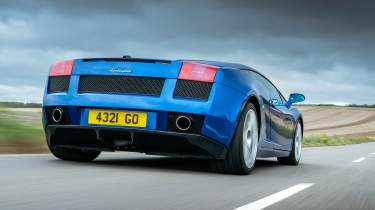
It is now well-known in Lambo circles that early Gallardos had a habit of ingesting their catalytic converters, which disintegrated with age. If you’re unlucky the resulting ceramic fragments can be large enough to cause a catastrophic engine failure. Fortunately for 4321 GO’s owner, the cats gradually crumbled into smaller sand-like granules, which slowly but steadily scored the cylinder bores until excessive oil consumption led him to have a voluntary engine rebuild at 106,000 miles.
Entrusted to marque specialist Ricky Elder at REPerformance, 4321 GO was given what is described as OE+ specification. That’s to say lightweight Carillo pistons – lighter and roughly a third of the price of the £14,000 Lamborghini charge for a set of ten OE items! – attached to standard rods, plus titanium valvegear, meticulously ported heads to Elder’s secret recipe and a gentle remap to compensate for running without catalysts.
While the car was in bits, the gearbox was also inspected, with the decision taken to rebuild it at the same time. The overall result is by far the sweetest and most impressive early Gallardo I’ve ever driven. The quickest, too. When back-to-backed with a recently serviced standard Gen1 5.2-litre R8 V10 on Elder’s MAHA dyno, it was found to produce 50bhp more than the Audi. That must have sweetened the £20k bill a little.
For a car that has covered such high mileage, it has worn extremely well. The interior shows signs of patination, but still looks in very good nick for its age. The seats are comfortable with plenty of support left in the cushioning foam, and there’s decent headroom (at least for me, though that isn’t saying much), so you can quickly get settled behind the wheel.
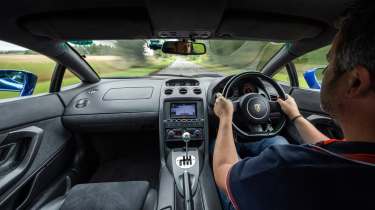
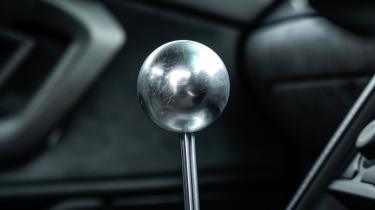
Adding to this car’s appeal is the manual transmission. The e-gear transmission is only passable these days, plus it has a habit of eating clutches. With an extra pedal in the footwell you notice the offset pedals a little more than perhaps you would in a two-pedal set-up, but the stick-shift ’box was always a good ’un and this one is a peach thanks to Elder’s rebuild.
The Gallardo’s in-house-developed 5-litre V10 has always been a blockbuster, but reacquaintance serves to remind just how impressive and characterful this original ‘pre-LP’ spec motor is. There’s a bit more fire in its belly somehow, with a grittier quality compared with the creamier Audi-developed 5.2-litre found in later models.
This car’s decat and switch to a Superleggera back box certainly add to the explosive soundtrack, but there’s something inherently more interesting about the 5-litre’s 7-8-5-2-1-10-9-4-6-3 firing order compared with the 5.2’s 1-6-5-10-2-7-3-8-4-9. Such is the weirdness of our obsession with internal combustion. Start the Gallardo and you’re immediately reminded why it was such a hit. It has far more mechanical swagger than the 360 (or indeed the F430), the yowling V10 instantly feeling and sounding larger than life even at idle. A Ferrari V8 sounds thin and brittle by comparison.
Old-school V12 Lambos had a reputation for being unwieldy beasts with excruciating control weights (a reputation not entirely deserved IMO), so effort was clearly made to ensure the Gallardo was more manageable. It certainly feels smaller and more biddable, which is welcome on the kind of roads you’d choose to enjoy a car like this. There’s meat to the controls, but the weight is well measured to balance effort against a feeling of connection. The clutch is far from the calf-busting pedal of 1970s supercar myth and legend. Likewise, the hydraulically assisted steering has satisfying treacly resistance that you just don’t get in a modern EPAS system, though it could do with being fractionally quicker-witted and offer a bit more feel.
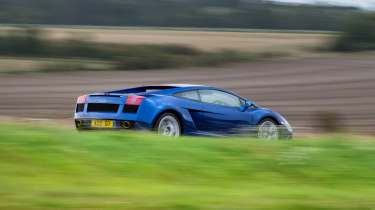
There’s a general ease of operation that’s very redolent of that early Millennial era. Cars like Ferrari’s F355 with its new-fangled F1 paddleshift had started the move towards more useable ‘baby’ supercars, but it was the 360 Modena and Gallardo that made the big strides towards everyday useability, and indeed durability. That might have eroded some of the quirks and foibles possessed by their predecessors, but there’s something deeply impressive about the way the Gallardo combines stimulating exoticism with temperament-free stoicism.
The Gallardo thrives on quiet country roads, threading accurately through the more confined and twisty sections and blasting along the open swoops and curves that carve their way across the undulating terrain.
You might sit a long way back, but you can place the Gallardo smack on your chosen apex, the base of the endless A-pillar giving you a handy visual reference as to where the front wheel is. The steering isn’t ultra-pointy in the contemporary sense, but you still get that delicious feeling of strong grip, tight body control and agility that comes in a compact, mid-engined supercar. It’s a completely absorbing process, looking further ahead to pick your line and adjust your speed as you stretch through the gears.
The pre-LP Gallardo just pre-dates the suite of switchable dynamic modes that are now commonplace, so there’s very limited scope to meaningfully alter the Gallardo’s character. Four-wheel drive from launch, as was Lamborghini’s default with all its models back then, it relied on a viscous centre diff with no fancy active electronics: the torque split was 70 per cent rearwards in normal driving, but up to 50 per cent could be directed to the front axle in extreme conditions. The 30:70 split suggests a rear-biased handling balance, but in reality it feels more neutral than that. You have to try unreasonably hard to make the Gallardo lose grip at the rear. When it does it’s not particularly happy about it, so best to play to its strengths and revel in the poise and purchase it manages to find.
There is traction control, but it’s more satisfying to switch it off in the dry to avoid it nibbling away unnecessarily over bumps during hard acceleration. The suspension is non-switchable, but the Koni shocks passively alter their damping rate according to the frequency of vertical movements. Ride quality is pretty supple, as was the way in the passive damping days when street cars had to strike a ride and handling balance that favoured road over track.
The simple, analogue nature of the Gallardo means it’s the driver who injects extra energy into the way it goes down the road. It takes a while to unlearn habits formed in newer supercars, which encourage you to constantly fiddle with settings to find an elusive sweet-spot. By contrast, once you accept the compromises Lamborghini settled upon for ride quality, body control, steering response and powertrain character, you soon find peace and satisfaction from letting the car do its thing. Of course, there are aspects of the Gallardo you would like to tweak in certain moments or on certain surfaces, but across the entirety of a day’s driving there’s a lot to be said for the deeper bond you form with a car that you have to take at face value and enjoy for what it is.
On proper driving roads, steadfast stability is the order of the day, the mix of all-wheel-drive traction and a handling balance that ultimately bleeds into settling understeer giving the Gallardo a very different feel to its Ferrari rivals. At times it’s a little too inert, lacking the flighty agility that increasingly came to define the F430 and 458. What it lacks in more delicate, detailed feel and fleet-footed dexterity it makes up for in poise and pace, so you can carry speed and attack the road.
The harder you work it, the better the V10 gets. Given that the Gallardo is relatively small, it’s easy to forget that its engine displaces 5 litres, especially as it revs so freely. It doesn’t quite have the whoop-whoop of an LFA or Carrera GT, but the way it works to 8000rpm is never less than mighty. And while there’s no doubt this car’s rebuild has given it some added zip, the essence of the ‘pre-LP’ experience remains intact, with this fabulous combination of sharp, naturally aspirated response, big-hearted mid-range flex and ferocious top-end fireworks.
Performance-wise it might pale a little compared with today’s turbocharged and turbo-hybrid supercars, but the reality is that an early Gallardo has rampant acceleration and more than enough point-to-point speed. It certainly had the legs on a Ferrari, despite a wet 1520kg kerb weight that’s 130kg more than a 360 Modena’s. Torque is the key. With a peak of 376lb ft at 4250rpm, and 80 per cent of that from just 1500rpm, you can be lazy and still romp down the road. In-gear acceleration is as effortless and vivid as you’d imagine, but because the engine is vocal and keen to rev you’re just as likely to blip-shift down a gear or two and wind the V10 into a frenzy when the mood takes you.
Spend a day in a Gallardo and you find you’re always enjoying the engine, whatever your speed, rpm or throttle opening. It’ll be fascinating to see how the Temerario’s 10,000rpm V8 compares, though of course the very real danger is that with 900bhp, plus the torque of twin turbos and a hybrid system, any moments of full-throttle driving will be so fleeting that time spent in that stratospheric rev-range will be all too brief. Sometimes less really is more.
If there’s one area where the Gallardo falls short it’s brake feel. Specifically, the lack of initial bite at the top of the pedal. It’s not so much of an issue during sustained stops, where you immediately push through the dead travel and stay in the meat of the braking effort, but it is at its most frustrating when you’re on a twisty road that has you on and off the brakes. Blending smoothly in and out of the pedal can be tricky, even when you consciously try to drive around the issue. It’s a real shame because the Brembo brakes (cast-iron discs with big eight-pot calipers at the front) certainly don’t lack for stopping power. The abrupt tip-in tip-out response is a trait that was inherited by the Huracán. The Temerario needs to kick this habit, which might be a tall order considering the challenge of smoothly blending friction and regen braking.
Historically, Lamborghini’s scissor-doored flagships have tended to hog the limelight, but the Gallardo could always hold its own. Sensational looks and a spectacular powertrain gave it the all-important Lambo wow factor, but it was the unique combination of that searing V10 engine and a newfound wieldiness and useability that ultimately transformed Lamborghini from a purveyor of rare and outlandish poster cars to a serious volume-selling supercar brand. Two decades on, the Gallardo’s star quality still burns bright.
Lamborghini Gallardo buying guide
It’s unlikely you’ll be looking at a car that has not been appropriately serviced by an authorised Lamborghini dealer, but if you are looking at a left-hand-drive car, examine the paperwork closely. UK Gallardos get a three-year warranty, but privately imported cars are only covered for two years. However, customers who have made claims have reported that their issues have been rectified with the minimum of fuss.
Engine and gearbox
The Gallardo’s engine is well engineered and strong, with failures a real rarity. The biggest issue with the Audi V8-based, Cosworth-fettled V10 is the oil level, or rather the correct checking of the oil level. Oil consumption should be minimal, and although the handbook quotes the possibility of a litre being consumed every 600 miles, a litre every 4000 miles is more usual. However, several owners (presumably unfamiliar with the intricacies of dry-sump lubrication) have ignored the instructions in the owner’s handbook when checking it and have overfilled it, which inevitably leads to an unscheduled dealer visit.
It’s absolutely vital that Agip oil is used. There have been several dealer-reported failures where engines (both for the Gallardo and Murciélago) have suffered catastrophic failures as a result of using cheaper alternatives. A new Gallardo engine costs around 60,000 Euros…
The only other thing to look out for is ‘hunting’ from the engine, usually signifying that the throttle bodies are sticking slightly. This can affect cars that have been regularly used in slow traffic, and although it is easily remedied with a simple clean-up, it’s a job best left to a dealer technician.
The same exhaust system is fitted to ’03-’05 cars and incorporates ‘noise reduction valves’. These two valves keep the engine relatively quiet at noise-test speeds, but allow for a louder note above 4000rpm. As the valve is active, a permanently quiet exhaust note may suggest a problem with the solenoid. Some cars may have been fitted with aftermarket sports exhausts, with Tubi and Larini the preferred choices. Even these can lead to rattling heat-shields, but this is an easily resolved problem. The limited-edition SE Gallardo had a much less restrictive exhaust and is loud at all times.
The gearbox is immensely strong irrespective of whether you want the cable-operated manual or the e-gear paddle-shift. At high mileages, the cable on the manual ’box may start to stretch slightly, but this is unlikely to affect even the earliest Gallardos just yet. Otherwise, the manual has no known vices. The e-gear system has three modes of operation: a normal mode, a faster and harder-hitting sport mode, and a fully automatic mode. There is also a setting for low-friction surfaces such as snow and ice.
One advantage of the e-gear system is that it can be easily examined electronically by a main-dealer technician, which can determine clutch life. This is a strongly advised course of action and may save an awful lot of worry when purchasing. Several different software upgrades were available for e-gear, as the system has benefited from continuous development. A jerky gearchange may simply indicate an early program is still in use.
Anyone considering a pre-owned supercar should be thinking about clutches, and the Gallardo is no exception. Early cars were fitted with what is now known as the ‘A’ clutch, and some of these – though by no means all of them – proved to be extremely fragile. The ‘B’ clutch came and went rapidly, then for ’05 the ‘C’ iteration arrived, proving to be very durable. Tales of lifespans in excess of 20,000 miles are not uncommon, but don’t forget that this is a 500bhp, four-wheel-drive supercar, and clutches can be destroyed almost instantly with abuse. The latest and best clutch design is designated ‘E’. MY06 manual cars have a sintered-type of clutch. Gallardo transmissions are situated behind the engine, so clutch replacement does not require removal of the engine.
Electrics
Some early Gallardos were prone to spark plug water ingress. Lamborghini’s customer care programme installed additional bungs to the camshaft covers to cure this, and all early cars should have had this modification done by now. The Gallardo has virtually every electronic gizmo and creature comfort you can imagine. No specific problems exist, but all should be working perfectly.
Suspension
Koni’s Frequency Sensitive Dampers (FSD) are fitted to the Gallardo and should give no cause for concern. UK cars were available with a ‘lifting system’ option (August ’05 cars onwards) to allow the front ground clearance to be raised by 30mm where necessary. If this system is fitted but not used regularly, oil leakage and system failure can occur, although this won’t affect the performance of the suspension, which is on a separate hydraulic circuit. A simple inspection and test should suffice.
Some cars had front and rear anti-roll bar bush problems, but these were part of an ongoing customer care campaign and should have been replaced by a dealer free of charge.
Wheels, tyres and brakes
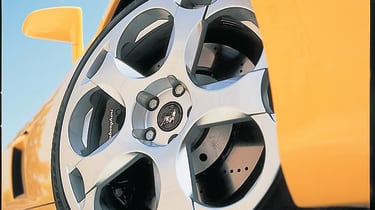
Gallardos came with Pirelli P Zero Rossos as standard (the SE came with P Zero Corsas). Tyre wear varies depending on use; for a car exercised but not abused you should expect between 5000 and 8000 miles from the rears (295/30 ZR19) and double that from the fronts (235/35 ZR19). Budget £550 for a pair of fitted rear tyres, but shop around as prices and availability vary enormously.
The 19in wheels are extremely easy to damage, as the tyres are very low profile and so do not protrude beyond the rims. Kerbed alloys are therefore a common sight. Budget £100 plus VAT to have a wheel refurbished by a dealer (although a good independent wheel repairer can often do it for less than half that price).
The Gallardo’s brakes are massive: 365mm vented discs gripped by huge eight-piston callipers on the front, 335mm vented discs with four-piston callipers on the back. The rear discs also accommodate separate handbrake callipers. The handbrake is notoriously unreliable and the best advice is to leave a Gallardo in gear – it’s even recommended in the handbook.
Some owners have experienced brake fade in the most extreme of conditions (like track work), but on the road you will not have a problem. Despite the power being reined in, the brake discs and pads are very durable.
Bodywork
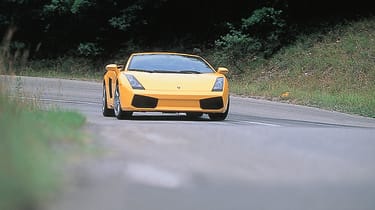
Its all-aluminium body means a Gallardo is easily damaged by small knocks that a steel shell would cheerfully shrug off. There have also been a few reports of corrosion at the inner upper and lower seams of the side oil-cooler vents. Front and rear bumpers are plastic and colour-coded to the bodywork. Panel gaps should be minimal and consistent. No composite materials are used in the Gallardo’s construction.
Film-type protection is popular on these cars to protect the paintwork from stone damage. Common areas of protection include the whole of the front bumper, bottom half of the boot lid, the sills and the door mirrors. If it’s fitted, there should be no signs of the film lifting. Though not standard, most original purchasers will have been offered it as an option.
Other things to check include the first screw, on both sides, securing the under-bonnet trim panel. These have been known to come loose, resulting in the inside paint surfaces of the buttresses becoming scratched.
Interior
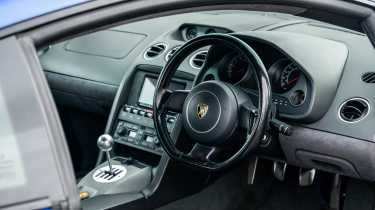
The quality of the Gallardo’s interior is excellent and certainly a cut above that of Lambos of old. The interior is also the most obvious sign of Audi’s supervision of Sant’Agata’s activities. Most instruments and switchgear are sourced from the Audi parts bin, and this is no bad thing. Audi’s equipment is as well screwed together as that of any premium-brand manufacturer, and equally reliable.
The dual-zone climate control is standard in all cars. It works well and should cause no problem. The area where individual cars may vary is the entertainment system. The Gallardo came with a six-CD changer as standard, but there was also the option of a satnav system with a 7in TFT display and integrated TV, radio and MP3 player. This was a £2500 option and is well worth seeking out.
All interior trim (including the dashboard and instrument binnacles) is covered in high-quality leather. The roof and sun visors are finished in Alcantara. Some cars had optional two-tone interiors, with some trim panels matched to the body colour of the car. All trim should fit perfectly and be flawless.
Lamborghini Gallardo values and specs
| Engine | V10, 4961cc |
|---|---|
| Power | 493bhp @ 8000rpm |
| Torque | Torque 376lb ft @ 4250rpm |
| Weight | Weight 1520kg (330bhp/ton) |
| Tyres as tested | Michelin Pilot Sport 4 S |
| 0-62mph | 4.2sec |
| Top speed | 192mph |
| Price new | £120,000 (£213,000 in today’s money) |
| Price now | From £60k (e-gear), £75k (manual) |