Porsche 911 Carrera (996, 1997-2005) review – an evo Car of the Year champion for under £20k
Performance cars have come a long way since the 996 Carrera became our first eCoty winner, but are the qualities that made it stand out in 1998 still alive and kicking today?
Issue 003. The very first Car of the Year back in 1998 was just the third go at this thing a group of guys – Harry Metcalfe, John Barker, Dickie Meaden, art editor Damian Smith and publisher Allan Pattison, plus Peter Tomalin, current editor Stuart Gallagher and a host of freelance photographers – called evo. I don’t want to pat them too heartily on the back, but you’ve got to admire the blind ambition, the tenacity to secure the cars and the commitment they showed to the cause, even when the future of this experiment was uncertain at best and downright precarious in the cold light of day.
That week in drizzly Wales set the dye for eCoty as we know it today: the best cars, the best roads the magazine could find (and afford to reach), a track element for some three-wheeling and sideways action photography, and a Porsche crowned the winner. To paraphrase Gary Lineker’s concise summation of football: eCoty is a simple game, several badly dressed people drive around like their hair is on fire for a week and in the end the Germans always win. In ’98 the German was the Porsche 996 Carrera.
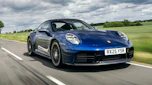
This means that right now, you can buy a usable example of the very first evo Car of the Year for well under £20k. A car that saw off the challenge of the, er, Alfa Romeo GTV. Not to mention the, um, Audi S4 and Jaguar XKR. OK, so the field wasn’t one of the strongest, but the plain Carrera also roundly beat a Caterham Clubsport, BMW M Coupe, Mazda MX‑5, the Subaru Impreza Turbo in its pomp, a sublime Lotus Elise 135 and Ferrari’s bewitching F355 Berlinetta F1. More importantly, it helped define what evo was all about – poise and composure, feedback and finesse, involvement and balance.
More reviews
In-depth reviews
- Porsche 911 Carrera GTS review – why Porsche's T-Hybrid is also one of the best
- Porsche 911 Targa review – the opposite of a purists 911, but still superb
Long term tests
Reviews
- Porsche 911 Challenge review – this £200k racer might be the most fun 911
- Gunther Werks Turbo review – part Porsche 911 Turbo, part hypercar
- Porsche 911 Turbo (1974 - 1989) review – why the 930 was the original 911 wild child
- Porsche 911 GT3 S/C review – does a convertible GT3 really make sense?
- Porsche 911 (992.2) GT3 Manthey Kit review – a road-legal race car with a warranty
- Porsche 911 GT3 RS Manthey kit review – the ultimate Nürburgring toy tested to the limit
Me? I wasn’t there. But I vividly remember reading Peter’s fine words in primary school (or was it pre-school?), and John’s conclusion on the 996 stuck with me: ‘So much character, so much ability, so much performance so effortlessly deployed. Offered any one of the ten sets of keys for the year to come I’d have no hesitation whatsoever.’ Woah. This new water-cooled contraption was pretty damn good, it seemed. Not only good enough to beat the opposition, it also quashed any thoughts that Porsche had dumbed down the 911: ‘Steely control, athletic suppleness… You’d have to be perverse to declare the old car was better.’
Now, it’s conceivable that the guys were wrong. Almost in the same breath as declaring the 996 Carrera their champ, the team also described the Ferrari’s early days paddleshift gearbox as ‘sweeter than honey’, and somehow the rabid little BMW finished several places behind the Jag and only a point or two ahead of the Alfa. To be fair, 21 years is a very long time and I hear attitudes to drink-driving were much more laissez-faire back then. Which might also explain why Meaden’s tongue is lolling out the side of his mouth in the cornering shots. Anyway, today we’ll discover if the very first eCoty winner has still got it, by driving a highly original example. No decals, no towering wing, no gaping intakes or tricks and flicks. For a car that so upset the purists it doesn’t half look pure.
History and specs
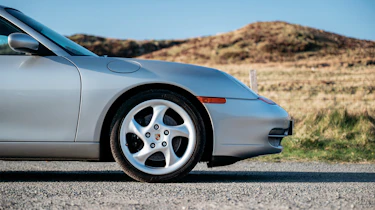
I suppose it’s worth reiterating just what a revolution the 996 represented for Porsche when it was launched. Longer, wider and lower, this clean-sheet take on the old rear-engined formula reimagined the 911 shape, referencing the classic silhouette but pulling at and smoothing all the surfaces to create a much more modern driving environment. Few would question it lacked the charm of the 964-era cars or the sex appeal of the 993, but the new 996 was more accommodating and much less, well, weird for people not of the 911 faith. Even better, it was lighter, more powerful, stiffer, and featured more sophisticated suspension.
Of course, the biggest change of all was the switch to water cooling for the flat-six engine. History has been rewritten to such an extent that you’d imagine this caused outrage amongst Porsche guys and girls everywhere… but these were different times. Porsches didn’t command quite such the fetishistic devotion that they do nowadays. Oh sure, people loved them and they tended to clean up in magazine group tests, but journalists and buyers seemed to largely simply treat it as another step in the 911’s relentless evolutionary march. The new 911 had a 3.4-litre flat-six that revved higher and produced 300bhp, the car was lighter at 1320kg, and in every measurable way it was faster and more capable than the model it replaced. There were – from memory and looking back at contemporary reviews – very few tears shed over the 993’s passing.
Driving the Porsche 911 Carrera (996)
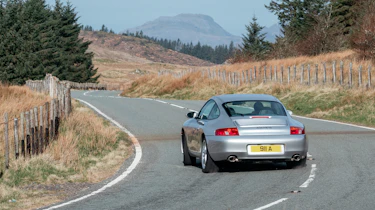
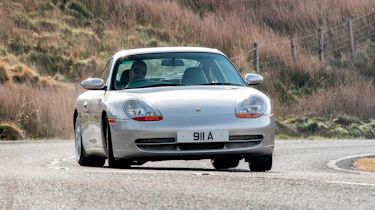
Anyway, that’s all ancient history and there are bits of the 996 that feel ancient, too. I happen to love the beautifully simple soap-bar lines, but recognise that when you pull open the door and slide into the driver’s seat it’s not all rosy. You sit a little too high even in the optional hard-backed sports seats, the steering wheel doesn’t adjust for reach and always feels a stretch too far, and the 996 will never win any awards for its interior architecture or the feel of some of the hard plastic buttons and surfaces. Having said all of that, the 996 is extremely compact and the good visibility creates a sense of lightness even before you get going.
Twist the key and the flat-six catches with a lovely dry howl that’s evocative of that of the older cars, but there’s a crispness to the way it revs when you go to the throttle that’s a marked improvement over the sometimes stodgy delivery of a st
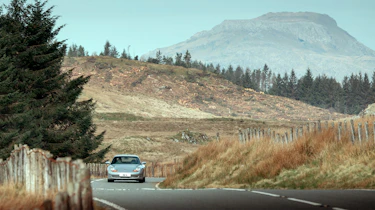
andard 993. Select first and you’ll notice a long throw and an extremely light gearshift action. It’s almost as if the lever isn’t connected to anything below and, honestly, you get the feeling the ’box will require little effort but also offer little reward. I should probably stop referencing the 993… but it’s interesting that Porsche should stray so far from its heavy, deliberate shift. It’s perhaps a metaphor for the whole car. The 996 is all about a sense of easy-going precision rather than hewn-from-granite stability.
The surface is damp in places, caked in mud in others, and the temperature is hovering at around 10deg C. Grip ebbs and flows like a river but the tarmac is choppy and coarse. Yet the 996 rides beautifully. There’s not the ruthless damping control of a modern 911, nor the laser-guided turn-in response, but the loose, limber feeling to the way the 996 goes down the road is fantastically liberating. It’s alive with messages, too. Once again, the steering is lighter than you might expect but it conveys the most exquisite detail. The slight softness immediately off centre is a reminder that the front wheels are lightly loaded, but stay patient and the front responds in kind, weighting and texture ever-changing just like the surface below and breeding confidence.
Grip levels are simply not in the same league as those of a modern Porsche – or indeed a modern hot hatch – but the 996 gives you the tools to exploit all it has and is so mannered when grip runs out that you never feel like you’re missing out in corners. In fact, although the sort of awe that John uttered in conclusion about the 996 is inevitably eroded with time – it simply doesn’t feel that fast or indomitable judged by today’s standards – the balance of each element of its dynamic make-up is so wonderfully wrought that the feeling of absolute cohesiveness runs just as strong today as it must have in 1998 near Betws-y-Coed. So maybe it’s not awe-inspiring, but boy does it feel alive, accessible and absolutely set up to entertain.
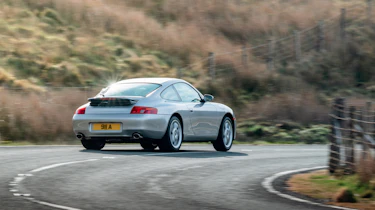
Inevitably, Aston wants me to express this level of playfulness for the camera. Usually he’ll find a fifth-gear sweeper and ask for the car to be on three wheels, sideways and preferably belching flames, and I don’t mind admitting as grip levels spiral upwards and body control gets more and more absolute, this can be extremely intimidating. In the 996? I’m happy to try anything. The engine isn’t loaded with torque but is crisp and responsive, and with 300bhp and 258lb ft the driver always has just a tiny bit more power than grip available. In these conditions at least. So balletically sliding the 996 around is amazingly easy: turn in and feel the front bite and then gently start to understeer as you load up the rear tyres. Have no fear, because it’s pushing rather than slipping out of your hands. This is simply the entry phase to getting the best from the 996.
Now take a breath off the throttle – no need to snap it closed – and balance is restored, then slowly swings the other way. This, right here, when the car feels almost weightless and in stasis, waiting for your next command, is pure 911 and pure heaven. It comes from the cohesiveness I mentioned earlier and the feeling that a million miles have been covered before you, right in this zone, by seriously talented people who know what makes a driver’s car special.
Pour in some more power – the engine really starts to bite over 4500rpm or so and gets more and more impressive as it zings around to the 7300rpm limiter – and the rear simply arcs around, so in tune with your throttle inputs, and the steering seems to fall onto the perfect amount of corrective lock. It’s so easy and fluid but never feels toy-like or inconsequential. You’re dictating every millimetre without stress or sweat but somehow it still feels like a game with high stakes. That’s the real magic of the 996: fast enough to thrill yet so accessible that every drive is peppered with moments of unforgettable action.
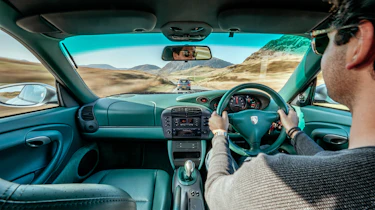
Even the rangey, lightweight-feeling six-speed ’box comes good at speed. There isn’t the deep mechanical connection of a short-action, ultra-precise shift – the sort you’d find in the Cayman GT4 or a new GT3, for example – but it’s so quick and easy to use and pretty soon you’re batting it around just for fun. Of course, judged by today’s standards the flat-six really does require work to extract its best. We’re so used to huge, turbo-enabled torque that comes on strong and sticks around for the meat of the rev range that it takes time to readjust to a car that needs revs to really fly. It’s no chore, though. In fact, you wonder quite who decided that a torque plateau from 1500 to 5000rpm was a good idea in the first place. Feeling the engine work through all its phases, its voice morphing in pitch and intensity and power inexorably building until the final rush to the limiter, beats the instant gratification of a fat slug of torque, that’s for sure. Overall, it’s safe to say that the 996 Carrera still stacks up today.
evo eras 1990s test – revisiting the Porsche 911 Carrera (996)
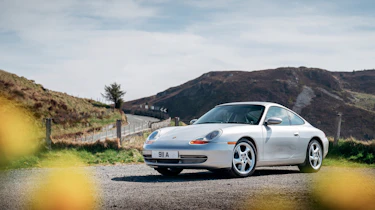
‘It’s the eternal 911 conundrum, that each generation brings quantifiable objective improvements, yet also a yearning for its rawer, quirkier, more distinctive predecessors, a sense that something has been lost.
In our ’80s test the Carrera had proved to be 911 turned up to 11; the 996 is a lot more civilised, a little less of the gentleman-racer’s road car, a little more executive play-thing. But the core appeal remains. As editor-at-large John Barker says: ‘When the 996 came out, everyone said, “It’s been denuded, it’s lost all the character.” With hindsight we can see that it hadn’t. It’s still very 911.’
‘In the 996 the feedback has been watered down, so you need to concentrate harder to find the rewards,’ says senior staff writer Yousuf Ashraf. ‘With time you do find them, and it is lovely to be driving a compact, basic, manual 911. But I was expecting the engine to be a bit more vocal and exciting, and a bit more bite and involvement from the chassis.’
I go for one last drive in the 911, and its body control over sometimes tricky crests and compressions is just superb. It’s immensely satisfying to stroke it along. The weight shifting and all those other evocative 911 tells are still there. It’s still a great car.’ – Peter Tomalin, evo 335
Porsche 911 Carrera (996) specs
| Engine | Flat-six, 3387cc |
| Power | 300bhp @ 6800rpm |
| Torque | 258lb ft @ 4600rpm |
| Weight | 1320kg |
| Power-to-weight | 231bhp/ton |
| 0-62mph | 5.2sec |
| Top speed | 174mph |
| Price when new | £64,825 |
| Value today | from £17,000 |