Used Porsche 911 GT3 (991, 2013-2019) review – a 9000rpm supercar for BMW M2 money
Despite radical technological changes, the 991 GT3 retained all the magic of a motorsport 911 and took victory at our 2013 Car of the Year test. Today you can buy one for £75k
When the 991-generation Porsche 911 GT3 arrived in 2013, some assumed that the GT3’s best days were behind it. On paper the 991 was a purist’s nightmare: larger, heavier and more complicated than the 997, it was no longer powered by a Mezger engine, no longer had hydraulic steering and crucially, wasn’t offered with a manual gearbox. The defining elements of previous GT3s were missing, the 991 seemingly taking a more digital route to compete with the likes of the Ferrari 458 and Audi R8.
In reality, we needn’t have worried. The 991 was stellar, and for what it gave up in terms of interaction it made up for with newfound precision and intensity. The new engine revved to 9000rpm and the sharp PDK gearbox fed into the motorsport vibe, while the introduction of rear-wheel steering and comprehensive chassis upgrades took it to supercar levels of abilities. It was enough to take outright victory at our 2013 Car of the Year test, where the GT3 beat the likes of the Ferrari F12 and Aston Martin’s V12 Vantage S.
But Porsche wasn’t done. For the updated 991.2 version built from 2017, it caved to demand for a three-pedal version while fitting a new, more powerful 4-litre flat-six, revised suspension and tweaked aero, as well as offering a classier wingless Touring version. By this point, almost everyone had warmed to what was a very different GT3 to those that came before it. What could have been the black sheep in the history of the GT3 turned out to be a defining model of the breed.
Engine, gearbox and technical highlights
- 9000rpm 3.8-litre flat-six, with the 991.2 gaining a 4-litre unit and optional manual gearbox
- First GT3 with rear-wheel steering and an electrically assisted rack
- Engine issues plagued early 991.1s
More reviews
In-depth reviews
- Porsche 911 Carrera GTS review – why Porsche's T-Hybrid is also one of the best
- Porsche 911 Targa review – the opposite of a purists 911, but still superb
- Porsche 911 Cabriolet review – going top-down is no longer a compromise
- Porsche 911 Carrera S review – the daily 911 that’s quicker than a GT3
Long term tests
Reviews
The engine of the first 991 GT3 was a new design, Carrera S-based with bespoke cylinder heads and aggressive cams, while it also featured specially-developed rotational components like forged pistons and titanium connecting rods. This in combination with race-inspired hydraulically-controlled rocker-arm valve clearance compensation allowed for that screaming 9000rpm redline and sharp responses. A dry sump oil system kept the mill lubricated. Power was up compared to the Mezger of the last GT3, though not to the heady heights of the 4-litre unit in the run-out GT3 RS 4.0.
The original 991.1 GT3 is notorious for the engine issues it suffered in its early days, which we’ll discuss in the buying checkpoints section of this review. This eventually resulted in Porsche recalling the first 785 examples to be built and replacing their engines.
The engine problems led to significant revisions for the first 991 GT3 RS and 911 R, which had lower 8800rpm redlines. But the all-new direct injection 4.0 introduced with the updated 991.2 GT3 bumped that back up to 9000rpm while also adding power, being good for 493bhp. Based on the 911 GT3 Cup race car engine, the 4-litre was more responsive, more efficient and more powerful. The most critical difference between the new motor and the 3.8 besides displacement, was the rigid valve control, replacing the hydraulic balancing elements used previously.
To begin with, the 991 was only offered with a seven-speed PDK dual-clutch gearbox, while electromechanical power steering took the place of the hydraulically-assisted rack of the 997s that came before. Also new in the 991 GT3’s dynamic arsenal was rear-wheel steering, which could steer in concert with the front wheels by 1.5 degrees in either direction, to either improve cornering agility or improve stability at high speed. The 991 also featured Porsche Torque Vectoring Plus (PTV+), which combined an electronically controlled fully variable locking differential with selective braking assistance to further improve agility.
Wider tyres and a broader footprint helped grip and stability, too. Add to all that the extra power, the precision and infallibility of the PDK gearbox, the understeer-killing rear steering among everything else, it all added up to a GT3 that could beat supercars on track. The biggest win for the 991.1 GT3 though, was that it was glorious on the road too. While the gearbox did represent a lost point of interactivity, it was immensely capable. The steering meanwhile was a pleasant surprise, with greatly improved feel over the 991 Carrera. The system was revised for the 991.2 update for further gains.
The most valuable development for the 991.2, however, was the option of the six-speed manual gearbox that first saw service in the 911 R. For many, a 991.2 GT3 manual is the GT3 to have, being more usable than GT3s of the past and more compliant than the 992 that followed. The manual was 15kg lighter than the PDK, though manual cars had to ‘make do’ with standard PTV, rather than the more advanced PTV+ with brake assistance. Touring versions of the 991.2 were only available with the six-speed manual gearbox.
The 991 is a much bigger car than the 997 it replaced. It’s 54mm wider at the front, 41mm wider at the rear with 100mm more in the wheelbase, though the platform is 25 per cent stiffer and 13 per cent lighter than the 997’s. The basic aerodynamic tricks of the GT3 were unchanged, though, with three cooling inlets at the front, an air dam, an air outlet feeding flow out from the vents over the car, a two-legged rear wing and a ram air intake.
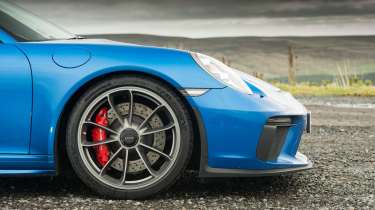
The 991’s adaptive PASM suspension was improved to be more compliant in Normal mode but offer greater control in Sport. The 991 also got dynamic engine mounts, which could tighten using magnetic liquid when driving aggressively, but keep the car compliant at normal speeds on the road. The brakes were also bigger, with 410mm and 380mm ceramic discs at the front and rear. The 991.2 featured revised rear suspension with helper springs, to improve traction and body control at speed.
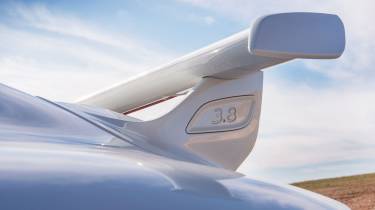
Aero was a significant area of improvement for the 991.2, with the larger rear wing mounted further back to put it in cleaner air, resulting in a downforce increase of 20 per cent. The Touring of course loses out on the rear wing. To alleviate the loss of downforce, the Touring got a Gurney flap on the active wing, which itself extends further upwards to balance the car at speed. The air filters and intakes are also revised, as the Touring loses the standard car’s ram inlets. The front is the most visually different element of the 991.2 GT3, with revised inlet profiles compared to the 991.1.
Driver’s note
‘Having to change gear the old-fashioned way in the 991.2 adds to the workload, but it unquestionably bonds you more closely to the process of going quickly, not to mention gives you tremendous cause for satisfaction when you nail your upshifts and downshifts for a whole lap.’ – Richard Meaden, evo Editor-at-Large
Performance, ride and handling
- Engine has stunning sound, reach and response
- Even more precision and capability than the 997
- Chassis revisions and manual option make the 991.2 the one to have
Twist the key in the 991.1 (set in its traditional position on the dash near the door) and the 468bhp flat-six engine starts with a more muted version of the familiar GT3 clatter. Select ‘D’ and begin manoeuvring out of the car park, however, and the feeling of the tight diff on full lock and the slight chuntering grumpiness of the drivetrain at low speeds signals that this is a car with only a thin layer of civility cloaking its race car internals. As soon as you have the wheel in your hands you feel hardwired into the chassis and every tiny shift it makes, which lets you drive it with fantastic precision.
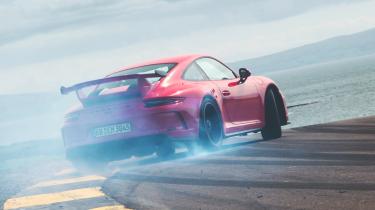
The front-end grip isn’t just astonishing for a 911, it’s astonishing for any car. And although the limits feel terrifyingly high from the passenger seat, when you’re in control you find the car is egging you on and encouraging you to drive it not only up to the edge of adhesion but well over it as well if you want. The breakaway that you assume would be snappy and unpredictable is as readable as a Wodehouse short story. And the stopping? Well, that’s just comical.
The engine is more than good enough to stand comparison with the old Mezger unit of the 996 and 997 GT and Turbo models. It lives to rev, starting to pull really hard at around 5000rpm and then giving its all from 7000rpm – the point by which you’d expect most engines to be giving up. From there to the 9000rpm redline the engine feels as rabid as anything, with a howling soundtrack that seems to have come straight from the track. And the ratios of the PDK gearbox are carefully selected to keep the flat-six in this zone when you’re in full attack mode.
The PDK itself works extremely well. It features a ‘Sport’ mode to sharpen gearchanges, and which will still work when the gearbox is left in ‘drive’ – revving the engine out to its redline and changing down aggressively to keep it in the zone. Alternatively you can take control yourself via the two paddles behind the steering wheel, which are smaller and nicer-feeling than those of the standard 991. The gear selector can also be switched to a manual channel, but one where you have to pull back to change up and push forward to change down – the opposite of the standard car, but what a ‘proper’ race car does.
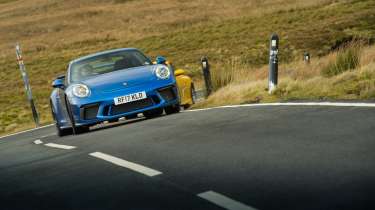
The steering is vastly better than in the standard 991, too. There’s more weight, but also proper communication. The GT3’s steering wheel tells you both when the front tyres are at their limit of adhesion, but also passes back messages about the surface you’re passing over. The rear-steer system, meanwhile, is almost invisible. Knowing it’s there you will feel a very slight sense that the car is turning around a pivot point further back than usual at low speeds, but when you add velocity it vanishes. The 991.1 GT3 came fitted with Dunlop Sport Maxx tyres as standard, which generate colossal grip. The car’s overall handling balance remains neutral right up to the limit, with levels of grip at both ends beautifully balanced. With the stability and traction control off the car will oversteer, but you don’t need to drive it sideways to feel that you’re getting the best from this remarkable chassis.
Impossible though it might seem, the 991.2 GT3 takes things to another level. The engine still utterly dominates proceedings, but the chassis’ ability and communication are stellar too. It rides firmly but never abruptly, with fabulous poise, and the revised steering is about as good as electrically assisted racks get: although not as transparent as an early GT3’s, it’s probably fair to say it tells you everything you need to know. Grip levels are extraordinarily high from the Michelin Cup 2 tyres, although introduce damp roads to the experience and it’s clear this isn’t a car to suffer fools lightly.
The upgraded 4-litre engine essentially offers two performance bands. Between 3500 and 6000rpm it is really, really fast, filling the cabin with a wall of rich flat-six noise. It is possible to drive around in this rev band and be utterly convinced that there’s nothing quicker on the road, right up until the moment you resolve to keep the throttle pedal planted, whereupon it simply erupts, sending a tingling resonance up your spine at 6500rpm and wailing dementedly with the sweetest, hardest-edged note imaginable. That takes you to 8000rpm. The last 1000rpm is just madness.
It’s a deeply immersive experience, and that’s why the manual gearbox suits it so well. The shift quality is much less demanding than the stiff, weighty mechanism in the Mezger engine era, but it’s still very precise and tactile. As with all those 996 and 997 GT3s, sometimes it’s just nice to drop the windows and take it easier, revelling in the sound of the engine, executing a neat downchange, enjoying the sensations of being in a really special and engaging car. In many ways it’s those moments that stick in the mind as much as the pin-your-ears-back-rapid ones.
Driver’s note
‘Of course, the 991.2 GT3 isn’t soft by any normal benchmark, but relative to the significantly stiffer and solid-mounted GT3 RS it feels much more rooted in road use. The manual transmission adds a layer of interaction, too.’ – Richard Meaden, evo Editor-at-Large
Interior and tech
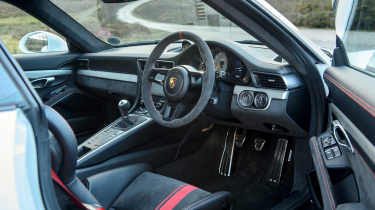
The 991’s interior might be the best of all GT3s. It benefitted from a huge bump in design, fit, finish and material appointment over the 997, and is purer and less digitised than the later 992. It had reasonable equipment levels, although the relatively small and fiddly PCM infotainment system does feel out of date now. The payoff of the 991’s age is a more timeless ergonomic layout than later cars, with plenty of physical switchgear and analogue clock faces.
The optional Clubsport package added a roll cage and bucket seats. However, those buckets are changed from the Carrera GT-sourced units of the 997, to the rigid carbon items found in the 918 Spyder hybrid hypercar. The biggest change to the interior for the 991.2, aside from improved infotainment, was the smaller 360mm GT steering wheel, also 918 Spyder-inspired.
Embraced by those carbon seats, you sit really low in the GT3, peering over the dash top even if you’re six-foot plus in stature. Despite their appearance, the buckets are comfortable on longer journeys, as well as being superbly supportive.
Porsche 911 GT3 (991) buying checkpoints
Not long after the first 991.1s hit the road, numerous owners reported engine issues, ranging from misfires to catastrophic failures. Following an investigation, Porsche disclosed that the issue was related to a defective batch of valve train rocker arms, something that had the potential to cause significant damage elsewhere in the unit. As a result, all 785 GT3s delivered up to that point were recalled and fitted with brand new engines – these are often referred to as the 'G6' unit.
While complete replacement of the defective units should mean you won't experience any engine troubles, plenty of owners have seen failures since. Aside from oil analysis to check for excess wear and a listen for any concerning engine bay sounds, there's not a whole lot you can look for prior to purchase to ensure a particular engine is strong. Regardless, Porsche has carried out warranty repairs on cars up to 10 years old, but it’s probably best not to bank on this should the worst happen. Opt for the more pricey 991.2, and you can avoid the engine problems altogether.
Elsewhere, the 991 GT3 is typical Porsche, with electrical issues almost unheard of and build quality top notch. Just be aware that GT3s are likely to have lived hard lives of track and vigorous road driving. It’s what they were built for and it’s what owners will have rightly indulged in over the years. Look for impeccable service history and good life in the regular consumables (tyres, brakes) at an absolute minimum.
Thirteen years since the 991.1 made its debut, you can find relatively clean examples for around £75k – not much more than the price of a new BMW M2. Stump up an additional £10,000 and 991.1 cars with under 20,000 miles come into reach, with 991.2 models costing at least £100k.
Porsche 911 GT3 (991) specs
| 991.1 Porsche 911 GT3 (2013) | 991.2 Porsche 911 GT3 (2017) | |
| Engine | 3.8-litre naturally-aspirated flat-six | 4.0-litre naturally-aspirated flat-six |
| Power | 468bhp @ 8250rpm | 493bhp @ 8250rpm |
| Torque | 324lb ft @ 6250rpm | 339lb-ft @ 6000rpm |
| Weight | 1430kg (DIN) | 1413kg (manual), 1428kg (PDK) |
| Power-to-weight | 327bhp/ton | 355bhp/ton (manual) 345bhp/ton (PDK) |
| 0-62mph | 3.5sec | 3.9sec (manual), 3.5sec (PDK) |
| Top speed | 196mph | 198mph |
| Price new | £100,540 | £111,802 |
| Value today | From £75,000 | From £100000 |