Porsche 911 Turbo S Cabriolet review – a 701bhp answer to the Ferrari Amalfi Spider
At £209,100 the new Turbo S Cabriolet is currently the most expensive 911 on sale, and the most powerful. Is it the ultimate open-top supercar?

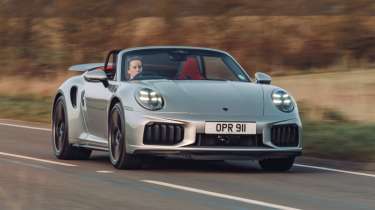
On paper the new Porsche 911 Turbo S Cabriolet is a purists nightmare. It’s the heaviest 911 on sale, for one, at a chunky 1810kg. Like all 911s bar the Carrera T and GT3 it’s PDK only, and this latest 992.2 generation Turbo has gone hybrid, with the added complexity and weight that brings. It’s also four-wheel drive and carries the inherent disadvantage of being less rigid (and 85kg heavier) than the coupe. On paper, it’s certainly not the configuration we’d choose for our perfect 911.
You’d be a fool to dismiss it though, because this latest Turbo S has already deeply impressed us in hard-top form. It’s not the most visceral and interactive 911, but it may well be the best in terms of all-round ability and real world pace. With over 700bhp from its hybrid flat-six and a more sophisticated chassis than the 911 GTS (from which the Turbo S derives its hybrid system), it’s a brutally effective car. So it needs to be to justify its £199,100 asking price, and go head to head with capable and charismatic GTs and supercars like the Ferrari Amalfi and McLaren Artura.
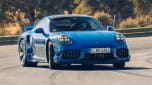
The Cabriolet costs £10k more than the coupe, making it the most expensive 911 on sale, and gets the same mechanical package. That means the aforementioned hybrid flat-six, borrowed from the GTS and displacing 3.6-litres. The Turbo S gets two ‘eTurbos’ in place of the GTS’s single unit, which spin up with the aid of electric motors to improve response, plus an e-motor built into the eight-speed PDK gearbox. The net result is 701bhp and 590lb ft, which is sent via a variable four-wheel drive system.
More reviews
In-depth reviews
- Porsche 911 Carrera GTS review – why Porsche's T-Hybrid is also one of the best
- Porsche 911 Targa review – the opposite of a purists 911, but still superb
Long term tests
Reviews
- Gunther Werks Turbo review – part Porsche 911 Turbo, part hypercar
- Porsche 911 Turbo (1974 - 1989) review – why the 930 was the original 911 wild child
- Porsche 911 GT3 S/C review – does a convertible GT3 really make sense?
- Porsche 911 (992.2) GT3 Manthey Kit review – a road-legal race car with a warranty
In your first few miles in the Turbo S there’s a looming temptation to feel the full hit of that power. It’s so undemanding to drive that you’re goaded to exploring its potential, and the first time you pin the throttle, the forward thrust is startling. It’s undramatic in a way, since even with the roof down the engine doesn’t have a hard-edged soundtrack, but the accelerative force is startling at kick-down, and is sustained through the gears and the full sweep of the rev band. It’s worth holding on for the last 1000rpm too, as the thrust intensifies right up to 7000rpm.
The GTS sounds grittier and already has huge performance and flexibility on the road, but the Turbo S takes that up two or three notches, and throws in a little more turbo whoosh for good measure. And you’re going far too quickly to notice the fact that 62mph is ticked off a tenth later than in the lighter coupe, at 2.6sec. The 200mph top speed is unchanged, presumably due to the fact that the profile of the cab is similar to the hard-top’s with the roof up. With it down, the car looks unbalanced somehow, the rear being bloated with an unusually high decklid (which also hampers your rearward visibility.)
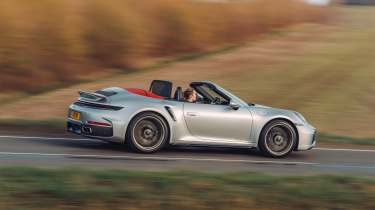
Buffeting isn’t intrusive, though, and there isn’t the horrible resonance and turbulence you get in a Targa at speed. It’s well controlled on the motorway with the electronic wind deflector raised, too, which makes the cabin less blustery with the penalty of some extra wind noise. The Turbo S Cab is a very adept cruising car, the connected low-speed ride smoothing out at speed – aided by a bespoke PASM damper calibration that gives it a less direct, more rounded edge than a GTS Cabriolet.
There’s also an ehPDCC (electro-hydraulic Porsche Dynamic Chassis Control) system that uses active anti-roll bars to minimise roll. The body does stay impressively flat under load, but compared to a GTS, there is an extra layer between you and action. The GTS feels more natural with a grittier edge to the driving experience, although some will appreciate the Turbo’s extra compliance and monstrous flexibility.
Twist the drive mode dial to Sport Plus and the engine response is even keener, and the dampers firm up – although the softest mode has control to spare most of the time. There’s a constant slight tremor through the steering rack but by and large the structure feels solid, with only really poor surfaces revealing less clarity and precision than a coupe. This gives you confidence to attack, and the way the Turbo S can deploy its potential is quite remarkable. Traction is resolute unless you punch hard out of corners in the lower gears, high speed stability is mighty and while it has a more heavy-set feel than a GTS, you can still hustle it through tighter corners and direction changes with massive commitment.
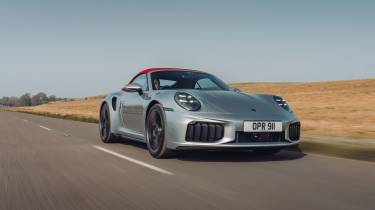
Overall though, you marvel at what the Turbo can do rather than being truly pulled into the experience. It’s a well worn Turbo cliche but it does feel like a point-and-shoot kind of car. You squirt at warp speed between the straights, jump on the brakes (which have excellent feel and power) to dial everything back, and then monster through corners. Push hard and you can feel traditional 911 traits – weight transfer is a powerful tool to help the nose in, and the rear kicks wide under power but still finds immense forward drive on the way out – but the speeds required to reach this point are high.
Most Turbo S buyers probably won’t go there very often. Its appeal is in its usability, and the unburstable nature and sheer quantity of performance rather than outright excitement. Despite sharing its engine with the GTS it does feel like a different character, more effortlessly strong and rounded, less exciting. As a drop-top it’s a multi-talented supercar with very few compromises, but for over £60,000 less (yes, you read that right) the GTS is a more charismatic car, that’s still as livable – and blindingly quick – as most people would need. It may be the most powerful and expensive 911, but the Turbo S Cab isn’t the one we desire most.
Price and rivals
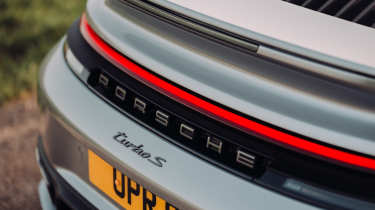
The Turbo S Cabriolet’s £200k+ price tag places it into battle with lower-end supercars and GTs from the likes of McLaren, Aston Martin and Ferrari. Serious company, but in terms of outright capability and bandwidth the Turbo S can live with them all.
Desirability is another matter though. Ferrari’s Amalfi (now available in Spider form) lacks the Turbo’s all-round pace, but it’s among the most usable Ferraris and expertly blends excitement and touring abilities. Aston’s Vantage Roadster is a more brutal take on the theme, and the McLaren Artura Spider is a much more focused and vivid driver’s car than any of them, while retaining an impressive level of compliance and hybrid capability.