New Aston Martin DB12 S review – Forget Bentley, Ferrari should be worried
Comprehensive dynamic upgrades not only make the new Aston Martin DB12 S a better GT car, but it’s now a far better performance car, too

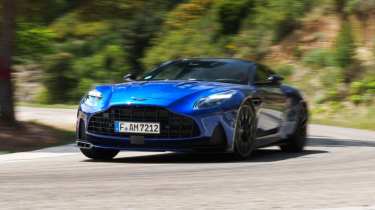
This is Aston Martin’s third new ‘S’ model in what feels like as many months. DBX707 and Vantage have both recently gained the extra letter in their nomenclature to create the DBX S and Vantage S, receiving some minor updates along the way. For the DB12 S the changes are far broader, more in-depth and detailed.
'With (DBX)707 and Vantage we were already close to their optimum performance, the work required to create the S was more fine tuning to create a step between them and the base car,' explains Neil Hughes, Head of Product Management. 'With the DB12 we had a much broader window to work with, an opportunity to go further and create a more distinct, more focussed car.'
A more focussed, more performance orientated DB12 might set off a few alarms. Aston’s DB11 replacement arrived with a level of aggression that resulted in a GT car that thought it was a supercar, feeling highly strung, unsettled and more than a little confused. It looks like a GT car, a stunningly elegant car and Aston’s finest work of its current line-up, and feels like one when you’re inside with beautiful detailing and a quality that puts Ferrari to shame. Even Bentley struggles to match the DB12’s interior in many areas. But how it drove was muddled. Hyperactive, unsettled and a little confused as to what it’s trying to achieve.
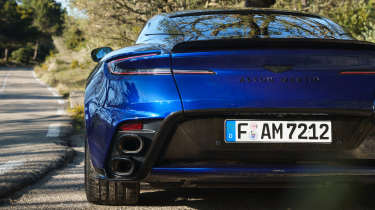
There is some immediate good news within the first couple of miles in the DB12 S: the hyper-activity and sharp edges of the DB12 have been smoothed over and calmed down. It’s when we’ve been travelling for a good six, seven kilometres that it dawns on me that the road surface is UK spec but the 12 S isn’t fazed by it. Its steering wheel is calm in my palms, the interior isn’t creaking under the inputs shooting up from beneath.
More reviews
On motorways the S demonstrates that it has lost none of its GT credentials. Its motorway speed composure not only calms the fidget the standard DB12 is prone to but there’s more composure throughout the car and less road noise (specifically tyres) giving it a Bentley-eque level of cruising comfort. It’s now a DB model that feels like you could sit on an autoroute all day for a gentle hop from Calais to Cannes.
Hughes talks with a calm passion about the detailed changes the DB12 S has undergone, from the styling upgrades that are aero defined - not in a downforce chasing way, but to improve airflow over, through and under the car to aid cooling - to the chassis that’s been recaliberated to a whole new level. The car’s Bilstein DTX dampers have come in for particular scrutiny.
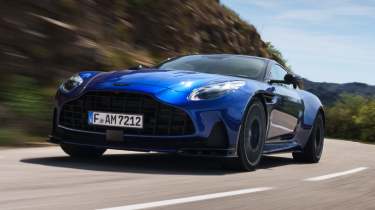
‘The range of damping control from full drop to full compression was previously non-linear. So as you got to the extremes of the full rise and then full compression, you’d get an increase in the damper rate’ he explains. ‘So as you come over a crest or run over a lump in the road the car would rise and suddenly clamp down generating the “lifting out of the seat moment” - that sudden loss of gravity feeling we’ve all experienced.’
The aim was to create a more predictable and consistent chassis performance - ‘it’s more measured and linear throughout’ add Hughes – where the car breathes with the road more consistently and evenly. Counterintuitive for what is meant to be a more focussed S model? Possibly, but the result is a night and day shift from the standard car.
That calmer ride is immediately evident, the S’s composure eradicating any nervousness that would creep through you and the car previously. Small surface imperfections evaporate between your eyes seeing them and you running over them and you barely, if at all, feel anything. Fractured surfaces and subsidence induced cambers barely challenge the Michelin Pilot S 5 tyres.
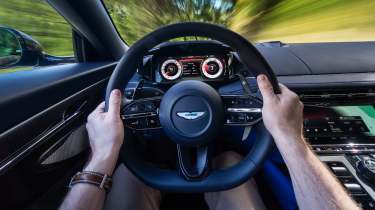
What’s been apparent since the off is a new, high level of calmness and fidelity through the steering. There was constant fidget from the original’s helm, a level of hyperactivity that was borderline distracting when the surface became a challenge or you began to ask too much of the rubber. There was sharpness and directness but you felt you were working against it more than you were working with it.
‘With the original DB12, to achieve the self centring we wanted we had to put negative torque into the steering to bring it back in line to keep the weight at an appropriate level for the car’ explains Neil. The result was a set-up designed to sit in the middle ground of heft and lightness, which meant it could also feel inconsistent and distracted at times. With the S, Hughes and his team took the decision that its steering could be a little heavier due to the direction they were taking the model and that customers would expect a set-up with more weight to it.
To achieve this the self centring electrical assistance has been backed off requiring less torque intervention and essentially adding an artificial caster. ‘We’re using the natural hysteresis from the tyre, so where the contact patch sits and the natural spring rate you get between the wheel and, we’re feeding that back up the steering column to allow you to manage the steering corrections. It’s as natural as you can get with an EPAS system’ explains Neil.
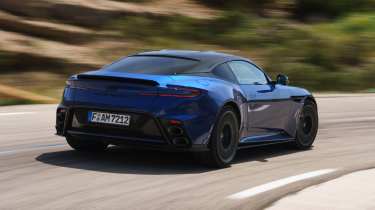
It’s the best steering I’ve experienced on the current front-engined Astons. Its calmness is matched to a linear response that’s so precise and accurate you can roll the wheel between your fingertips with near absolute certainty, those 21in Michelins going exactly where you want and need them to go.
Build your speed and the front latches on to turn-in, apex and exit points with a sharp clarity making what is a large car feel far more dynamic and hooked-up than before, like your hips have a direct connection to the ground and the S is arcing around you. There are no camber or caster changes, it’s as natural a force as possible feeding back to you and it’s addictive.
Where there have been geometry changes is to the rear. Roll stiffness has been increased by seven per cent thanks to an anti-roll bar that is half a millimetre wider, which allows for more load to be put through the outside rear tyre to maintain the contact patch. ‘The idea behind this was to create a greater degree of low speed agility. For obvious reasons we didn’t want to do this at high speeds, but we did want to create that feeling of a slighter shorter wheelbase’ says Hughes as he walks us around the S.
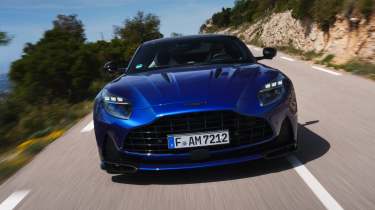
It means the DB12’s skittishness is gone, the traction far better controlled, the e-diff able to work harder for you.Turn-in with more speed than you thought possible, feel the nose arc around the curve, the centre pivot with utter conviction and the rear load up, manage the torque between the two rear tyres for the cleanest, sharpest exit.

Hughes explains that changes to the diff in terms of removing the tightness means as much load as possible is taken out of the diff to aid turn in (too tight a diff causes ‘push’ through a corner). Its quicker reactions and lack of lag as it unwinds delivers that instant steering response.
The DB12 S feels like a totally different car to the original. You can position it so cleanly, feed it through quick fourth gear kinks or place it on its nose at the heart of a hairpin and it feels solid and controlled with a natural intuition for what you need it to do next. On a road this technical with its spectacular views the DB12 S initially felt like a brave choice to take it on, but as more sky and breathtaking vista fills the windscreen it’s demonstrating with fearless confidence that it’s up to the challenge.
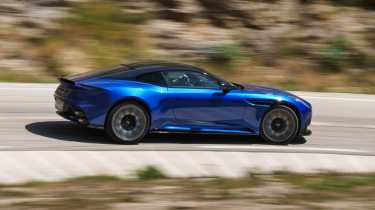
Cars of this type require a more measured approach. They don’t respond well to being hurried or hustled, they want to ebb and flow, cruise rather than pummel the straights between the corners and crush the braking zones. The S is different.
There’s some Vantage-like feral attitude within it and Vanquish-like monster performance when required. Its limits are high but approachable, the DB12’s solid foundations (there’s still DB11 in here and that was far better to drive than it was put together) have provided a platform for Hughes to create a DB12 they always knew was within the car.
Such confidence is evidence of the modest power increase for the 4-litre hot-vee twin-turbocharged V8. Now sanctioned to open up the AMG supplied motors Aston Martin has chosen not to for the 12 S. Rather they have rewritten the engine map to provide you with a sharper, more accelerative top end when the tacho sweeps by 6,000rpm.
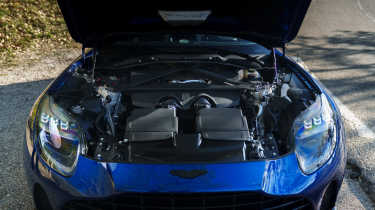
The 20bhp increase to 690bhp (torque remains at 590lb ft) is more a byproduct of the goal rather than the target. Coupled with increased clutch pressure in the first three gears the S is far less trigger-happy on the throttle. You notice it out of slower corners, your muscle memory telling you to be measured with your right foot so as not to spike the DB12’s rear tyres, a memory forever etched on anyone who has given an original everything it has at low speed.
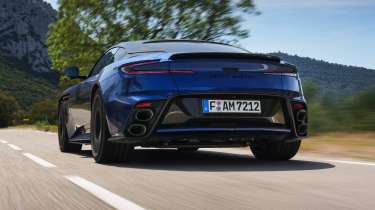
These engine tweaks combined with everything that has gone into the dynamics - both hardware and software - make the S a better, much calmer GT car in GT mode, a purer sports car in Sport and an enthralling beast in Sport +. With the original DB12 the feeling was of a car confused, one that didn’t know, or perhaps understand, its remit. Too harsh and nervous as a GT, not precise or engaging enough as a super sports car.
The S resolves all this, its ability to flow like the very best GTs and excite as a super-sports car addresses the frustrations of the original. An Aston Martin that can deliver the go to match its beguiling show.
Price and rivals
Aston Martin’s £211,500 DB12 S lines up between Bentley’s new £212,500 Continental GT S and the headline £251,00 Continental GT Speed. Both Bentleys feature a hybrid powertrain while the Aston Martin is pure internal combustion engine and feels the more engaging for it. The fourth generation Continental GT is the best the firm has built, with the chassis hardware combining to deliver the most precise and athletic driving experience the model has offered. Close enough to match the Aston? We’ll need a back to back test to answer that, but our suspicion is the Aston would get the nod over either GT.
Another new front-engined, twin-turbocharged V8 super-GT car the DB12 S might want to go toe to toe with is Ferrari’s new £202,459 Amalfi. The Italian is another step up from the impressive Roma and focuses more on performance and dynamics than being a GT car. But the Aston Martin DB12 S has the potential to run it close.