New Bentley Continental GT S review – the sweetest Continental aimed at Aston Martin's DB12
The advanced chassis of the Speed matched to a less powerful hybrid powertrain creates possibly the best Continental GT you can buy

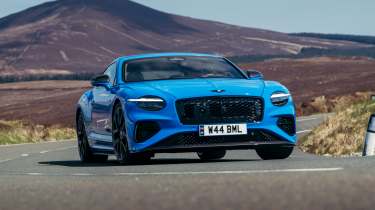
Until now Bentley’s Continental GT family has been split into two distinct camps: The Mulliner and Speed are the flagships featuring Bentley’s 771bhp Ultra Performance hybrid powertrain, while the GT – or ‘Core’ in Bentley speak – and Azure make do with the company’s 671bhp High Performance Hybrid powertrain. The new S takes the latter, featuring VW Group’s ubiquitous 4-litre hot-vee twin-turbocharged V8 with clipped wings for 512bhp on its own – 79bhp less than the Speed and Mulliner models.
Not that you notice this power dip in the S. You’re met with silence from the electric motors as you pull away, the 188bhp e-motor – identical across all Continentals – whisking you along for up to 50 miles at speeds of up to 80mph. Impressive, yes, but the S has much more to offer, even over its identically powered siblings.
Wake the V8 and the woofle is deep chested, meaty and meaningful, albeit one supported by the optional Akrapovic titanium exhaust fitted to our test car. Introduce a degree of throttle and there’s a hint of the S rocking gently back on its haunches, its rather bluff nose rising and the rugged edges of the Isle of Man’s mountain course becoming a little blurred. Third quickly becomes the meat of the fourth gear and the big Bentley finds its rhythm and flow, the V8 welcoming every additional 188bhp of boost from the e-motor. At no point do you feel bereft of the 100bhp it loses to the Continental GT Speed.
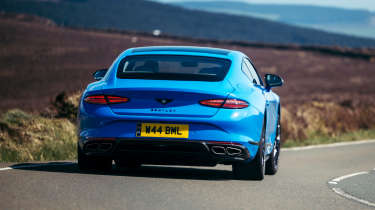
The speed you can carry through corners is higher than your muscle memory remembers a regular GT capable of managing. Directional changes are more precise. It’s sharper, quicker and more precise in its responce to your inputs. There’s less lean, too, more resilient body control and a clearer understanding of the front and rear axle’s behaviour. It makes positioning the GT S on a tight road a more relaxing process. That’s because while it shares the core model’s powertrain, it blends it with the Speed’s more advanced and technical chassis.
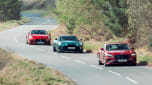
Connecting its four 22-inch alloy wheels is Bentley’s Performance Active Chassis that includes active all-wheel drive, the GT’s electronic diff, all-wheel steering and torque vectoring that works front to rear and across both axles. Dual valve dampers and two-chamber air-springs and active anti-roll bars all find their way under the S’s body, too, informing its compelling cornering talents.
More reviews
Group tests
In-depth reviews
- Bentley Continental GT review – not Ferrari sharp, but still the ultimate grand tourer
- Bentley Continental GT (Mk3, 2018 - 2024) review – ultimate luxury meets performance
Reviews
- New Bentley Supersports review – 500kg lighter Continental GT is the best yet
- Bentley Continental GT Speed 2025 review – driving the most powerful Bentley yet
- Bentley Continental GTC Speed 2025 review – huge power, huge weight, huge price
- Bentley Continental GT W12 (Mk1, 2003-2010): the car that saved Bentley
This set-up lifts the GT S to another dynamic plane, not simply a singular and focussed one but a more rounded, immersive experience. You can thread the big Bentley along with an unnerving level of confidence, with natural, true and seemingly delay-free responses to your inputs. There’s no hesitancy when you need to make small directional adjustments and in bigger, longer curves the S has no interest in straying from your chosen trajectory. Its calmness and accuracy at high speeds is equally reassuring and impressive.
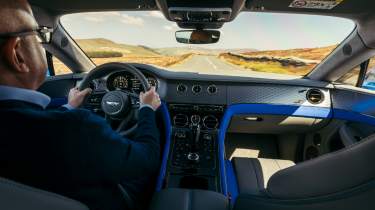
The changes Bentley has made to the S over a GT’s chassis aren’t as involved as those Aston Martin’s efforts to evolve the DB12 into the DB12 S. Headed by the soon-to-depart Markus Thiel, who will soon head up Audi’s engineering department, the team have leant heavily on learnings from developing the most extreme Continental GT: the rear-wheel drive Supersport.
“We have given the S its own character, it would have been easy to just use what we have on the Speed and transfer it to the S but we have learnt so much from the Supersport we knew some of this understanding would help provide the S with its own character,” he explains.
The character is a more assertive car when you ask more of it more frequently. On roads that provide less opportunity to call upon all 671bhp in the higher quartet of its eight-speed double-clutch gearbox but do provide a test of its more detailed dynamic attributes, the S is perhaps more impressive. Through 90-degree second gear corners, blind entry and exit third gear sweepers that command accuracy and precision, the S is unfazed where the softer, less primed GT might be.
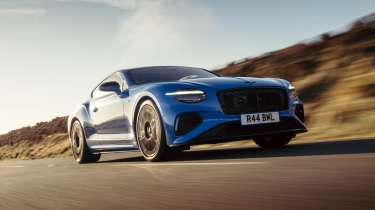
It supports its weight, all 2459kg of it, with more conviction so you can get the nose into a corner knowing it will stick. You can feed in the throttle the moment the corner – and your vision – opens up, feeling the torque split across the rear axle as the diff spreads the load. The S picks an attitude that straddles a composed all-as-one four-tyres smearing the surface with the slightest over rotation of the rear wheels to push you through the exit.
The measured and calm process means there’s no requirement to jump out of the throttle, rather simply stay as you are and drive forward along the next straight. Through quicker curves the loads you can put through both outside Pirelli P Zeros without a hint of push is a match for any modern supersaloon with far more sporting pretence.
This fourth generation of Continental GT has impressed from the off. Its composure, dynamism and level of engagement feeds back a considerable step up from its predecessors. It has shone against key rivals from Aston Martin and Maserati based purely as a GT car and has held its own when the comfy shoes are swapped for trainers. In the S it still feels like a GT car should, but one that’s carved its own niche and uses its more dynamic focus to maximum effect.
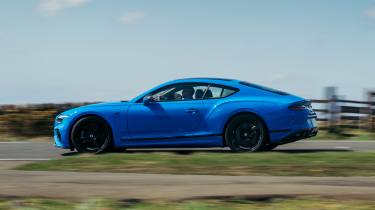
Where it does feel exposed against its performance narrative is inside. Like all Bentleys, it delivers an interior of supreme confidence with its high-seated driving position and general controls providing the peerless experience you’d expect from one made in Crewe. But when you tap into the S’s performance those big, broad shouldered chairs don’t offer the best support and you become aware you’re sat on rather tahn in the cockpit. The paddles behind the steering wheel aren’t the most engaging, nor the downshifts as quick as you sometimes want them to be.
Considering the weight they’re hauling back the brakes – cast-iron as standard with Bentley’s carbon-ceramics an option – offer strong retardation and consistent pedal feel; they still allow for those seamless and silky smooth chauffeur stops where the passenger is only aware you’ve come to a halt when the door is opened for them. A consistent pedal travel means you can modulate the rate at which you wish to shrug off speed, which helps keep it all balanced and prevents you from turning in with the nose still snorting the tarmac. With the repeated heavy use needed when running back and forth for a photographer, some whiffs of white smoke waft up from the pads between the wheel spokes, but that’s quite an extreme, specific scenario.
Even with Bentley’s push for a younger audience, you don’t have to follow the trim of the S we tested – please don’t, the interior was a challenging combination of light grey and bright blue. There’s some bespoke detailing the new model carries to identify it, such as the front and rear diffuser finished in Beluga black and blackline trim for lettering and badges. And there’s a new 22-inch wheel design, too. Inside there’s a unique colour-split for the S that features Dinamica inserts in place of leather. Being a Bentley, colours and trim are only limited by your budget, the team at Mulliner more than happy to help you realise your fantasy spec.
Price and rivals
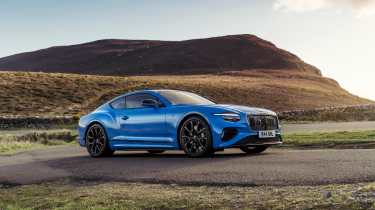
Talking of budget, the S commands a £12,100 premium over the GT but offers a £38,500 saving over a Speed, which in the strange world we live in makes it a bit of a bargain (‘bargain’ doing a lot of heavy lifting here). A good car has never been all about its power output and the Continental GT S demonstrates this to a tee.
Aston Martin’s DB12 starts at £197,500 with the soon to be reviewed (6 May) DB12 S starting at £211,500 the Continental GT S is more expensive than both at £212,500. Maserati’s V6-engined GranTurismo Trofeo looks a relative bargain with its £150,850 price. But for all its Italian charm and excellent GT credentials it falls short dynamically against its rivals. If you’re willing to forgo four-wheel drive and some space, Ferrari’s brilliant new £202,459 Amalfi should pique your interest – a different approach to the GT car but the most thrilling.
Specs
| Engine | V8, 3996cc, twin-turbo, plus 140kW electric motor |
|---|---|
| Power | 671bhp (combined) @ 6250rpm |
| Torque | 686lb ft (combined) |
| Weight | 2459kg (277bhp/ton) |
| Tyres | Pirelli P Zero |
| 0-62mph | 3.5sec |
| Top speed | 191mph |
| Basic price | £212,500 |