Aston Martin Vantage S review – does it offer enough to take on Porsche's 911 Turbo S
Tweaks to the chassis and aero, plus more power and attitude – in S form, one of our favourite Astons promises even bigger thrills

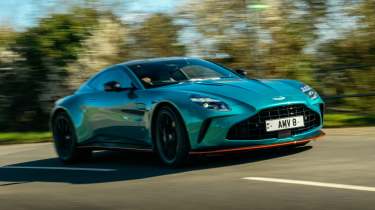
Walking up to a new Aston Martin Vantage early in the morning, spring sunlight catching the droplets on the paintwork, it’s hard not to stand and stare for a moment. There are a lot of modern cars that make you squint a bit, or ask you to take some time to acclimatise to their looks in order to appreciate them. But there is no need to adjust to any new design language or understand complicated aero decisions with the Vantage and the new £175,000, 671bhp Vantage S, here to rival Porsche’s 911 Turbo, Ferrari's Almalfi and McLaren’s Artura, is no exception.
For me, it is the best-looking model in the current Aston range. Compact but with plenty of One‑77, it wears its bodywork very much the way Daniel Craig’s 007 wore a suit, leaving no doubt about the musculature underneath.
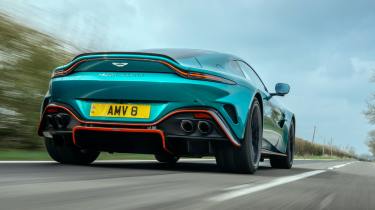
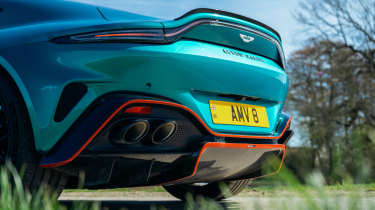
The S has slightly deeper vents in the bonnet, complete with new blades in black or carbon, and there is also a small carbon lip on the distinctive ducktail. The latter apparently adds another 44kg of downforce at the Vantage S’s top speed of 202mph and there are some additional aero additions on the underside of the car, but none of it does anything to significantly disrupt or indeed elevate the standard car’s fabulous form.
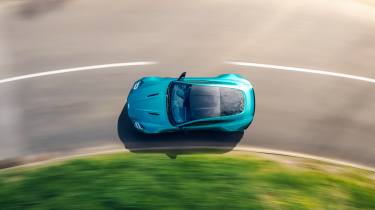
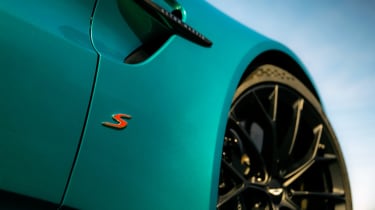
Overall, I think it’s fair to say that the aesthetic changes to the S are subtle. Which is perhaps why Aston has gone to town on the single-letter badging. On the seats, the upper shoulder panel is emblazoned with a large ’S’ that apparently takes over 16 metres of thread and 2500 stitches to create. On the outside you’ll find the 19th letter nestled behind each of the front wheels, while the handmade badges here are brass forged and filled with red glass enamel. You can have either bright or dark chrome to match whichever wings badge you choose on the bonnet.
More reviews
Carrying luggage? Lift the rear hatch and there is plenty of boot space. Not something to make you fall in love, perhaps, but it’s nice not to have to squash and squeeze your goods and chattels into an afterthought of a cubbyhole. Again, it makes the Vantage easy to like – and to imagine using and living with it every day.
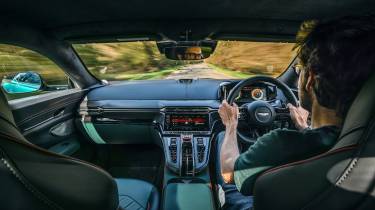
Swing out a swan-wing door on its shallow, graceful arc and, as you step inside, your eyes are drawn, magpie-like, to the rotary switch that surrounds the glass start/stop button. It’s a detail that has always been a tactile delight, but in the S it’s a feast for the eyes as well because you can have it anodised in silver or, as in this test car, red.
The S also furnishes the interior with a special Alcantara and leather combination; our test car had the Sports Plus seats, which, despite the name, are actually the comfort option. Given the choice, I’d opt for the Valhalla-style padded carbonfibre buckets simply because they sit you a little lower and hold you a touch tighter. They would also match the carbonfibre trim that comes as standard with the S and replaces the parts that normally look like they’ve been hewn from a Steinway piano.
Engine, gearbox and performance
But back to that start button. Press it and you get a nice moment of traditional shrill starter motor before the basso profundo V8 kicks in. It’s a rumble that may well penetrate the slumbers of the neighbours, but legislation has ensured they’ll likely be back in dreamland before they’ve had time to plump the pillow. Just right, in other words.

I’m up with the lark to get a clear run at some decent roads not too far away; the early bird drives on the empty worm, or something like that. A few slower, more measured miles across country are needed first, however, and the Vantage S has a slightly impatient demeanour. It tries hard to pretend it’s happy just pottering, but it has the feeling of a well-trained gun dog that’s staying to heel because it knows it must while simultaneously remaining on constant canine DEFCON 1 for the merest sniff of a chance to be let off the leash.
The engine is still the same 4-litre, twin-turbo V8 with its origins in Affalterbach, but it’s an engine that shouldn’t be taken for granted because both its performance and character are from the very top drawer. Torque remains exactly the same as the standard Vantage at 590lb ft, but a touch more power has been tickled out of it, raising the total a whole two per cent from 656bhp to 671bhp at 6000rpm.
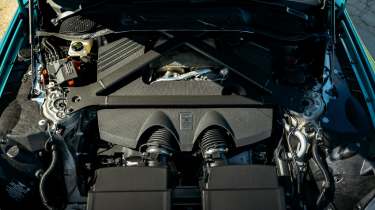
The monstrous reserves of torque mean it’s easy to travel quickly while still short-shifting, but this also leads to the slightly uneasy sense that it could all get a bit out of hand when you unleash the full potential of the V8 on the rear wheels of what feels like a very short wheelbase. Only one way to find out.
Turn right at a junction and a long, clear straight opens up ahead. This is what the Vantage S has been waiting for. Second gear, delve deep into the throttle travel and… holy moly it’s quick! The initial response is impressive and there’s more than enough performance to unstick the 325-section rear tyres. It’s the top end however that’s the real surprise, because what feels like a big-displacement muscle-car most of the time then revs really cleanly and quickly towards the limiter. It’s not the highest-revving engine, but there’s no sense it’s tying up at the top end.
This is big-league pace and no doubt about it. What’s more, it’s not the clean, clinical lunge of an EV but the slightly messy old-school punch of a traditional internal combustion engine that makes everything seem that much more visceral. The way you rip through the gears with the long paddles adds to the slightly frantic nature of the charge down the road, and the sound elevates the shock-and-awe assault on the senses still further.
Aston claims that some optimisation of the launch control has shaved a whisker off the 0-62mph time, bringing it down to 3.4 seconds, and while that’s not a time that will make headlines any more, it’s definitely the sort of acceleration that feels really exciting. It also occurs to me that it’s only a tenth of a second behind a McLaren F1, and that seems pretty extraordinary.
Ride and handling
The chassis changes for the S seem to be the sort of give-and-take adjustments that come through ongoing development rather than big upgrades that were always part of a plan. The rear subframe is now bolted directly to the body instead of using rubber bushes.

By contrast the transmission-mount stiffness has been reduced by ten per cent and the rear spring aids have been softened. Tweaks have also been made to camber, caster and toe for the suspension (still double wishbone at the front, multi-link at the rear and anti-roll bars both ends), along with some fine-tuning of the hardware and software for the DTX dampers.
The dampers deal superbly with larger movements and there is a real quality to the way the 21-inch wheels soak up speed bumps and roll through a continuous catalogue of craters. However, there is also a tautness to the secondary ride that means it never entirely relaxes.
There is a certain amount of tyre noise from the Pilot Sport S 5 rubber too; meanwhile the default mode is Sport (there is no Comfort or Normal mode), the creep from the auto is surprisingly aggressive when you release the brake, and the 12.8:1 steering ratio is very quick. All of these things are a reminder that this is meant to be more focused than a DB12.
Criss-crossing the countryside on my early-morning canter, it took me a while switching between the various dynamic modes and then a few more miles altering single settings in Individual mode to really dig into what the best combination of settings might be.
In the end I felt that the best way to dial it all in for fast driving was to have the dampers in their Sport Plus setting, controlling the bigger movements marginally more tightly, but then backing the steering off to its less resistant Sport setting. Exhaust volume and throttle response could be adjusted to taste.
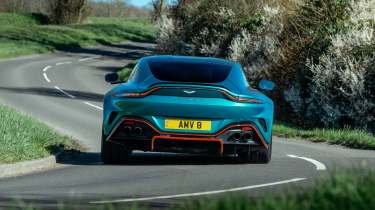
It’s a car that really needs to be grabbed by the scruff of the neck and driven hard to get the best from it, but initially it takes a bit of a leap of faith to do that. The chunky-rimmed steering wheel has plenty of weight and directness but it lacks feel and fluidity at first, so it doesn’t immediately inspire trust. There’s also a sense that the car might be a bit spiky once you get to the limit, so it feels sensible to be a touch timid. In actual fact it’s the opposite.
You can’t edge up to the limit, you’ve just got to get stuck in. But load up the chassis, push the tyres and you’ll find that the Vantage S is remarkably friendly. You can really lean into the systems too, because both the slightly looser Track setting for the ESP and then the eight steps of traction control when you turn the ESP all the way off are hugely reassuring if you call on them. Combined with the e-diff, they make for a car that is surprisingly confidence-inspiring at the limit and easy to catch when it starts to slide, even when the surface is damp.
There can sometimes be a bit of lingering boost pushing you on when you first back off the throttle, but the optional carbon brakes on our test car (410mm at the front, 360mm at the rear) are very reassuring. Just as it’s easy to get a bit lateral under acceleration, so the Vantage S doesn’t feel totally locked down under really hard deceleration either, but the slight squirm always feels nicely controllable.
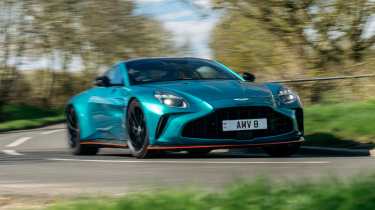
To be honest I think you’d need a back-to-back drive with a standard Vantage to really appreciate the differences the fine tuning has made. My impression is of just a touch more directness to the way it turns in, with a little more response from the front end, but it certainly hasn’t changed the fundamental character of the car. You wouldn’t call it more hardcore or a track version, and Aston hasn’t seen fit to make a step up to Cup 2 rubber or anything like that.
It’s a real rush driving the Vantage S quickly, but I think that endearing eagerness to its character also means it isn’t a car that feels content settling for six or seven tenths and just flowing down a road like you can in a McLaren or the best Porsches. It comes into its own at pace, when the suspension seems to gel and you feel a greater sense of connection with the steering, but that also means finding a wide enough, fast enough, quiet enough bit of tarmac to be able to push the chassis with some freedom.
You can get flashes of instant gratification from quick stabs of acceleration, but for real satisfaction you crave the right bit of road and the next opportunity to really open the taps and work the treadblocks. It’s a bit like one of those magic eye images where you have to put in a bit of time and effort in order to see the full picture; you can’t just glance at the pretty pattern in passing and reveal all the hidden depths.
Price and rivals
The Vantage S is certainly an easy car to fall in love with, but it’s also a car that then takes a bit more time and the right conditions to really get to know. And I can see the appeal in that, too, even at £175,000.
That price point edges it closer to the Porsche 911 Turbo S, Ferrari Amalfi and McLaren Artura, which all straddle a £200,000 starting price, but not too close. Even combining sports car, GT car and supercar traits, the Vantage S is a value proposition by comparison. Not so much compared to the £158,200 911 GT3, though what the more hardcore Porsche gains in focus, it loses in refinement and outright performance.
The broadness of the Vantage’s potential pool of rivals and the fact it can face each of them with appreciable competence speaks volumes of what a great all-rounder it is.