Aston Martin Valhalla review – a new era for Aston, and the supercar genre
Aston’s mid-engined supercar is finally here. Can it bridge the gap between the lunacy of Valkyrie and usability of Vantage?
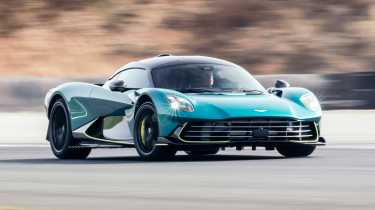
Questions, questions, questions. There are plenty to level at the Aston Martin Valhalla. Does it feel worth its £850,000 price tag? Does it have any direct rivals, or is it an outlier in a segment that doesn't quite know what to make of it? How does it compare with the Valkyrie? Most importantly, what does this new breed of Aston Martin – a mid-engined plug-in hybrid with more power than a modern F1 car – actually feel like to drive?
Aston Martin Valhalla: the basics
This is a car of firsts. Not Aston Martin’s first mid-engined car – there was the Valkyrie and the (one-off) Bulldog; nor is it its first car with a carbonfibre chassis – there’s been the One-77, Vulcan and aforementioned Valkyrie. But it is Aston’s first series-production mid-engined car, its first plug-in hybrid, its first with an electrified front axle and its first to enter a whole new market segment for the brand – and usher a new player into the supercar/hypercar game.
Since Valhalla was first shown in public as the AM-RB 003 concept car all the way back at the 2019 Geneva motor show, it’s undergone an on-off-on-again-off-again development phase, a switch from an in-house V6 to an AMG-sourced V8, and seen four different CEOs in the Aston Martin boardroom. Production will be limited to 999 cars and customer cars are already being delivered. The ‘basic’ price starts at £850,000, with many customers expected to spec bespoke ‘Q’ personalisation options on top.
More reviews
Although the Valhalla has previously been described as the ‘son of Valkyrie’, there are few genetic links between the two cars. The £2.5m, actively suspended, V12 Valkyrie was a specialised moonshot of a machine, but knowledge from the project has informed the Valhalla’s active aero, composite construction and F1-influenced ethos.
Technology, aerodynamics, powertrain and packaging
The Valhalla is powered by a 4-litre, twin-turbo, dry-sump V8 – the highest-performing V8 yet fitted to an Aston, and first with a flat-plane crank – working together with three electric motors. Two drive the front wheels, with full torque vectoring capability and the third is integrated into the all-new eight-speed dual-clutch transmission at the rear.
It is also Aston’s first car with a pure electric mode, capable of around nine miles under e-motor power only. It’s predominantly front-wheel-drive in this mode but the rear motor can help in certain circumstances.
The V8 is sourced from AMG and based on the unit developed for the GT Black Series but its internals have changed considerably, with new turbos, pistons, exhaust manifold and more. Whereas it developed 720bhp in the Black Series, it turns out 817bhp in the Valhalla. With the three motors contributing up to 248bhp on top, total power output is 1064bhp.
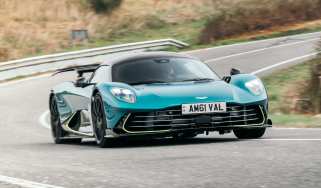
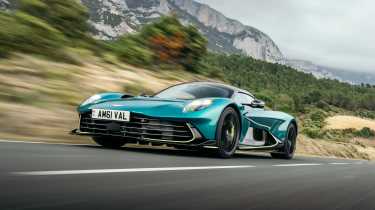
The Valhalla is a compelling machine to walk around, wearing some of its tech on its sleeve while retaining a clean shape. There’s a little of the Valkyrie’s visual character in its layered, aero-shaped design but more meat on its bones. It’s recognisable as an Aston Martin despite being such a different entity from the brand’s familiar front-engined cars.
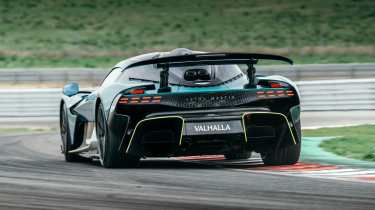
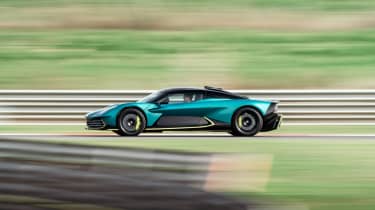
Behind the traditional Aston Martin grille integrated into the low-lying nose is an active full-width front wing. It has two active elements each side, and a narrow, gurney-shaped connecting spar across the middle. Its movements are conducted in tandem with the active rear wing, which sits flush with the bodywork at rest, rising into a partway position above 90mph. In Race mode, it extends fully on its struts, upwards and rearwards until it’s 255mm higher than the Valhalla’s tail. Under braking, it can stand upright as an air brake. At other times it’s adjusted actively for lower drag on straights and a stable balance in cornering. From 149mph, the Valhalla is generating more than 600kg of downforce. It actively bleeds the aero surfaces from that point all the way up to its electronically limited 217mph maximum, to maintain the same level of downforce for consistent handling at higher speeds.
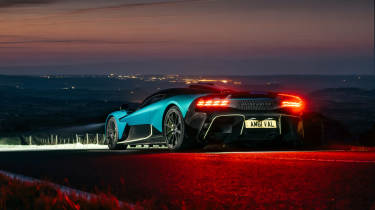
Air is extracted from deep vents ahead of the windscreen, flanked by hollow cut-outs exposing part of the inner front tyres. Intricate razor-like winglets on the sills ahead of the rear wheelarches further help marshal the air for rear downforce, and there are giant passive venturi tunnels beneath the rear lights’ jagged ‘light blades’. Airflow from the wheelarches is even directed through the doors’ inner surfaces, and out into ducts for the engine and oil coolers.
There’s no rear window, since the space is occupied by a distinctive Formula 1-style snorkel inlet and twin upswept central exhausts, with valves to take care of noise regulations. Two further, unsilenced, exhaust outlets are sited lower down between the venturis. The snorkel feeds air intakes, air-charge coolers, and cools the turbochargers, since the engine is a ‘hot-vee’ with the turbos between the cylinder banks.
The composite structure was designed in conjunction with the Aston Martin F1 team’s Performance Technologies consulting arm. The lower tub weighs less than 75kg. Aston Martin quotes the Valhalla’s overall dry weight as 1655kg, and does not communicate a with-fluids figure. Given the cooling demands and hydraulic systems, it’s likely to be a sizeable increase.
Rather than an active system as per the Valkyrie the Valhalla adopts passive suspension, albeit with adaptive dampers. The front springs and dampers are mounted inboard (partly to get the scuttle nice and low for forward visibility) and exposed to be visible from the outside as a neat design detail. Rear suspension is a five-link layout.
Inside the Valhalla’s cockpit
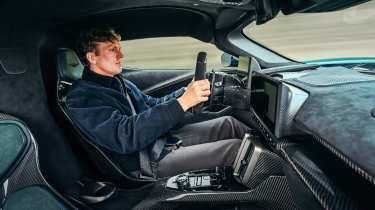
Climbing in is an event in itself. The large butterfly door takes a section of roof with it, and the A-pillar is further forward than in most cars, leaving a big aperture to step into and lower your frame toward the low-slung, reclined driving position. Customers can choose from three manually adjusted angles to ensure they’re comfortable. Your feet rest higher than in most cars, for aero and for some electronic modules to be packaged. No space is wasted. The seats are one-piece carbonfibre shells but with conventional over-the-shoulder seatbelts, so there’s no need to grapple with harnesses before you set off.
The doors need a hearty heave to close. Once they’re thumped shut, you find yourself in a roomy cockpit. Aston’s 6ft 4in design director Marek Reichman explains that they started the design process with the seating position, and says both he and similarly tall exec chairman Lawrence Stroll can comfortably fit side by side.
It’s spacious but spartan, with a stripped-back, race-car-ish atmosphere; a sort of deluxe Le Mans car vibe. As with most modern cars, two tablet-like digital screens sit on the dash, one in the centre, one behind the wheel. It would be nice to have something more bespoke in appearance for your £850k, but the displays are neat, crisp and clear, with a linear rev-counter and shift lights in Track mode. Incidentally, there’s one low-tech physical item that’s very welcome: this is a supercar with a real indicator stalk rather than switches or sliders on the wheel.
Some of the switchgear is shared with other Aston models, in particular the selector and switches for the transmission and the tactile collar-like twist control for the driving modes.
Beyond the digital oblongs, the view out is clean and clear too with excellent forward visibility. There are physical door mirrors but the main interior mirror displays a camera view, since the roof snorkel means a solid bulkhead and no rear window.
Driving the Aston Martin Valhalla: on track
Despite its enormous power, the Valhalla is a confidence-inspiring car and easily acclimatised to.
It pulls away as smoothly as you’d expect of a hybrid. Apart from Pure EV mode there are three further drive modes: Sport, Sport+ and Race. Sport is the default hybrid mode and Sport+ unshackles the full 1064bhp. Director of vehicle performance and attributes Simon Newton (who, during development, has been tasked with the technical and philosophical question of what exactly a mid-engined Aston Martin should feel like) has told us Sport+ is designed to be the most playful mode. Race mode prioritises grip and stability but Sport+ is for fun and agility.
And so it proves. An integrated vehicle dynamics control system keeps a fluent conversation going between the rear e-diff, braking and energy regeneration systems (the front axle in particular harvests energy to feed back into the battery), establishing how much of the Valhalla’s 812lb ft torque to apportion not only front-to-rear but side-to-side, too.
Aston’s engineers have aimed to give Valhalla similarly progressive handling to front-engined models such as the Vantage, albeit with the more responsive yaw characteristics inherent to a mid-engined car. There’s a huge amount of front-end grip, both on corner entry and exit. The front motors’ torque vectoring capabilities have all manner of benefits, from keeping the Valhalla straight and true under heavy braking to helping it rotate on turn-in, lock down mid-corner and claw out of slow corners with maximum traction.

Like other Astons, there’s an intuitive multi-stage traction control with eight levels of assistance you can dial up or down by twisting the drive mode collar. In its middle setting, the stability control is subtle in operation, intervening gently without disrupting your flow. Dialling it back allows real freedom and it’s possible to powerslide with confidence. This might be an all-wheel-drive car but it’s very much rear-drive in character.
With stability control switched off, it's far from snappy; all 1064bhp is usable and driveable. The electronics systems are not a sticking plaster and the Valhalla is an inherently fine-handling car at its core. Its tail unloads with weight transfer in a predictable way and it’s exploitable and catchable under power. In Race mode, it’s less expressive and more locked down but balance is remarkably neutral.
Whether being a hooligan or lapping neatly and tidily, it’s easy to modulate the brakes as you turn in, manipulating the balance as you do so. Not always the case in a brake-by-wire hybrid such as this, which blends braking between the e-motors and friction brakes (410mm carbon ceramic discs at the front with six-piston calipers). Motors and physical brakes are both fully in play right up to the point of ABS intervention.
The way the Valhalla stops is as impressive as the way it goes, particularly in Race mode where the rear wing flips forward to become an air brake. It feels like it’s going to ruck up the tarmac beneath its tyres like a rug, yet tracks arrow-true.
There is a noticeable step in downforce between Sport+ to Race. In the camera screen where the rear-view mirror ordinarily would be, the T-shaped wing rises to fill much of the frame. In a straight line at high speed, you can see it trim backwards into a DRS-style low-drag position. Despite the downforce it’s not an on-rails car. It’s stable yet malleable, always progressive at the limit.
The DCT’s gearchanges are ultra-fast. With eight speeds and the rear e-motor assisting with gear synchronisation, it rips through the lower ratios in short order. The motor also lends torque-fill shove to the engine as its big turbos spool, and the acceleration is a curious sensation. There’s less of the ebb and flow of a conventional engine working through its torque curve in each gear. Speed builds as quickly as you’d imagine of a car with 1064bhp but in the wide environs of a racetrack there’s less drama than you might expect.
The flat-plane V8 has a thinner, higher note than the rumbly cross-plane engines in other Astons and wearing a crash helmet with tight-fitting earphones built in, it’s difficult to make out much of the V8’s voice. That, combined with a low-for-a-supercar 7000rpm redline, makes it easy to bump into the limiter in manual mode until you’re used to it, despite the clear shift light graphics, developed with feedback from Aston’s F1 drivers.
The rectangular steering wheel (made from a one-piece carbonfibre armature) feels odd at first but becomes natural with time. That said, several times I find myself accidentally touching its spoke-mounted controls and changing the screens’ displays.
Driving the Aston Martin Valhalla: on the road
There’s plenty of space for people but not for their luggage: one of the Valhalla’s greatest flaws is that it has no boot.
Lidded bins in the doors have decent space for a smartphone and a wallet, for example, and there’s space to charge a phone under the slim centre console and a cupholder further back but bags have to go under the passenger’s legs or on their lap.
The solid bulkhead makes over-shoulder vision a bit claustrophobic but the broad windscreen and low nose let plenty of light in and the combination of physical door mirrors and fast-frame rate central camera work nicely. Without a helmet on, you hear more of the engine’s character; some gruffness and grit at low revs and real savagery towards the redline, with distinctive gasps and swooshes from the turbos in between.
At regular road speeds, the Valhalla is a relatively chilled experience. You can hear stones pinging from front wheels against the carbon tub and there’s a little road noise but it’s easily overpowered by the stereo’s speakers. It is a car at the more hardcore end of the scale but no more so than an Alpine A110R, for example.
Unlike in the Valkyrie, the engine is not a stressed member of the chassis, rubber-mounted instead in an aluminium subframe. As a result, sound and vibration are not overwhelming. (In fact, the engine mounts were revised during development to deliberately let a little more vibration and sensation through to the driving seat.)
While we prioritised Sport+ and Track on the circuit, the default hybrid Sport mode is the best choice for typical driving in traffic. It’s smooth and tractable – mostly. In the transition from electric-only to petrol power, there’s occasionally a clunky thump as drive engages, a sensation a bit like downshifting quickly in a manual car without rev-matching. [Aston Martin technicians plugged a laptop in to analyse the data after our test, identifying a software glitch as the suspected cause; customer cars are not expected to suffer the same issue.]
Sport+ is the mode of choice for quieter roads, the Valhalla becoming more alert and responsive. You can revel in its wieldy agility, feeling the front wheels claw out of hairpins while the rear axle remains very much engaged. It has a unique dynamic character.
We were on bespoke-spec Michelin Cup 2 tyres with optional magnesium wheels on track, but are now on less extreme (but still Valhalla-bespoke-construction Michelin Pilot Sport 5 S tyres on forged rims for the road, and they work well, both in terms of progressiveness and ride comfort.
The ride, in fact, is one of the Valhalla’s most impressive aspects on road. In Sport and Sport+ it is controlled yet forgiving and even in Race mode there’s still a level of pliancy. The car skims its nose a couple of times in compressions in Race but there are no such issues in Sport+ and, regardless of mode, we never need to reach for the nose-lift button over speed bumps. There’s no rear-wheel steering (which no doubt helps with the transparent, predictable feel on track) but the turning circle’s good, too.
With lighter braking inputs on the road, I find the brakes not quite as feelsome as they were on track but they’re in another league to the overly abrupt response in the Lamborghini Revuelto, for example. Likewise the steering doesn’t have as much feel as that of a rear-drive McLaren but it’s good; weighty but not obstructive, responsive but not flighty. It sometimes stiffens slightly when accelerating out of tight turns, as the front motors come into play, but it doesn’t become overwhelmed with torque-steer or muddy the messages coming through the wheel.
The Valhalla has previously been described as ‘son of Valkyrie’ but it very much has its own character. The highs are higher in a Valkyrie – as they should be, given its price and no-bounds technology – but its operating window is narrower. You can have more fun in a Valhalla more of the time, on the road and – to an extent – on the track too, given the playful side to its handling.
And you don’t need a track to enjoy it; it’s also a very capable and intuitive road car (luggage space notwithstanding). You can pootle along (unobtrusively in urban areas in EV mode), or carry searing point-to-point pace, or grab it by the scruff and sling it around. Few cars have that bandwidth. After a morning on track and an afternoon on the road, however, it feels like we’re still getting to know it.
This is an odd criticism, but the Valhalla is almost too good. It’s so easy to drive quickly, so neutral in its balance and capable of making such unflustered and undramatic progress that it can feel curiously undramatic. Yet it's certainly not an aloof car because its touchpoints are communicative, its responses are consistent and there’s a real playful side to its handling.
The Valhalla mixes elements of racing car, concept car and hypercar, plus some traits of traditional Aston Martin sports cars too. It’s a unique blend. The supercar world has a new player, and it’s a very talented one indeed.
Price and rivals
The Valhalla’s price puts it in an unusual space in the market. Lamborghini’s Revuelto and Ferrari’s 849 Testarossa also combine a combustion engine with three e-motors and at the time of writing are priced at a little over £450,000 and £400,000 respectively. Since the Testarossa also employs a 4-litre twin-turbo V8 it feels the most natural competitor on paper but Aston Martin is happy to invite comparison with the Ferrari F80, priced at £3.1m (and sold out). It considers the Valhalla to have comparable outright performance with the F80, for a significantly lower outright price.
As a result, the Valhalla sits in curious clear air between supercar and hypercar.
The lack of luggage capacity severely limits the Valhalla’s touring potential, just as with 2021’s Ferrari SF90 and its 849 Testarossa successor. Lamborghini’s V12 tri-motor Revuelto finds space for a couple of small bags under its nose by contrast, though it has poorer visibility and a less exotic suspension layout than the Aston.
The Lamborghini has a similar power output and top speed but a less downforce-led design, less exclusivity as a car for continuous production rather than a limited edition, and a more road-biased focus – though we’ve discovered in testing that it’s also hugely fun, challenging and rewarding on a circuit. The Aston Martin feels a more advanced machine than the Lamborghini, with greater precision on track and more exotic technology at play, though the Revuelto is arguably a more expressive character on the road.
The Valhalla perhaps doesn’t quite have the livewire sense of nimbleness of a Ferrari, the total immersion of a McLaren or the theatre of a Lamborghini. But it can do things other supercars cannot, possesses some fascinating engineering elements, and a unique character. Far from an underdog, Aston Martin feels right at home in the mid-engined arena. The Valhalla is a thoroughly impressive machine, worthy of comparison with cars from any established mid-engined marque.
| Model | Aston Martin Valhalla |
| Engine | V8, 3982cc, twin-turbo, plus three e-motors (2x 120kW front, 150kW rear) |
| Power | 1064bhp (total) |
| Torque | 812lb ft (total) |
| Weight | 1655kg (dry) |
| Power-to-weight | 653bhp/ton (dry) |
| Tyres | Michelin Pilot Sport Cup 2 (on track), Michelin Pilot Sport S 5 (on road) |
| 0-62mph | 2.5sec |
| Top speed | 217mph |