This unseen Slovenian tech is about to change cars forever, and I've already tried it
In-wheel motors promise a revolution in vehicle dynamics, offering lightning-fast control and superior grip for performance hybrids and EVs. I put it to the test

The future of electric propulsion is in-wheel motors. Their positive effect on a car’s dynamics is significant and the reason enthusiasts like us should be interested is because some of the first cars to get them will be hybrids. The Lamborghini Revuelto is an example of how impressive hybridisation can be, but with in-wheel motors driving its front wheels it would be even more capable, because they offer much finer control.
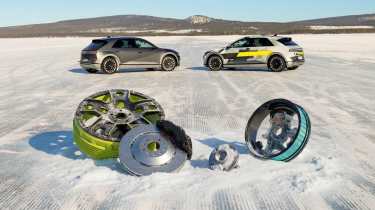
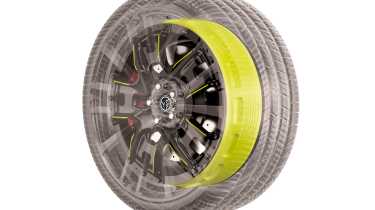
Forget the image you have of a regular electric motor, the chunky type that powers your washing machine or your slot-racing cars. Imagine instead an expanded version that fits inside the road wheel like a cap over the brake disc, the outer part rotating with the disc and wheel, the inner part fixed to the hub. The compact nature of in-wheel motors – literally filling in the spare space inside the road wheel – gives the opportunity to hybridise all types of performance car, including, say, a traditional, V8-engined muscle car. We’ll come back to that.
> Driving a car with no steering column – can feel really be faked?
Of course, all those magnets and windings add a lot of unsprung mass. Elaphe Propulsion Technologies, a Slovenian company that has pioneered in-wheel motors (IWMs), says that its ‘Sonic X’, a 21-inch motor that delivers 400kW (536bhp) peak power, 200kW (268bhp) continuous, and fits over a 375mm brake disc, adds a hefty 27kg. That sounds like a lot more unsprung mass for the suspension to control, but Elaphe says it isn’t a problem. Really? Well, yes; Lotus, for decades a champion of minimising unsprung mass, has tried in-wheel motors for itself and has come to the same conclusion.
Meanwhile, the upsides of IWMs are compelling. Able to deliver torque at a rate of 500Nm/ms, with a sensing rate of 10kHz, response is measured in milliseconds and is around 20 times faster than with standard EV architecture. It’s direct, too: there are no driveshafts to slow the response. Elaphe says the degree of control that IWMs offer enables them to generate 10 per cent more braking force than a regular anti-lock braked/regen EV, resulting in stopping distances 9 per cent shorter. The gain in longitudinal and lateral grip is even greater, up 15 per cent, cutting 0-60mph times by about 13 per cent, while fine slip control finesses on-limit behaviour.
Elaphe invited us to Arjeplog in northern Sweden to try its IWM demonstrators and see for ourselves. The company has been working on IWMs since 2006 and during development has subjected them to extreme tests, including dunking hot motors into ice-cold water, leaving them submerged for hours, and immersing them in sandy mud, which was then allowed to dry solid before the motor was restarted. For Elaphe, that stage is done and it’s now refining its expertise in the software that controls the motors. It doesn’t want to be a mass manufacturer of IWMs; it wants to offer its skills to help car makers get the best out of them.
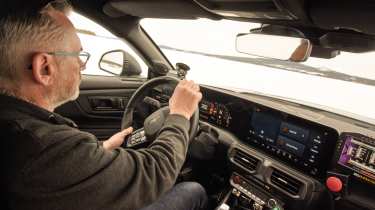
The first demonstrator we tried was a Hyundai Ioniq 5 fitted with four IWMs, running the same wheels and tyres as the standard, four-wheel-drive Ioniq 5 provided for comparison. Like the standard car, the Elaphe version has drive modes ranging from Normal to Sport to Drift. Our first stop was a snow handling circuit on a frozen lake that was fast and occasionally tricky with patches of ice. With the IWMs micro-managing the grip at each wheel, progress was smooth and predictable in Normal, allowing a little rotation to turn the car. As the modes got sportier, the character stayed smooth and progressive, the slip allowed greater but still with a clearly defined limit. Even in Drift mode the car was controllable and effective, its responses clean and clipped with no overshoot.
After this neat and consistent demonstration, the standard car felt quite different. Oddly, it felt heavier, I think partly because its brake-based stability control was responding less quickly and a little more abruptly, even in Normal mode, leading to the feeling that the car was getting loose. This sensation only increased as the modes got sportier, with clumsier and sometimes absent interventions over quick surface changes, from snow to ice. In Drift mode you had to be on your toes because occasionally, just when you thought it was balanced, the rear would kick out, requiring a stab of opposite lock.
Next we got to try starting off on a split-mu hill in both cars, with the right-hand wheels on asphalt and the left-hand wheels on ice. The standard car eventually got going but the IWM car drove up almost instantly.
With the ability to run the motors in different directions on each wheel, you can do ‘tank turns’ – turns on the spot – which is of limited value, but there are other effects Elaphe has discovered during development that are more useful. One is that the motors can give haptic feedback through the wheel or floorpan, which could be used to illuminate changes in surface grip or perhaps indicate the limit of grip. The second discovery was made when they looked into neutralising the whine that can come from electric motors, when they found that they could manipulate the motors to play tunes. It was quite surreal standing on the ice listening to the theme tune from Knight Rider coming from the wheels. A more practical use for this ability would be to pipe in engine sounds, which was also demonstrated.

Elaphe says we’ll see hybrids with IWMs before pure EVs. Lots more car makers are currently looking at hybrids as a transition into pure EVs, and IWMs are a much less invasive way of electrifying established cars. To show the benefits, I got to try a familiar muscle car with IWMs fitted to its front wheels. (We all know what the car is, but for various reasons Elaphe would prefer us not to name it.)
I know that with traction control disabled, the standard car is eminently spinnable on wet asphalt, so the torque of the 5-litre V8 landing at the rear wheels on a frozen lake ought to have it pirouetting helplessly, but with IWMs it’s a car transformed. Slalom along and it’s as if there’s a mass in the nose pulling the car in the direction steered and keeping the tail from straying too far. In one mode a defined angle of drift was set, allowing a huge ice circle to be lapped with the throttle pinned and a few degrees of opposite lock applied. And on the handling circuit it was tidy, exploitable, fun. Turning off the IWMs was a stark reminder of their effectiveness, the rear tyres struggling to even get the car going.
‘We think of the motors as actuators,’ says Elaphe’s Luka Ambrozic. ‘When we first invited manufacturers to try our IWMs, they sent powertrain engineers. Now they send software engineers.’ There is currently only one vehicle being sold with IWMs, the Panterra, a bespoke, £325k-plus Land Rover Defender built in the Netherlands, which uses four Elaphe motors. But Elaphe says at least two-thirds of the world’s biggest car makers are actively investigating the technology, some with their own IWMs, some with Elaphe or one of its competitors.
The first EVs developed around IWMs won’t appear until the early 2030s, says Elaphe. This is because to maximise the benefits requires a bespoke platform and a new electrical architecture. For instance, controllers for anti-lock brakes and stability and traction control can be incorporated into a single motor control unit, while IWMs free up space inside the vehicle, potentially making cars smaller and therefore lighter, allowing a smaller, lighter battery for the same range… In short, in-wheel motors could be the start of a virtuous circle.
This story was first featured in evo issue 345.