I daily drove a £525k Ferrari 12 Cilindri, and it was as fabulous as it was frustrating
We already know Ferrari’s latest V12 grand tourer is immensely exciting, but what’s it like to use every day for every journey?

If you’re naming a car after its engine, it needs to be a special one. Otherwise you’d end up with cars called Vauxhall PureTech three-pot, or Volkswagen EA221 inline-four. Ferrari has and does make some of the greatest engines of all time, not least one of the last remaining naturally aspirated V12s in production, so the 12 Cilindri (pronounced ‘Dodici Cilindri’) gets a pass. It’s the latest in a lineage of front engined V12s that goes back to the very first Ferrari – the 125 S – and with the way legislation and emissions regs are going, could be one of the very last.
But rather than get soppy and reflective about the potential last days of one of the world’s great engines, we wanted to enjoy it and get to know Ferrari’s flagship grand tourer on a deeper level. What better way to do that than to spend 500 miles and seven days in a 12 Cilindri, using it as your only car for everything from shopping and moving furniture, to the long motorway slogs and countryside blasts it was designed for? Experiencing a car away from the picture-perfect environment of a road test and in the real world is always revealing, and I can confirm that living with a 12 Cilindri day-to-day is captivating and mildly frustrating all at once. Mostly wonderful, though.
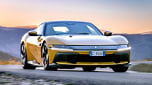
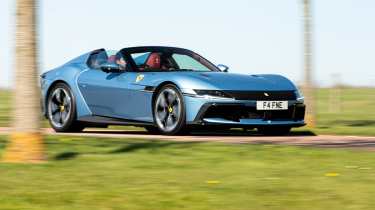
Before you’ve climbed in, the intimidation factor is very real – mainly because of the sheer size of the 12 Cilindri. In a normal sized parking space its hips bulge out to the white lines and the bonnet is vast, leaving two thirds of the car stretching ahead of the driver’s seat. You really don’t want to graze the nose either, because the carbon splitter is one of many options that take the price of our test car from the Spider’s £369,245 base figure to…wait for it…£525,411. The most expensive option is the two layer Avio metallic blue paint, which at £22,500 costs the same as an entire (and fully painted) Renault 5.
More reviews
That’s a huge amount of money, and while I’d argue the 12 Cilindri doesn’t actually look half a million bucks worth, it's still a spectacular thing to behold. I remember being stunned by the shape and clever Daytona references at the official reveal in Maranello, and among other cars in a gloomy UK city centre it looks as though it’s beamed in from another planet. Way less dramatic than a Lamborghini Revuelto, sure, but less try hard, more effortlessly beautiful. Even more so as a Spider, I’d say, with its slimmer and less bulky rear deck with neatly integrated buttresses.
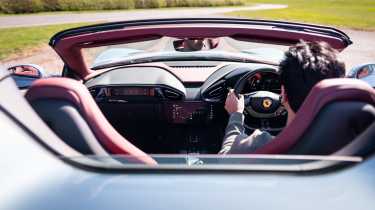
The 12 Cilindri’s cabin made a good first impression. It’s more open and less airy than you might think, with a low central tunnel and a low scuttle giving a great view of the shrinkwrapped bodywork over the front arches. Physical buttons on the steering wheel are another plus, and a welcome change from other recent Ferraris. However, the more I touched and interacted with it, the more oddities I found – and areas that should be finished to a better standard for the price. The flimsy plastic air vents and plastic grab handles on the doors, for instance, and those new steering wheel buttons, which feel a bit ‘Stellantis’. For two thirds of the price a Bentley Continental GT is more solid and exquisitely detailed.
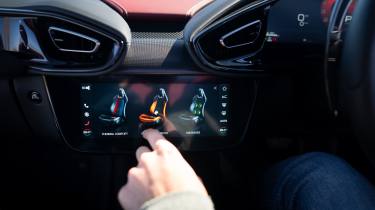
Despite the introduction of physical buttons I still didn’t gel with the infotainment system, either (and everyone on the evo team who has driven a 12Cilindri has equally struggled with it). The digital dash is clear and well laid out but the central touchscreen is far from intuitive. It’s set quite low and away from your line of sight, and I never fully grasped the layout of the various menus and sub menus (although switching off the ADAS systems is simplified by a shortcut on the wheel). While there’s wireless Apple CarPlay to bypass the UI, Android users are forced to use a cable, which seems mean.
There are other irritations too. Why are adjustments for the seat bolsters and heating buried in the screen, split up from the adjustment switches on the side of the seats? And why is the nose lift activated via the touchscreen, rather than a physical button on the wheel? It’s something you need to use frequently while driving in town, and it would be so much better as a tactile, easily accessible switch.
Ferrari seems to pay these details less attention than others, but boy is there enough to distract you from them once moving. In truth, it’s hard not to be captivated by the 12 Cilindri after simply starting it up. Sadly this is by a haptic switch rather than the anodised red start button on the very latest Ferraris, but the snap of revs and smooth timbre of the V12 as it settles at idle is wonderful and never gets old. You wake the neighbours every single time, but part of me loves the indulgence of it.
The noise immediately settles down once you flick into gear and get moving. One criticism myself and colleagues have levelled at the 12 Cilindri is that the engine lacks the volume and voice you’d expect, particularly since the car has been built (and named) to celebrate it. This is true when unleashing it to the full but when cruising it’s nice not to have a constant exhaust blare. In fact the 12 Cilindri is a fantastic car to travel long distances, feeling much more like a GT than a livewire front-engined supercar. There’s some road noise but it’s not excessive (the upgraded Burmester sound system packs enough punch to drown it out), and with the roof down there’s no more turbulence than in, say, a convertible 911.
I love the fact that the engine is free to flex its muscles in auto mode too, without the gearbox needlessly kicking down and sending the car into hyperdrive. You sink into the throttle and allow the engine to work through the revs, using its torque. It all culminates in a very dignified and calm cruiser, which is helped by a supple ride – with the bumpy road mode selected its fluid and controlled, and sharper yet still livable with the dampers in their firmest setting. The only snags for a long road trip are the relatively small boot (smaller than the coupe’s) which can swallow up a couple of small suitcases but not much else, and the seats. They look great but are strangely flat and unsupportive – even after you’ve dived into the touch screen to fiddle with the bolsters…
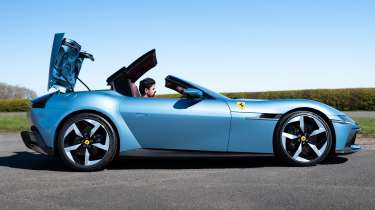
Initially I had no problems with the 12 Cilindri’s size. Most of the time it does a fantastic job of hiding its bulk – mainly thanks to the light, quick steering and rear-wheel steering – but when I ventured into chaotic town centre traffic or residential streets, it felt like carrying a large backpack through a china shop. I became very well acquainted with the button to fold the mirrors, with plenty of ‘creep and hold your breath’ moments when squeezing through gaps. Low speed manoeuvres weren’t helped by a slightly jumpy initial throttle response, which can make the car lurch in stages, but the rear-steer and rear-view camera – perfectly positioned directly in front of you on the digital dash – made parking easy.
You could daily the 12 Cilindri with some commitment, but it's that bit too big and (to me) valuable for it to be a thoughtless process. Instead I found myself heading for the hills to enjoy it properly, where it takes on an extra level of aggression to become something truly exciting.
It was a little too exciting at first. The Manettino switch moves through five positions, with the final twist-and-hold deactivating the ESC. However, even if you move it to the Race position without the final twist you loosen the traction control, which caught me by surprise when I first applied full throttle. The 12 Cilindri demands respect, mostly due to the savage nature of the engine and how quickly it responds and builds power. Keep it pinned and the thrust builds exponentially towards the redline in the most intense, addictive way. And the rest of the car is fluid, responsive and biddable one you’re in tune with those responses. You really can fully exploit and enjoy it.
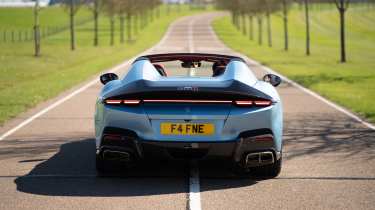
Dynamically, there’s very little penalty for going for the Spider. In fact, on the road there’s no reason to want the coupe. The structure is stiff and there’s only a little more vibration on the roughest roads, the car remaining consistent and crisp in its responses. But where you might imagine the Spider would deliver the noise and drama the hard top is missing, it doesn’t quite get there. There’s satisfying induction noise under load but the more aggressive drive modes don’t unlock an air-shattering exhaust cry, and the engine competes with wind rush the faster you go (it sounds best with the roof up and the rear window dropped). Gear shifts are the best part, with sharp cracks on upshifts and instantaneous blips on the way down. It responds like a race engine.
There’s no question the front-engined V12 Ferrari has morphed into something more exotic and specialised since the days of the 456 and 550 Maranello. At the time, these were chosen over mid-engined alternatives to do big miles, but today’s supercars have taken such huge strides in usability and refinement that many of them can now do the same job. So much so that I’d probably prefer to daily drive the more wieldy 296 than the 12 Cilindri. Does that limit the latter's appeal? Not really. It isn't perfect (Ferrari’s new Johnny Ive-designed interiors can’t come soon enough) but the 12 Cilindri has the ability to make any journey feel special, and the V12 is absolutely central to that. I hope this isn’t the last time I get to experience it.