This secret British sports car is a £5m gamble, inspired by Lotus and with Ferrari looks
Robin Wells fancied a new sports car so decided to build his own. The result is the Wells Vertige, and now you can have one too

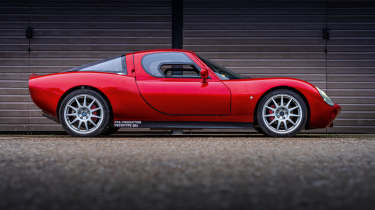
There’s a wry phrase from the entertainment industry that goes ‘It’s only taken ten years to become an overnight success’. What you see here is perhaps the closest thing you’ll find in the automotive industry. It’s called the Wells Vertige and it’s a sub-1000kg, mid-engined British sports car that’s been flying under the radar for the last decade. The prototype was shown at the Goodwood Festival of Speed in 2021 and driven by a rival car magazine soon after, and a number of ‘first generation’ cars have already been delivered, but only now has the Vertige reached a level of completeness where its creator, Robin Wells, is happy(-ish) to lay down tools, push the button on full production and, in a few months’ time, let us drive the finished car.
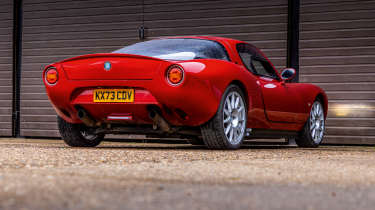
I can’t wait. It’s an appealingly small, low, pretty, two-seater sports car, a little bigger than an Elise, a little smaller than an Evora. I see hints of D-type in the nose, Dino too, and Stratos in the tail with its circular lights and small ducktail, but with its dihedral doors and glass fastback the Vertige is very much its own thing, a car designed to compete with Lotus and Alfa’s 4C, and which has reached completion just as both manufacturers abandon this particular market niche.
> Lotus ditches all-electric plans, launches 939bhp Eletre X-hybrid
Beneath the Kevlar-reinforced glassfibre body is a very stiff, folded-steel chassis with tubular subframes at either end, double wishbones and disc brakes all round, and modestly shod 17-inch alloy wheels. The definitive engine will be a naturally aspirated, 2.5-litre Duratec four making 225bhp, the gearbox a six-speed manual, and there’s no power steering, no brake servo and no anti-lock. Dry weight is just 867kg, kerb around 950kg.
Robin Wells is a life-long car enthusiast but didn’t intend to become a car manufacturer. ‘At university I’d studied music, and of course that was largely useless from a professional perspective, so I started a business and spent 25 years building it up. We had clients all over the world and it was generating good money, which I wasn’t spending on anything sensible – it was cars, the usual suspects, Ferraris, Lamborghinis… Over time I realised they were getting louder and faster, wider and heavier, and not necessarily more enjoyable. I had Lotuses too, which were great, and a McLaren MP4-12C, which I’ve still got.
‘Around 2014, I was planning my exit from the business. It was always just a means to an end. I toyed with the idea of having a Stratos replica built, which was going to cost around £50/55k, but then I thought, “Why pay for somebody else’s design? Why not just have a go and make one yourself?” So with the mixture of ignorance and megalomania that characterises entrepreneurs, I thought I’d give it a go.
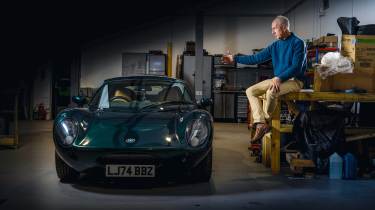
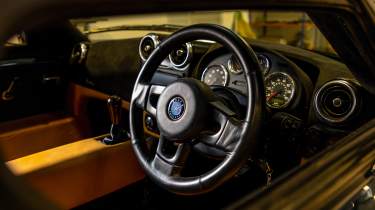
‘I spent hours on the internet and looking at car magazines, and what emerged was the vision of a small, compact, lightweight, responsive but not masochistic sports car. Somewhere between a Dino 246 and an MX‑5 with a bit of Golf GTI in terms of daily useability… that sort of vibe. Four metres long, 1.75m wide and a target weight less than 900kg. And it would have a very simple engine. I didn’t need to go V6 or anything complicated. So a four with a six-speed manual, a pure, back-to-basics driving experience but comfortable: I wanted noise insulation, Apple CarPlay, Android Auto. I wanted leather and Alcantara and a proper boot at the back.’
To put a physical form to the concept, Wells rented a warehouse outside Birmingham and purchased four 17-inch wheels and a Lotus Elise windscreen. ‘I knew it had to be beautiful, because if it’s beautiful, people will buy it. It had to be engineered really well too, but the first thing is how it looks. That’s what sucks you in.’ He fashioned a metal frame to hold the wheels and screen in place and over the next two years, with a friend who worked in glassfibre, sculpted a body until he was happy. But how to turn that into a car?
‘In sixth form I’d built a kit car, which confirmed how useless I was in a workshop setting,’ he smiles, ‘so I knew I had to surround myself with people who knew what they were doing.’ At the 2016 Stoneleigh kit car show he spotted a beach buggy that, even to his layman’s eye, had a really good chassis. ‘Turns out it was designed by an engineer called Robin Hall who had been lead suspension engineer on the R50 Mini. So I called him up and told him, “I want to make the perfect sports car,” and I just heard laughter. Once he stopped laughing, he said: “Well, okay, how much money have you got and how much time?”’
Having satisfied Hall on those first two points, Wells invited him to the warehouse. ‘When he saw the styling buck he said, “Yeah, I think this could work, but it’s going to be a lot of time to do it justice, to do it properly.” He also stipulated another condition: “We will not cut metal for two years.” And thank God he said that. The trap you fall into, particularly if you’re enthusiastic or you’ve got a bunch of somebody else’s money, is you rush into building a car straight away, before the fundamentals have been mapped out.’
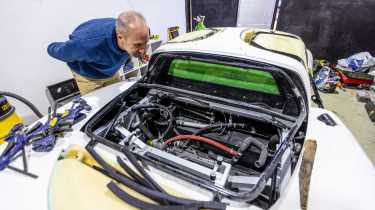
The buck was scanned so that Hall had it in CAD; Wells had decided on a Ford Duratec (initially a 205bhp 2-litre) and six-speed ’box and now provided some general requirements including an integrated roll-cage and a really stiff chassis to allow super-compliant suspension. He’d also wanted the car to be practical, which meant it needed to have a boot at the rear and ideally another at the front.
‘Robin [Hall] was on the CAD every day creating everything, absolutely everything. I sucked it up because I knew it was a long-term project, and the net effect of that was that when we built the first car and took it for its IVA test, it passed first time. We drove it around Bruntingthorpe for 14 hours non-stop and nothing broke. I’m not saying it was perfect, but the package worked.
‘I was thinking, OK, this has got legs but I don’t want to go to the market yet, I want to make a few tweaks to the body.’ A second prototype was built, swapping the Triumph GT6-like clamshell front end of the first car for a fixed front end with a bonnet opening (that car, by the way, is currently on display in the British Motor Museum). That was followed very quickly by P3, finished in a classy silver with black and cranberry coloured trim for the cockpit. Wells deemed this the last of the prototypes as far as the body was concerned and ready to serve as the show car. It was time for the big reveal. Sort of…
‘I decided, OK, we’re ready. Let’s go for it. So Goodwood Festival of Speed, July 2021. I get £5000 pounds together and pay it to the organisers. In return we were allocated a tiny tent next to the tool makers and the cuddly toys – about as far away from the main attractions as possible. Even so we had a lot of interest. Mike Flewitt from McLaren came over to see us and said, “Don’t tell any of my colleagues from McLaren I’m here, but this is very interesting, very impressive.”
‘Off the back of that and the Autocar drive that followed, we had a lot of interest, and by May 2022 I’d sold out all of the initial batch of 25 cars I was planning to sell. So I had a very healthy order book, I had a product, but I had absolutely no one to build it and nowhere to build it.’ So he bought and converted some old farm sheds a couple of miles from Gaydon, Warwickshire, and also set about securing the whole supply chain. ‘We have more than 2000 line items from about 190 different suppliers and 99.9 per cent are in the UK and a lot within a 40-mile radius from us,’ he tells me.
There are, of course, many hard yards on the road to creating a brand new car, many of which can’t be anticipated. ‘We’re onto our third body supplier, our fourth chassis supplier and our fifth exhaust manufacturer,’ says Wells, adding that if he could have slipped the guys at Ariel a tenner for a list of all their suppliers he would have saved three or four years.
‘There was a lot of problem-solving too: making that transition from prototype to production and resolving issues in such a way that they don’t arise again. Detail engineering. Locking all of that in.’ In 2024 they started building an initial batch of six or seven cars for family and friends, very much on an invitation-only basis, which were delivered over the course of 2025. Then came the Launch Edition, capped at 25, which are the cars currently in build.
‘From a financial perspective, it’s like we dived into a swimming pool: we’re still under water, but we’re heading in the right direction and will be coming up for air soon. This year, we will deliver nine to 10 cars, next year 15 to 18, and then in 2028, we want to be going to capacity, which is 24 cars a year. I know that it’s possible. We have the processes, we have the skill set, we have the supply chain and the people – there are ten of us now, including me.
‘So that’s my model: 24 cars a year, £85k base price, each car personalised to the customer, buying direct from the factory – and I have a viable, sustainable business. There’s no bank debt, and we manage the overheads. I own the land, I own the buildings, and I have a great team around me. This is not a way to get rich but, if run properly, it can be a nice little business.’ There are, of course, the development and start-up costs, which Wells puts at ‘approaching £5million’…
How does the Vertige drive? ‘What I wanted is a car that bridges the two compromises, which is to feel alive but also to feel solid at the same time. This is a rare feat: a lot of cars which feel alive don’t feel solid, and the majority of solid cars just feel dull and stodgy. The Vertige feels really solid because the torsional rigidity of the structure is over 40,000 newton-metres per degree, so it’s tremendously stiff – we foam-fill all the bulkheads, all of the cavities – but it’s a car that feels alive, too.’ We’ll find out for ourselves just how alive it feels when we drive the Vertige later this year.
Add the prospect of compliant suspension with a degree of roll to the Vertige’s minimal mass and it sounds a bit like an Alpine A110. Wells doesn’t disagree, revealing that as well as Mike Flewitt and ex-JLR man Mike Cross, he’s also had ace A110 fettler Dave Pook in the car. It all bodes well for this brand new, ten-year-old British sports car company.
This story was first featured in evo issue 345.