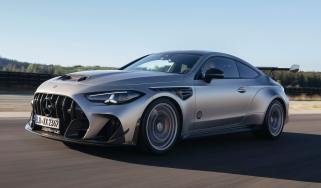
Driving a car with no steering column – can feel really be faked?
Steer-by-wire eliminates the column and with it the physical connection between you and the front wheels. Here’s why that might not be a bad thing…

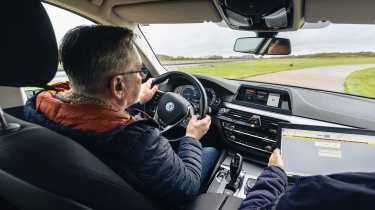
If you’re a driver who values feedback, removing the rod that connects the steering wheel to the steering rack feels like a move that can only end badly for your sense of connection. This BMW 5‑series is such a car. It’s fitted with steer-by-wire: there is no intermediate shaft, the connection between wheel and rack is only electrical.
Yet lapping this short circuit in the rain, through the wheel I can feel the coarseness of the surface on one corner and the squeaky smoothness of the new asphalt on another in what seems to be authentic detail. Just to be sure, I’ve had a look under the bonnet and can confirm there is nothing connected to the stubby input shaft of the steering rack.
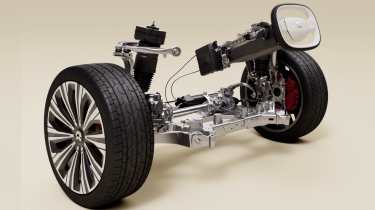
Why would you want to disconnect the steering wheel and the rack? ZF, the German automotive systems supplier whose steer-by-wire (SbW) prototype this is, isn’t short of reasons. You can change the rack ratio – how fast the steering is – at will, fine-tune and turn the level of feel and feedback up or down for different drive modes, retract the steering wheel for autonomous driving, render the wheel dormant in self-parking manoeuvres… Also, losing the direct connection deletes a potential noise path and improves passive crash safety for the driver.

These are not just hypothetical advantages, because there is already a car on sale with ZF’s steer-by-wire system: the Nio ET9, a large, Chinese, luxury EV that combines SbW with fully active suspension. It also features a wide and squat rectangular steering wheel, which is not awkward because you can get to full lock without crossing your hands. ‘Chinese customers are enjoying that,’ says Jake Morris, ZF’s steer-by-wire champion. The first European car with the ZF system, a Mercedes, will launch in 2026.
How is it done? The forces at the track rods are measured and relayed to a ‘torque feedback unit’ attached to the upper steering column, which then recreates the loads being measured as feedback at the wheel. The fidelity and realism of the feedback is something that ZF has worked hard on.
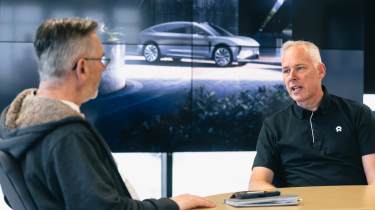
‘There will be different ways to how different companies deliver steering feedback with steer-by-wire,’ says Morris. ‘ZF took a route that focused on steer feel, therefore we’ve got a torque feedback unit designed to reduce backlash, to really work on giving you a precise steering feel.’
Essentially, this is a twin worm-gear system with two motors that can work against each other or together to eliminate slack and deliver low- and high-frequency feedback. The unit has two separate power sources so will always steer.
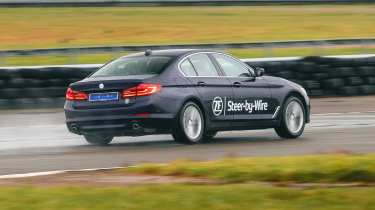
Taking the wheel of a car that you know has no physical link to the steering rack naturally puts you on high alert. We are at MIRA on the handling circuit, a twisting, undulating, cambered, crowned, ridged and precisely potholed track. This BMW 530i is limited to 50mph but that’s enough.
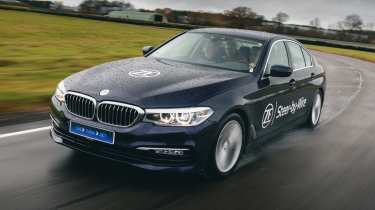
It rides on Dunlops with tall sidewalls, and in the sportier of the two steering tunes I try it feels just like a regular 5‑series: decent steering efforts and on-centre connection, linear response, and expected levels and quality of tactility and feedback over the various surface imperfections and cambers. That little shimmy you get when you’re driving on a centre line that’s been eaten away by water and frost? You feel that. That gentle tug when the left-hand wheels drop into a camber? That too.
In short, if you hopped into this car not knowing it was steer-by-wire, you wouldn’t even suspect. That said, in the more comfort-orientated steering tune, there’s a little less tactility on-centre and a stronger and less appealing self-centring character, which just goes to show that the engineer tuning the steering and its feel still needs to have a good idea of what they want.
The steering of this prototype could be wildly different, showing the available extremes with much quicker rack response for the same input, or a total absence of feel. In fact, the system in the production Nio ET9 exploits more of SbW’s potential, with 180 degrees of steering giving full lock and also enhanced manoeuvrability through integration with the model’s active rear steer, endowing the big car with the turning circle of a much smaller car. To maximise the potential, ZF has created ‘EasyTurn’, a redesigned front stub axle that increases the maximum steering angle from 40 to 80 degrees, reducing the turning circle further.
In large part, we have EPAS (electric power assisted steering) to thank for the fidelity. It took a while even for Porsche to get to a good place with EPAS, to minimise latency between steering inputs and rack motor response. The relentless improvements in hardware response over the last decade mean that the step from EPAS to SbW is smaller than from HPAS (hydraulic power assisted steering) to EPAS.
In theory, you could give any supercar the same superb steering feel as a McLaren with hydraulic power steering, without the low-speed efforts. That’s a very European perspective, says Morris. China and North America are not as hung up on steering feel as we are, he says, and it’s not just market preference. ‘There’s also a bit of a generational change as well on how people want cars to feel, and I see that particularly in China. I think that they want cars to feel very differently to Europe.’
Thing is, a car with steer-by-wire can be built with the same hardware, left- or right-hand drive, and sold in different markets with only different software needed to deliver the expected steering character for each market.
The Chinese market has a hunger for new technology, so SbW satisfies that, and Nio’s decision to use the ZF system helped accelerate its development. ‘Nio develops cars very, very fast: two years from concept to production,’ says David Kay, an ex-Lotus engineer who is now a chassis control expert at Nio’s advanced engineering facility in Oxford.
'We made the decision to go steer-by-wire very early on and that was it. We didn’t even package for an intermediate shaft, so we were committed or the car doesn’t launch. That put the pressure on everybody. Customers love the variable ratio, which is right for every speed.’
Steer-by-wire removes many of the compromises inherent in a mechanical system, offering exciting possibilities, but it still needs to be intuitive and authentic, tuned by engineers with a clear idea of what they want to achieve. So the likes of Matt Becker, Gavan Kershaw and Chris Porritt will still very much be required to oversee the tuning of steer-by-wire and its integration with all the other chassis systems to create cohesive and satisfying cars for any market.