Alpine A390 v Hyundai Ioniq 5 N – are these EV crossovers fun as well as fast?
A world away from the A110, Alpine’s most ambitious gamble yet is a 464bhp electric ‘sport fastback’. Can it match Hyundai’s Ioniq 5 N when it comes to pure driver appeal?

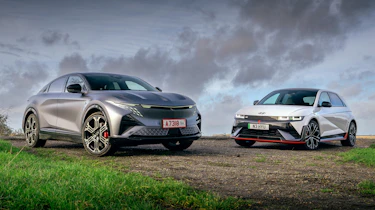
I don’t think it’s exaggerating to say that none of our recent twin tests would appear quite so alien to an evo reader of 25 years ago as this. Here we have a pair of two-ton semi-SUVs, powered by electricity alone, one hailing from Korea and the other from a brand that in 2001 was long defunct. Never mind being unrecognisable beside the performance cars of that era, a £65,000 Hyundai with over 600bhp would sound like it was from a different reality – another universe entirely.
Yet today, Hyundai’s Ioniq 5 N sets the standard among driver’s cars that feast on electrons rather than hydrocarbons. While Taycans, Emeyas, and i4s with M badges have demonstrated that electric powertrains can impress beyond their acceleration figures, it’s the 5 N (and its 6 N saloon sibling) that has pushed the bar higher still. As such, it is the benchmark against which any other EV with sporting pretensions must be measured.
The latest to take on that challenge is the Alpine A390, which as a high-riding four-door weighing over 2000kg appears alien in the French brand’s own line-up; the antithesis of its principles of light weight, agility and tactility for which it was until recently best known. Yet Dieppe insists that the A390 has been imbued with a more than detectable sense of ‘Alpineness’. Our first drive (issue 342) proved the car lived up to the claim in isolation, so now it finds itself getting an audience with the seemingly unbeatable 5 N.
More reviews
In-depth reviews
Editor-at-large and evo co-founder Dickie Meaden doesn’t approach this pairing with much in the way of detectable excitement. If you’re a regular reader of his columns, you’ll know why: these machines are the foreword to a future that many of us would rather not come to pass. All the same, the Hyundai, which we are already familiar with, soon has him cracking a smirk, the SEMA restomod looks aiding the recall of a driving experience that’s almost as amusing. I make a dive for it, leaving him to get acquainted with the Alpine.
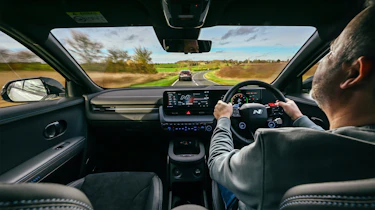
Being up close with an Ioniq 5 N confuses and pleases all at once. It’s always so much bigger than it looks in pictures, the giant door as prone to catching a sturdy gust of wind as the sail of an America’s Cup racer. Jump in and you quickly find a good driving position in the excellent bucket seats – impressive for a car with a ‘skateboard’ battery mounted below you. Then the endless configurable settings within the touchscreen confuse and frustrate, almost more so when you know what joy the right combination of settings grants access to. It’s a welcome mercy that you can save your preferences with the wheel-mounted N buttons.
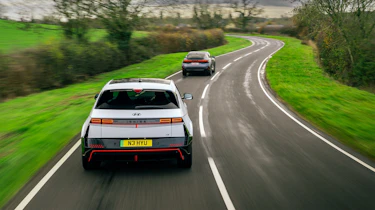
Engaging the most aggressive mode serves as an immediate reminder that, on bumpier roads, this car works best with the four-stage adjustable dampers slackened off slightly, to the second-firmest setting. Now the 5 N feels keyed into the road, refined enough but responsive and controlled, with decent weight and progression to the steering to boot. I default to engaging the simulated gears and engine sound; synthetic though they are, these points of interaction are an advantage that I’m surprised other performance EVs have been slow to replicate. Configured thus, the 5 N is a bit of a riot, a car that wants to put a smile on your face. That it’s also stupendously, dumbfoundingly fast is almost superfluous.
When we eventually stop to swap cars, Dickie delivers his initial impressions of the Alpine in a single line: ‘It feels quite good.’ Faint praise, or still forming a verdict? At least it sounds as though my own initial findings from the launch drive in Spain are holding up, so I’m keen to reacquaint myself with the A390.
Inside, it’s a mixed bag. Depending on where you look and what you touch, you’ll either find matt plastics from an old Renault, or nice Alcantara, metal and carbonfibre. The steering wheel is taken straight from the A290 hot hatch – no bad thing – and comes complete with overtake boost button and regen adjustment dial. All told, it’s probably a finer environment in here than inside the Hyundai, even if the latter’s seats are more supportive and can be set lower than the Alpine’s top-spec forged carbon-backed Sabelts.
The first stand-out engineering item is the dampers. Bravely for a relatively heavy and high-riding car, they’re passive, albeit with a long stroke and hydraulic bump-stops. Alpine considered adjustable items, but decided against them on the basis of reducing weight and complexity. It meant a lot of tuning and more than a leap of faith, but the result is damping that feels high quality at all times, with great body control that aids a swift build-up of trust. The ride is a bit thumpy around town, unable to isolate low-speed shocks such as speed humps and potholes, but it smooths out nicely at speed.
Further demonstrating the extent to which Alpine has gone to town on the engineering of this car is its tri‑motor set-up. Where the Hyundai has only a single motor at each end, the A390 has one at the front and two at the rear, the latter sitting shoulder-to-shoulder at the centre of the axle in a bespoke aluminium cradle. Why not just a single rear motor with a limited-slip differential? The engineers say two motors provide greater scope for the Alpine Active Torque Vectoring (AATV) software. You can adjust how this behaves via the Track Mode or in Perso under the ‘Agility’ banner. Also adjustable are throttle response and steering weight.
Alpine has exercised restraint where power is concerned. This being the top-billing, £69,390 GTS, we’ve got 464bhp to play with – positively conservative by hot EV standards and 177bhp behind the Hyundai’s peak. Not so middling is the 608lb ft torque figure – 62lb ft more than the 5 N. The A390 is certainly quick enough, pulling as hard as an A110 R from a standstill, as per Alpine’s claims. A playful car in prospect, then? Not quite.
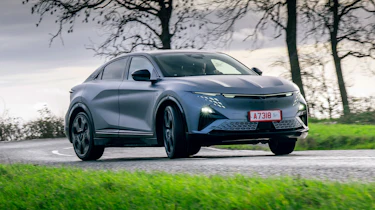
It’s agile, yes. The Alpine’s nose is incredibly pointy, thanks in part to the sharp (if a tad too light even in its heaviest setting) steering and also because of the push through corners from the AATV-activated outside-rear wheel. But it feels as though the amount of torque fed to that wheel is dictated on a linear curve by how much lock you’ve got on – the tighter you turn, the wider and more aggressively the car will spit with a glug of throttle. The A390 is also quicker to understeer than the 5 N if you don’t fully commit, which given the former’s clever rear axle doesn’t quite make sense, at least until you notice the Hyundai has 275-section front tyres, compared to the Alpine’s slimmer 245s.
Ultimately, this means a neutral, middle-ground cornering balance isn’t as accessible in the A390 as it is in the more progressive 5 N. The Alpine is a car you point and squirt, then you lean on the dampers and set it up using the rear axle, the Michelin Pilot Sport 4 S tyres skating if not outright spinning. It does at least brake with more consistency than (if not as much strength as) the Hyundai.
Another drive in the Ioniq 5 N confirms it is a more willing and engaging performance car. It’s faster, yes, and you’re interacting with it more thanks to the ‘gears’ and sound. But it’s the chassis and the way the power moves between the axles that feels more natural. It’s perhaps not as agile a car as the Alpine (the wheelbase is nearly 300mm longer), but the steering’s not as hyperactive and its rate of response is in tune with the rest of the car’s more fluid capabilities. The way the steering responds and builds friction is also more intuitive. The 5 N is biddable in that weighty, overpowered, oversized way that people familiar with Nissan GT‑Rs might enjoy.
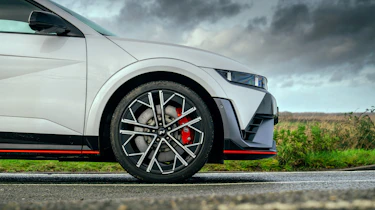
Despite their apparent similarities, the A390 and Ioniq 5 N are devices of a disparate nature. I admire the Alpine’s passive suspension set-up enormously, not least because it obviates the need for configuration by the driver. Even if the Hyundai’s adjustable dampers afford it more bandwidth, the Alpine’s ride feels special for more of the time. Between this, the dual motors on the rear and the AATV software, you can feel the depth of engineering exertion; it’s a car whose behaviour has been agonised over.
Yet the sum of the parts doesn’t equate to a better time behind the wheel than you’ll have in the Hyundai. The 5 N is simply the more involving, engrossing car. It’s also four grand cheaper, which is difficult to ignore even if Alpine claims it’s not a core rival. It’s more practical for passengers too, especially those in the rear quarters, thanks to its longer wheelbase and greater headroom. The ‘Tomorrow’s World on steroids’ vibe may not be to all tastes, admittedly, in which case the A390’s more subtle, premium presentation will enhance its appeal.
And the Alpine A390 is a great car. To be clear, its appreciable qualities are highlighted in the Hyundai’s company, not diminished. But it doesn’t thrill like the Ioniq 5 N and, on this most timeless of bases – one that would make as much sense in 2001 as it does in 2026 – the Korean car takes the victory. L