Best performance SUVs – supercar performance on stilts
High-performance SUV sounds like an oxymoron but in 2026, brute force engineering and clever chassis tech have given us some genuinely exciting fast 4x4s
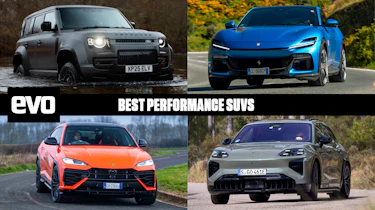
Performance SUV used to be an oxymoron on par with a deafening silence. But for some time now very serious brands have been throwing very serious money and engineering might at their attempts. The result has been a crop of super SUVs that can rival super estates for driver appeal and agility.
Everything from the Aston Martin DBX S, to the Ferrari Purosangue and even the flagship Land Rover Defender Octa, are genuinely thrilling cars in their own right. You only need a short drive in one to realise that these are cars that have been engineered to sit proudly in dealers alongside Vantages and 12 Cilindris.
To be clear, nothing on this list is ever going to beat a proper sports car for the thrill of driving. One of these go-faster (and louder) trucks is the family-friendly option to park alongside – rather than replace – your purpose built driving machine. A proper sports car, supercar or even fast saloon or estate will usually be physically lighter and occupy less space on the road than an SUV, even if trick suspension, rear steering and torque vectoring does work diligently to (not completely) disguise the mass of the best super SUVs.
The best SUVs to buy in 2026
- 1. Land Rover Defender Octa
- 2. Ferrari Purosangue
- 3. Aston Martin DBX S
- 4. Range Rover Sport SV
- 5. Alfa Romeo Stelvio Quadrifoglio
- 6. Porsche Cayenne GTS
- 7. Porsche Cayenne Turbo Electric
- 8. Lamborghini Urus SE
- 9. Bentley Bentayga Speed
- 10. Mercedes-AMG G63
Land Rover Defender Octa
- Price from: £147,245
- Pros – Engineering quality to rival a sports car
- Cons – At its best off the beaten track
- evo rating: 4.5 stars
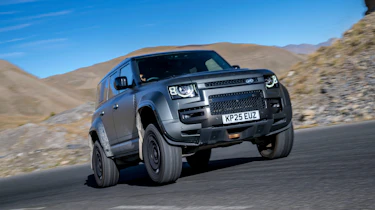
Did Land Rover really need to build the Octa given it already has a 5-litre nigh-on 500bhp V8 model in its line-up? If you happen to have a talented team of Special Vehicle Operations techs in the building it would have been rude not to and the resulting machine is truly staggering, redefining what it is to be a super-SUV by embracing the utility bit, to effectively become an M-powered Dakar truck with number plates. It pairs the 626bhp V8 familiar from the BMW M5 with trick hydraulically-linked continuously variable semi-active dampers and 400mm Brembo discs. But the Octa’s special talent lies in the way it combines all of its elements on- and off-road.
On the road the Octa is unexpectedly impressive, to the point it earned itself a spot on evo Car of the Year 2025, shrugging off the numbness and remote feeling that regular Defenders have, replacing those less-than-ideal attributes with a level of agility and ability that defies its 2585kg kerb weight. It’ll lift up its skirts and fly when you ask it, knocking off the 0-62mph sprint in 3.8sec when launch mode is activated which adds an additional 37lb ft to its already impressive 553lb ft torque peak. One catch for buyers in late 2026 and into 2027 however, will be that the Defender Octa will be dropping in power fairly significantly, from 626bhp to 533bhp, to aid its meeting Euro 7 emissions regulations.
It's equally impressive off-road too, dispatching rock climbs, gravel special stages or rugged tracks. In Octa mode, the Defender operates in another realm to any other super-SUV in not just tolerating unpaved routes, but ingesting them in a manner that would turn a DBX S’s optional 23-inch wheels into scrap metal.
> Land Rover Defender Octa review
Ferrari Purosangue
- Price from: £313,220
- Pros – Superb powertrain; impressive dynamic ability
- Cons – Complex UI; heavy
- evo rating: 4.5 stars
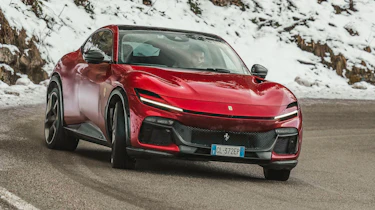
The Purosangue is undoubtedly the most divisive, unusual and complex SUV on sale, but somehow, Ferrari's engineers have moulded it into the most exciting of all to drive. Take one look at its technical specification and it's not hard to see why; with an astonishing 6.5-litre V12 up front generating 715bhp the Purosangue has the noise, drama and performance of a traditional Ferrari GT, even if it looks unlike anything we've seen from the brand before.
There's more under the skin. Ferrari has developed a unique suspension technology specifically for its first SUV, which uses electric motors to control the damping forces on the move to counter body roll and absorb bumps in a way that feels alien to most lead-footed, conventional SUVs.
The results are staggering on the road. Yes, the Purosangue sometimes feels synthetic and hyper agile in a way that reveals its electronic complexity, but no SUV feels as fluid, characterful or as playful at the limit.
But while the Purosangue feels more like a sports car than other car of this type, it's also deeply impractical compared to rivals like the Aston Martin DBX S. With four seats and a compromised luggage area, Ferrari has sacrificed some of the usability you'd expect from an SUV to deliver the most engaging, exotic car in the segment.
The Purosangue is soon to receive a Handling Speciale upgrade soon, reducing roll by 10 per cent thanks to a new calibration for the Multimatic suspension.
Aston Martin DBX S
- Price from: £210,000
- Pros – Drives like a super saloon rather than a SUV
- Cons – Looks like an SUV with a bodykit
- evo rating: 4.5 stars
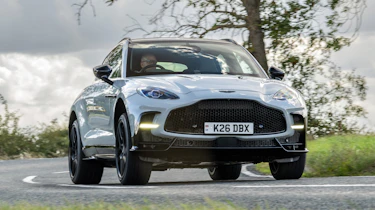
The thought of an Aston Martin SUV might make some enthusiasts squirm, but the DBX is one of the most desirable cars of its type – more rounded (and less ostentatious) than a Lamborghini Urus, more sensibly priced than a Ferrari Purosangue and more special than hot versions of more mainstream rivals from the likes of Range Rover, BMW and Audi.
The DBX707 was a dramatic step on from the original and eventually gained an upgraded DB12-style interior and infotainment system and Bilstein DTX dampers. The DBX S continues that good work, with a 47kg weight saving, retuned chassis and quicker steering.
Mercedes-AMG’s 4-litre ‘hot-vee’ twin-turbocharged V8 has uprated ball bearing turbos, a redesigned exhaust system and revised mapping to produce 717bhp and 664lb ft of torque, driven through a nine-speed auto with a shorter final drive. All that means a 0-62mph time of 3.3sec, and a top speed of 193mph. Thankfully, ceramic brakes come as standard.
As striking as straight-line performance figures can be, though, this isn’t where the Aston is most impressive. Instead, it’s the way it blends a fluid, GT-like feel with hot-rod performance and entertaining dynamics when the right buttons are pressed.
Range Rover Sport SV
- Price from: £146,195
- Pros – Dynamic quality has sports car level of detail
- Cons – The answer to a question no one really asked
- evo rating: 4.5 stars
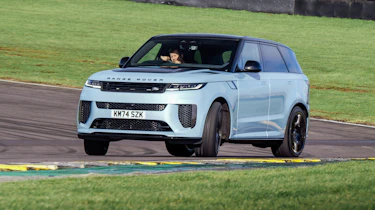
The previous-gen Range Rover Sport SVR was enormously fast and dripping with character, but for some, the rip-snorting V8 SUV was too brash to blend into everyday life as a Range Rover should. The fact that most were bright blue and fitted with 3D number plates didn't do much for its image, either.
For the new Sport SV, Land Rover has turned things around. With a stonking 626bhp 4.4-litre V8 it's a good deal faster than before, but all that potential is clothed in a more subtle design that doesn't draw as many eyeballs as before. Do you need carbonfibre wheels on your 2560kg performance SUV? Probably not, but specifying these and the SV's optional carbon ceramic brake package saves over 70kg in unsprung mass, enabling a 3.6sec 0-62mph time.
It has the chassis to back up the firepower, too. The SV uses clever cross-linked hydraulic suspension – similar to what you'll find on a McLaren 750S – to deliver a blend of comfort and control that's up there with the very best SUVs on the market. It even makes a decent impression on track, with a precise, honed feel and an exploitable balance.
Few customers will ever explore this ability, but it's good to know that Land Rover has engineered it into the SV. The Range Rover Sport SV will soon be off sale, with only the SV Ultimate Edition now available from retailers, as the current 626bhp version of the BMW M-sourced V8 faces discontinuation.
Alfa Romeo Stelvio Quadrifoglio
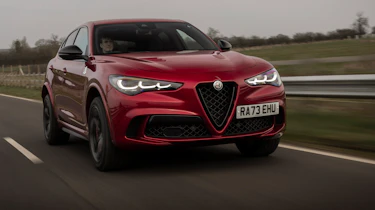
- Priced from: £96,090
- Pros – Genuinely fun to drive
- Cons – Less fun than a Giulia; almost £100k(!)
- evo rating: 4 stars
We adore the Giulia Quadrifoglio, but alongside the brilliant saloon there’s always been its Stelvio cousin, which is almost as good. Unlike almost all of the other options on this list, the Stelvio is relatively lightweight, its edges raw and its character dominant in a class usually defined by the lack of it.
The facelifted Stelvio Quadrifoglio packs the same muscular 513bhp 2.9-litre twin-turbo V6 as its saloon namesake and is capable of a sub-four-second 0-62mph time. The V6 is mated to the familiar eight-speed auto, recalibrated for its SUV application and teamed with Alfa’s Q4 all-wheel-drive system and for this latest model, a revised mechanical limited-slip differential. It’s this all-wheel-drive system that helps the Stelvio feel distinct from the saloon, trading a little of its ultimate agility and precision for the sake of improved traction but still with tractability thanks to the diff.
Left in its automatic mode it’s well-mannered and rapid above 3000rpm, but you’ll need to engage Dynamic or Race mode to feel the full force of the V6 with a sharpened throttle response and reduced shift times. Powertrain aside, the Stelvio Quadrifoglio has a highly entertaining chassis, with the same quick-witted steering feel you get in the Giulia – combine this with strong brakes and decent body control, it’s surprisingly engaging to punt along at speed.
> Alfa Romeo Stelvio Quadrifoglio review
Porsche Cayenne GTS
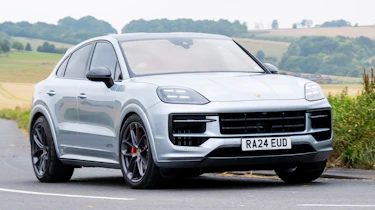
- Priced from: £114,045
- Pros – Class-leading dynamic quality
- Cons – Not as plush as you’d expect for the price
- evo rating: 4 stars
It’s the sporty SUV that started it all. When Porsche first announced it was putting its iconic badge onto something that wasn’t a low-slung sports car, there was outrage. Porscheophiles were out for blood, incensed that such an abomination should be signed off.
Then the first-generation Cayenne arrived, and once the outrage over the dilution of the brand (and the heinously ugly looks) died down, it became evident that Porsche’s chassis engineers had worked some magic on the Cayenne. It became a sales hit and can, in addition to Porsche’s early-noughties salvation, be credited with the rise of sporty SUVs.
Even with the proliferation of fancier rivals from proper supercar manufacturers, the Cayenne is still one of the best to drive. At the top of the tree is the monstrous, 729bhp Cayenne Turbo E-Hybrid, equipped with a twin-turbocharged V8 and a plug-in hybrid system. An optional GT Package transforms it into a more driver focused SUV with suspension geometry upgrades, ceramic brakes, carbonfibre exterior elements and a titanium exhaust.
But it’s the Cayenne GTS that’s arguably the sweet spot of the lineup, at £33k and 300kg less than the monstrous hybrid. No it’s not a flyweight but that’s far from an insignificant difference and the GTS is lighter on its feet as a result. ‘Just’ 493bhp might make it the motive minnow of this crop but that just means you can revel in the 4-litre twin-turbo V8’s personality for longer before speeds get silly.
Porsche Cayenne Turbo Electric
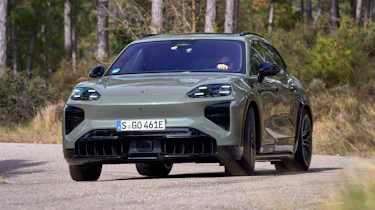
- Priced from £130,965
- Pros – Extraordinary performance and capability
- Cons – Can drink electricity when you use that performance
- evo rating: 4 stars
Porsche was too far down the road to change course when it came to the Macan and Cayenne Electric. The Cayenne’s introduction is conspicuous alongside the brand’s prominent walkback on its electrification plans elsewhere. Even though premium electric cars are struggling in terms of sales, however, that doesn't mean the cars themselves aren’t good.
As much is the case with the new Cayenne Electric, which is an extraordinarily fast and capable performance SUV. It’s also, in many ways, a better everyday car than the combustion version – more comfortable, more refined, more luxurious inside. Life is quite serene at the helm of a Cayenne Electric when cruising down the motorway.
Turn off onto some mountain roads and the exact spec and options list of the Cayenne Electric you’re behind the wheel of will come into play. If it’s a Turbo, it’ll have the torque vectoring diff on the back axle – good. But it won’t necessarily, unless the boxes are ticked, have rear steering and the hydraulically interconnected Porsche active ride damping system. Both of these are required to get the very best out of this extraordinarily performant SUV. So equipped, the Cayenne Turbo Electric feels more like a super estate than an SUV, defying the laws of physics.
> Porsche Cayenne Turbo Electric review
Lamborghini Urus SE
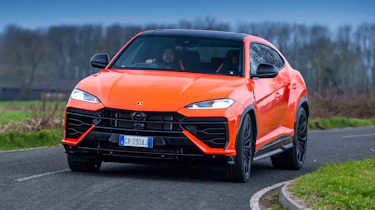
- Priced from: £210,000
- Pros – Brutally fast and now more playful than ever
- Cons – Fidgety ride; weight; top-spec Cayenne does most of the same
- evo rating: 4 stars
We’ll leave the debate as to whether companies such as Lamborghini and Ferrari should be offering SUVs to another day, but the sector is undeniably popular and thus tempting for marques in the business of big business (and bankrolling low-volume supercars that shore up brand image). Lamborghini got in early as the first proper supercar brand to approach the SUV genre in this new era. Revealing the Urus all the way back in 2017, it swiftly reaped the rewards, with the model delivering Lamborghini the deliciously lucrative combination of high sales volumes and high profit margins. Post-pandemic the Urus evolved into a two-pronged lineup, in the Urus Performante and Urus S. Both pure-petrol, each featured the Lamborghini-fettled version of the Volkswagen Group 4-litre twin-turbo V8 putting out 657bhp and 627lb ft of torque.
They were potent enough for most but compared to 2024’s Urus SE and indeed, a number of rivals also listed here, 657bhp is chump change. The newly hybridised Urus SE now puts a combined 789bhp and 700lb ft underfoot. It might be the fastest Urus yet – good for 0-62mph in 3.4sec – but it’s also the most versatile, being also capable, in theory, of 37 miles of all electric driving.
As with virtually all performance SUVs there are a plethora of different driving modes to choose from, but it doesn’t take too long to settle on a setting that suits most driving situations. On smooth surfaces the Urus’s chassis can deliver physics-defying agility, but rougher roads upset its composure, especially with ludicrously large 22- or 23-inch rims.
The Urus SE goes some way to rounding off the rough dynamic edges of the original ICE-only Uruses. It’s also a marginally more attractive thing to behold, relatively speaking of course… The upcoming Urus SE Performante could move things on again and will certainly be more performant, now with 801bhp.
Bentley Bentayga Speed
- Priced from: £223,600
- Pros – Polished dynamics; you don’t miss the W12
- Cons – DBX S-rivalling price; aging design inside and out
- evo rating: 4 stars
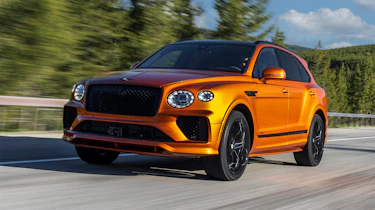
What is there to say about Bentley’s SUV that hasn’t already been said? It’s fast (193mph), heavy (2500kg-ish) and expensive, with V8 and V6 hybrid powertrains available, as well as two bodystyles – standard and extended wheelbase. It’s always been a divisive car, in concept and in the way it looks, but it continues to fight near the top of the SUV tree with a compelling blend of luxury, comfort, refinement and huge pace – especially in Speed trim.
The latest Speed ditches Bentley’s traditional W12 engine, in its place a twin-turbo V8 with 641bhp. The performance is faintly absurd, with the Speed cracking 62mph in a supercar-rivalling 3.4sec and pulling to over 190mph, and thankfully Bentley has installed a suite of chassis tech to manage it all. There’s revised adaptive damping, four-wheel steering, an e-diff and optional ceramic brakes, all of which gives the Speed a level of dynamic ability that doesn’t square with how it looks, or how much it weighs.
It’s not as sharp or exuberant as the most aggressive versions of the Porsche Cayenne or Lamborghini Urus, but it’s far more luxurious than both. It’s a decade old now, but the Bentayga still has a blend of opulence, quality and performance that not many high end SUVs can match.
> Bentley Bentayga Speed review
Mercedes-AMG G63
- Priced from: £190,975
- Pros – An engineering triumph in excess
- Cons – Less is more
- evo rating: 3.5 stars
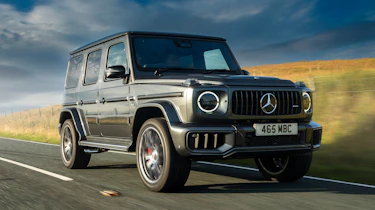
Whereas Land Rover completely modernised the Defender to create the current model, Mercedes designed the latest G-Class through rose-tinted glasses. It looks pretty much as it always has, its squared-off bodywork reminiscent of the 1979 original, but beneath the skin lies a tech-packed interior, some modern chassis hardware, and if you go for the full-fat AMG G63, a 4-litre twin-turbo V8. It doesn't make much sense on paper, but in practice the G63 is undeniably appealing, and would have even the most hardened cynic cracking a smile at just how ludicrous it is.
577bhp in a breeze block with side-exit exhausts will do that. The G63 is a symbol of excess, and objectively not a patch on more sophisticated and dynamic performance SUVs like the Defender Octa and Aston Martin DBX. But that's not the point. The G63 is all about feel-good factor, from its looks to its bombastic engine and the satisfying chink when you shut the doors, and the current version backs this up with more refined road manners than ever.
Again, it's no sports car on stilts, but standard Active Ride Control suspension and adaptive damping helps control the body and absorb bumps, to the point where driving a G-Class is no longer a chore. You could happily use it as everyday transport without the novelty wearing off.