Land Rover Defender Octa review – the super SUV that’s more fun than sports cars
Put aside your SUV cynicism. The Land Rover Defender Octa is a triumph, with 911 GT3 levels of engineering making it an unexpected thrill to drive
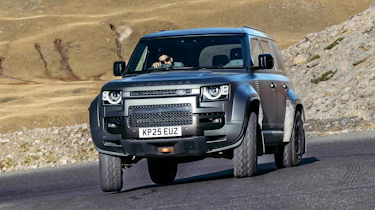
Land Rover and its Special Vehicle Operations division could have made the Defender Octa a straight down the line, blinged-up super SUV with more power and bigger arches to rival the Mercedes-AMG G63, and the Nitra facility in Slovakia would have been lit day and night, building them to meet demand. But it didn’t take the easy route, with the Defender Octa proving more akin to the Lamborghini Huracan Sterrato and Porsche 911 Dakar, in terms of how richly detailed an engineering exercise it is and how an off road-ready vehicle can appeal to evo sensibilities. It’s turned Tarquin and Tabitha’s school run bus into an SAS-spec super truck.
There are, of course, many questions surrounding the Land Rover Defender Octa. You will undoubtedly have potentially just one of your own: why? Why build a 626bhp high performance version of a slab-sided, snub-nosed SUV aimed at the UK’s upper-middle class. Conventional wisdom suggests that if you’re going to build a performance car you wouldn’t start with a Defender. Unless, of course, your team has previous where mad performance projects are concerned – see Jaguar Project 7 and Project 8 – and are stuck for something to do, and have the father of the Ford Raptor, Jamal Hameedi, at the helm.
More reviews
In-depth reviews
Long term tests
- Living with the Land Rover Defender 90, the world's first V8 hot hatch
- Land Rover Defender 110 Fast Fleet test – 9000 miles in the go-anywhere SUV
Reviews
- Land Rover Defender V8 (2021 - 2026) review – Britain's Mercedes G63 rival is no more
- Land Rover Classic Defender V8 2024 review – driving a £190,000 Land Rover
- Bowler Defender 2023 review
- Bowler Defender Challenge 2022 review – the ultimate off-road toy?
- Land Rover Defender 90 X P400 2020 review – heart over head
The results of their efforts are unexpectedly brilliant, and endearing to anyone who enjoys driving. The Octa really could be all the car someone could ever need, and it impresses in its unique way as much as a blue-blood sports car.
Engine, gearbox and technical highlights
Land Rover’s entry into the Dakar, with the Octa being the racer’s road-going allegory, should be enough of an indication this is not your standard ‘super SUV’. Beneath the wider bodywork (+68mm) and increased ride height (+28mm) lies a BMW-sourced 4.4-litre twin-turbo V8 engine and SVO’s 6D Dynamic chassis tech, both seen on the Range Rover Sport SV. The engine is a known quantity and related to that of the latest M5, but it’s been fettled for JLR’s use, with 626bhp delivered from 5855-7000rpm and a peak torque figure of 553lb ft served up between 1800-5855rpm.
Performance figures depend on whether you fit Goodyear Wrangler RT off-road rubber, standard all-terrain tyres or Michelin all-seasons. With the latter, 62mph is dispatched in 4sec, and the top speed is 155mph. Not bad for a 2510kg lump…
The 6D tech is the defining piece of the Octa puzzle. The system includes hydraulically-linked continuously variable semi-active dampers, and does without anti-roll bars. When off-road it provides an additional 119mm of axle articulation, and on-road allows for much flatter and calmer cornering. Each damper is equipped with its own Load Distribution Unit (LDU) that controls the three individual valves they have, with the valves controlling rebound and compression and the LDU managing the system’s hydraulic pressure accordingly.
Rob Patching, Technical Specialist at JLR SVO and a key figure in the development and testing of the Octa, told us the system was benchmarked against that of the McLaren 720S. Many confuse 6D with being a copy of the McLaren system but will be reminded, the McLaren doesn’t feature pitch control.
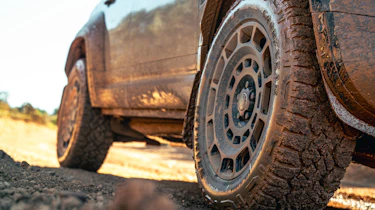
Unlike on the SV, the 20-inch ‘motorsport’ wheels aren’t formed from carbon-fibre, but the brakes behind them are still suitably impressive Brembos with the front discs measuring 400mm. The software to manage the existing and new hardware is equally bespoke.
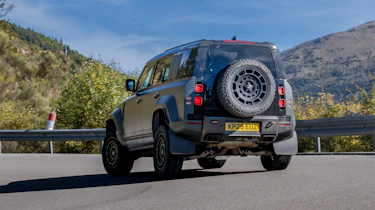
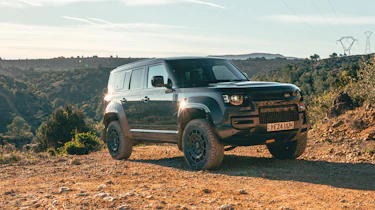
If such things are possible, the Octa makes a regular Defender look a touch meek. Its wider arches and elevated ride height give its appearance more attitude as well as altitude, its wheel design more Sahara functional than Kings Road statement. Whether on French rally trails or climbing up the side of a Scottish mountain, the Octa looks like it's on a special-ops exercise, or about to mount an assault on Skyfall. There’s a real purposeful look to it, with nothing that appears tacked on, quite unlike some aftermarket attempts to add visual menace to a Defender.
Driver’s note
‘The Octa is a comfortable, easy car to cover big miles in, and its V8 is relatively calm. The old 5-litre V8 Range Rover Sport SVR used to sound like an entire Goodwood Revival grid was squeezed under its bonnet. Modern regs mandate the Octa’s V8 be a little more muted, but it’s a lovely engine: smooth and seriously muscular.’ – James Taylor, evo Deputy Editor, who tested the Land Rover Defender Octa on the road
Performance, ride and handling
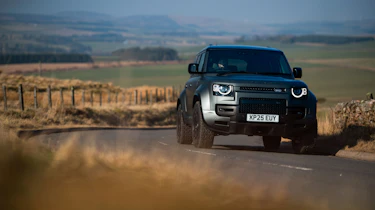
On the road, there’s some tyre noise from the optional Goodyear Wrangler ‘advanced all-terrain’ tyre fitted to the test cars we’ve driven. It’s the most extreme of three options, lumbering the Octas to which it’s fitted with a 100mph speed limit. You can have a ‘standard’ all-terrain tyre on the 20-inch wheel, which is limited to 130mph. There’s also a 22-inch wheel available either in black or with diamond-cut detailing, which wears a Michelin all-season, allowing a 155mph limited top speed.
The tread blocks of the pro off-road tyre aren’t shy in moving around as you put some load through the steering, but not to the point of adverse distraction. You can take advantage of the added flex in the rubber and the tighter chassis to carry some attitude through corners, leaning more on the car’s outer edges and letting it move around much more than you’d feel comfortable with in a Defender 110. The Defender Octa on these monster tyres feels entirely liberating, soaking up and shrugging off the kind of potholes that would render any supercar, and most other super SUVs, embarrassingly immobile.
What sends a bone-shattering shudder through the frame of a Urus or X6M begins and ends with a badum in the Octa. The compliance and composure means you’re free to explore the Octa’s dynamic talents all the time, on any kind of road. The suspension system is enormously intuitive, allowing just the right amount of pitch, heave and lean to signal where the load is. It always feels like you’re managing a hefty vehicle, but the enormous forces at play are contained far, far beyond the point where a standard Defender would be crying enough.
With each mile the Octa gives signs that there’s depth beneath the initial numbness and remoteness it has compared to a road-biased performance SUV, like a Cayenne. On fast, open roads where there’s more momentum behind you and less opportunity to work through the initial vagueness of the steering, it can be a little tricky to bond with. But soon your confidence and commitment grows, particularly when slower, tighter corners present themselves, and the Octa starts expressing itself in a way that calls to mind an Ariel Nomad. Only bigger, and without a constant assault from the elements.
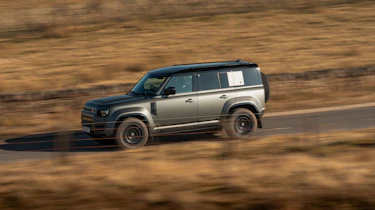
Fitted with longer wishbones (hence the Octa's extended width) it takes a four-square stance on the road, reacting to steering inputs cleanly and with the movement through the front wheels separated from the feedback of the tread blocks shuffling about. It makes for a Defender you want to set-up for a corner: pick a turn-in point, pour it in, wait for the settle then tap into the V8 to top-up your corner exit speed. Naturally there’s a drive mode to up the on-road ante, with Dynamic tightening the steering, boosting the throttle’s sharpness and increasing roll resistance by 67 per cent and maximising pitch control; the changes feel more authentic here than they do in the majority of cars when you cycle through their drive modes.
Where a single press of the Octa button on the base of the steering wheel activates Dynamic mode for the road, hold it down longer and you’re into Octa off-road mode – the car’s high performance off-road setting. Not only does it allow you to use the off-road launch control function, it also halves roll resistance pressure in the dampers, removes pitch control and increases wheel travel.
It also shifts more power and torque to the rear axle, maximises the damping force depending on the surface and with the stability controls slackened it also adapts the car’s ABS software to allow more lock up to allow a build up of loose surface material to form in front of the tyres to aid retardation. On tarmac, Octa mode replaces the neater cornering attitude of Dynamic with something much more expressive. The lean (and slip) angles can get quite large, but so too the entertainment factor. Hustling the Octa along, managing its weight and feeling it move beneath you in a wide window of slip is a unique thrill among fast SUVs.
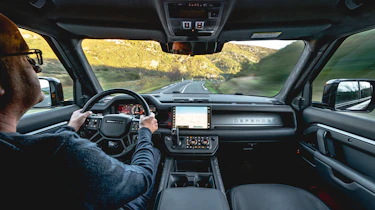
It’s quick, too. Even with its claimed unladen weight of 2585kg the V8 has the guts – 553lb ft or 590 in launch mode – to give it the hurry up, the Octa’s 246bhp/ton a little shy of Audi’s latest RS3. While its mass means its off the line punch isn’t a match for the hyperhatch, once the Octa is up and running it gathers momentum with serious pace, yet remains controlled rather than reaching an uncomfortable edge, managing its mass and bulk and throwing up no surprises. Call on its 400mm and six-piston front Brembo discs and calipers and the physics are harder to mask, but it pulls up consistently with only the slightest squirm from its Wranglers.
On the road the Octa is unexpectedly impressive. It’s not simply a Defender with the wick turned up, and there are many layers to peel away and explore beyond raw performance. Adlard and his team, led by Matt Becker, have created a Defender with a totally unexpected level of on-road ability and agility. It might say Defender on its bluff nose, but how it takes on a road is unlike any other. And that’s before you’ve explored what it's really designed to do…
Off-road test
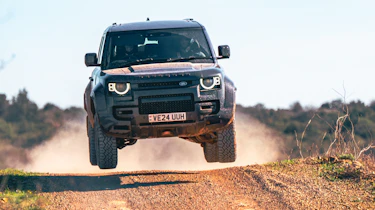
At Chateau Lastours, an 800 hectare estate that, along with producing its own wine, is home to 80 kilometres of off-road test tracks, the Octa feels immediately at home. The SV team spent as many hours here as they have anywhere else, primarily fine tuning the air-springs, semi-active dampers and the ABS braking system.
From the on-site hotel car park to the 300 metre climb to the wind turbines at the summit, the first section we drive feels no more challenging than a track that runs through a stately home. Until you clock the regular Defender support vehicle behind is dropping further and further back every few metres.
We’re still in Grass, Gravel and Snow mode selected via the Terrain Response system, but such is the breadth of the 6D chassis our speed is nearly double that of our followers. It’s down to the composure and bandwidth of the dampers allowing the car to float over the surface as each corner absorbs each impact it faces with engineered excellence. While the Octa’s cabin remains calm and comfortable, the occupants behind are on the brink of being moved uncomfortably around the cabin.
A rock crawl climb is dismissed with ease as we cut across to our final destination, the Octa’s revised bumper design providing the required approach and departure angles, the differentials and head spinning software managing the torque distribution at each wheel.
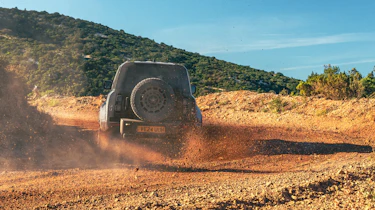
But a Defender chewing through rocks is nothing new. A Defender taking on a WRC stage and not making a fool of itself is, however. Across a loose surface it moves around with an eerie precision, every one of your inputs faithfully performed beneath you as this five metre long SUV pivots, slides and glides like a late Nineties-era Evo across a snow covered supermarket carpark.
With every corner, high speed braking area and rut and crest you learn something new about the car. It will pull off the most ridiculous drifts through 180-degree hairpins, your right foot managing the slug of turbocharged torque, your hands winding lock on and off as those meaty Goodyears bite through the surface to find traction with the tenacity to match a Cup 2 R gluing itself to the tarmac through Eau Rouge.
At the end of the longer straights the Octa delivers another of its party pieces: its brakes. Hit the left pedal as hard as you can and while your brain tells you this is going to result in ABS intervention and very little retardation, the exact opposite happens. The ABS kicks in later as the front wheels lock for longer to build that wall of debris to help slow you, and boy does it stop with an unexpected force.
The way the Octa draws you into the action, engages you and just wants to have fun is something that never leaves you even months after driving it. This is a luxury super SUV that could dispatch a middling Pennine as a house spider would a shagpile rug; a performance car with a breadth of yobbery that includes being able to jump over a roundabout, as well as drift around it.
Driver’s note
‘It takes some time to feel truly comfortable in the Octa. It’s such an enormous, heavy car and on off-road rubber it can feel a bit vague, but throw it at a few corners – preferably slower ones with room to play with – and it reveals how friendly and playful it is. The way it slips, slides and rolls is hilarious, and completely addictive.’ – Yousuf Ashraf, evo Senior Staff Writer, who tested the Land Rover Defender Octa on the road
MPG and running costs
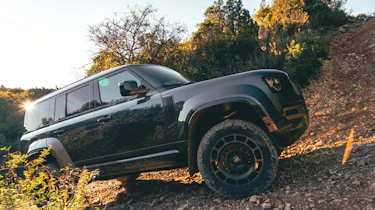
We had the pleasure of running a Defender Octa for over six months on evo’s Fast Fleet, where it made a compelling case as an only car – enormously practical and robust to take on any challenge as a daily driver, but also an enormous laugh any time its bluff nose was pointed at an interesting road.
Running costs weren’t its strong suit, however, which shouldn’t come as a surprise for a 2.5-ton bus with a 4.4-litre V8, riding on knobbly off-road rubber. Expect mpg in the low twenties, sometimes in the high teens, in mixed use.
In the name of consumer testing, we tested the Octa on all manner of surfaces and conditions – from off-road trails to the Goodwood Motor Circuit, which inevitably took its toll on the tyres. Expect to pay around £1000 to replace all four with all-terrain items.
Interior and technology
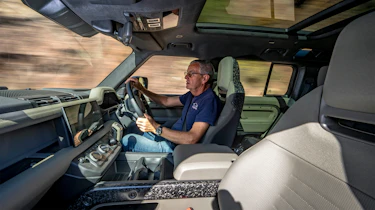
Given its extra ride height, you need a little more energy to make the step up to the Octa's cockpit, once there you’ll find surface-level changes rather than a more comprehensive overhaul – a bit of a shame considering the price. Despite lashings of chopped carbon trim and leather it’s still more of a functional than outright luxurious, particularly compared to conventional performance SUV rivals like Aston Martin’s DBX.
Still, there are new Performance seats up front with ‘body and soul’ rumble tech to give your music extra thump (the Octa development team delivered a diplomatic response when asked if they’d prefer the seats to be a little more motorsport inspired than they are). Elsewhere there are garish forged carbon trim elements that will no doubt prove popular. The shift paddles with clear – and + tabs that glow red in Octa mode are new, as is the Octa button below the steering wheel.
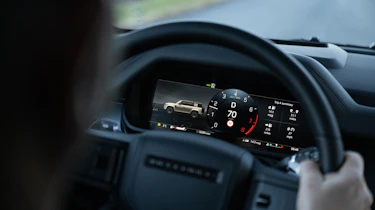
Tech wise, you get a fully digital dash and JLR’s standard issue central infotainment touchscreen. It’s one of the easier interfaces out there with crisp graphics and a modern-looking UI, and the Octa thankfully still has the standard car’s physical climate controls beneath the screen.
evo Car of the Year 2025 result
While John Barker is a sucker for V8s, he’s also usually front of the queue when it comes to pointing pitchforks at SUVs. So we were all a little taken aback by his enthusiasm for the Defender. ‘You need it in Octa mode. This is when it falls onto its rear powering out of corners. It unlocks the car, unshackles it,’ he enthused, adding: ‘Loved it. A jacked-up hot-rod.’
‘I love having stuff like the Octa in eCoty. It rams home the fact that this is a test unlike any other,’ said Henry. ‘When you’ve unlocked Octa mode and found the confidence to chuck that much weight around on tyres that squirm like a schoolboy caught eating sweets in class… then it’s a riot.’
Yousuf was initially left cold: ‘I was thinking, why have we brought it?’ But then he had the drive. ‘I honestly had one of the best drives of the test in the Octa. The way you can get it up on its toes, adjust it with weight transfer or the throttle coming out of corners… just hilarious.’ JB scored it level with the GT2 Stradale, and overall it was ranked tenth out of 12 contenders.
Price and rivals
Land Rover charges £148,045 for the Defender Octa with that price climbing to £158,045 for the Octa Black, which gets diamond-turned 20-inch wheels, black exterior detailing and different seat trim inside.
Because SVO has elevated the Defender Octa above the usual crop of ‘super SUVs’, it's mostly beyond conventional comparison. While an AMG G63 at £189,375 might seem like a suitable rival, if you asked it to do what an Octa can, you’d learn a very expensive lesson in why you shouldn’t over-estimate a car’s ability based on how hefty the door feels.
Aston Martin’s DBX is a more sumptuous and conventional answer to the fast SUV question, with dynamics that resemble a supersaloon rather than a trophy truck. The latest DBX S, with its 717bhp V8, is significantly more expensive than the Octa at £210,000.
At that level there’s also Lamborghini’s Urus SE to consider, which offers a huge hit of performance from its hybrid V8 and more flamboyance in its design and interior, but far less of a sense of purpose and authenticity than the Land Rover. For less money – £166k – the GT Package-equipped Porsche Cayenne Turbo E-Hybrid does much of the same as the Lambo, both offering handling ability that belie their size and weight, if not the grin factor of the Octa.
You could buy a couple of £68,970 Ariel Nomad 2s for the price of one Octa, and that’s really the only option to have more fun in a road car off the beaten track, now that the Lamborghini Huracan Sterrato and Porsche 911 Dakar have been taken off sale.
Land Rover Defender Octa specs
| Engine | V8, 4395cc, twin-turbo |
| Power | 626bhp @ 5855-7000rpm |
| Torque | 553lb-ft @ 1800-5855rpm |
| Weight | 2510kg (253bhp/ton) |
| Tyres as tested | Goodyear Wrangler DuraTrac RT |
| 0-62mph | 4.0sec |
| Top speed | 155mph (all-season tyres) |
| Basic price | £148,045 |