Lexus GS review - the alternative executive car choice
Japanese executive saloons offer a different take on the Germanic norm, with mixed success
evo Verdict
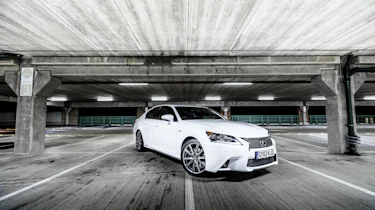
Just as the E-Class and 5 Series play supporting roles to the S-Class and 7 Series, so too does the Lexus GS under the LS. The GS arrived shortly after the LS, and, like all the Lexus range, has focused on hybrid power in recent years.
Unlike the CT 200h that starts the Lexus range, or its RX SUV sibling, the GS is offered with a choice of two disparate hybrid powerplants. The GS 300h features a 2.5-litre four-cylinder petrol engine and in GS 450h form there’s an electrically assisted 3.5-litre V6 behind that bold spindle-shaped front grille.
Recently, Lexus has also added a thundering GS F model to the range, with a 5-litre naturally-aspirated V8 to counter the downsized turbocharged units of more recent super saloons. In a market where even the German brands now offer hybrid models in addition to their petrol and diesel variants, the atmospheric GS F is perhaps the most unusual, and compelling model in the GS range.
evo Tip
A big value package, the GS offers the sort of standard equipment levels in entry-level models that buyers of German rivals could only wish for. The hybrid powertrains were once something of a USP, but both Mercedes-Benz and BMW offer hybrid versions of their E-Class and 5 Series respectively now with electrically assisted petrol engines.
More reviews
BMW’s 520d is only a few grams off the GS 300h’s emissions output too, and betters its official combined consumption figure. That 520d will also reach 62mph some two seconds quicker than the Japanese contender, which seals the Lexus’s fate here.
evo Comment
Like its other hybrid Lexus relations the GS makes a lot more sense outside Europe, where diesel engines aren’t so heartily embraced. The USA is a good example, where the GS’s power and consumption make it a far more popular proposition. If we’re being cruel we'd say that US roads suit its demeanour, too, as, while it’s among the better handling Lexus models, it trails its rivals for agility. That’s not to say it’s not competent, it just fights in a class where excellent is the norm, which makes it difficult for the GS.
That hybrid system brings with it a few compromises, too, not least the need for a continuously-variable automatic transmission, while commendably quiet at a cruise, the peace is broken when you ask for the engine and motor's full output.
It’s a different driving experience then, and one that used to be justifiable thanks to the tax-cheating numbers associated with the hybrid powertrain, but diesels have long offered better performance and economy - if not quite the outright emissions - and the hybridisation of the European offerings is now growing apace.
Performance and 0-60mph time > Basic hybrid model is slightly hamstrung by its four-cylinder layout, but the GS 450h is punchy and the GS F really quite brisk, with a 4.6-second 0-62mph sprint.
Engine and gearbox > Hybrid models both use continuously-variable transmissions, with four cylinders for the GS 300h and six for the GS 450h. GS F gets five litres, eight cylinders and dispenses with the hybrid components.
Ride and handling > Perhaps the best Lexus to drive, in all its iterations. GS F is a highlight - not quite an M5 or Panamera in the corners, but agile, grippy and fun.
MPG and running costs > Official figures for the GS 300h just nip 60mpg in some trim levels; real world economy likely to be lower.
Prices, specs and rivals > The GS's main problem isn't its pricing, which is competitive, but the talent of its numerous rivals. Standard equipment levels are very high, though.
Interior and tech > Not the most imaginative or beautiful of cabins, but certainly among the highest-quality. GS F adds desirable sports seats and neat adaptive TFT dials.
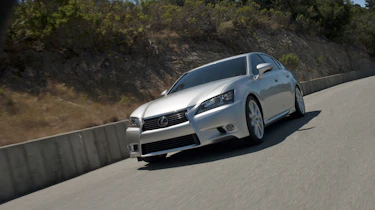
Design > Distinctive and modern, yet understated. Range-topping GS F adds a welcome dose of aggression and some eye-catching paint schemes.