760bhp Aston Martin DBS GT Zagato revealed – with 3D-printed gold details
The model completes the DBZ Centenary Collection, sitting alongside the DB4 GT Zagato continuation
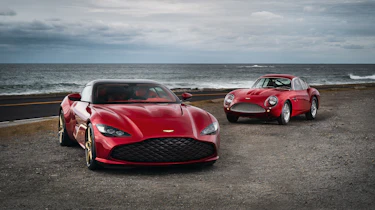
Following the reveal of the first of Aston Martin’s DB4 Zagato continuation cars, now the first production DBS GT Zagato – the modern-day, DBS Superleggera-based counterpart to the aforementioned DB4 – has made its debut at Audrain’s Newport Concours in the US.
The models will be sold exclusively as a pair for an eye-watering £6million, plus local taxes, yet despite the sky-high price tag, that’s still £3-4million less than an original DB4 GT Zagato on the classic car market. Together, they’re known as the DBZ Centenary Collection, an exclusive duo commissioned to celebrate 100 years of Zagato, the last 58 of which it has enjoyed a close working relationship with Aston Martin.
> New Aston Martin DBS Superleggera review – a mighty V12 GT with supercar speed
Just 19 pairs will be built, with the DBS models built at Aston Martin's Gaydon factory and the DB4s at Aston Martin's Works facility in Newport Pagnell. As with the earlier DB4 GTs and the recently announced James Bond DB5 continuation cars, the DB4 GT Zagato will not be homologated for the road, meaning it’s limited to ‘track use only’. Unlike the Bond and DB4 GT specials, however, this isn’t the first time the Zagato has been treated to a factory rebirth. The original was built between 1960 and 1963, but there were two further batches of cars in 1988 and 2000, known as Sanction II and Sanction III versions respectively.
The latest DB4 GT Zagato will closely follow the template of the ’60s original though, meaning it’ll get thin-gauge aluminium panels covering a lightweight tubular spaceframe chassis. While the early cars were powered by a 3.7-litre straight-six, the new car will feature a larger version of the 4.7-litre unit, borrowed from the DB4 GT continuation. Peak power is rated at 'over 390bhp', with power being sent to a four-speed manual transmission that drives the rear wheels through a limited-slip differential. Each car will also be treated to some subtle modern upgrades to improve reliability.
The DBS GT Zagato features typically Zagato elements, such as the simple, open-mouth grille and cockpit-like glasshouse, referencing modern and historical elements of Zagato design. Of course, a double-bubble roof also features, a solid carbonfibre canopy that eliminates the rear window in this instance, meaning a virtual rear-view mirror is used in its place. The standout feature of the model is its ‘dynamic’ grille, featuring 108 carbon, diamond-shaped pieces that remain closed when the engine is switched off, and open once the V12 is fired into life, allowing it to breathe. A bump of 45bhp over the DBS Superleggera upon which it’s based puts it at 760bhp. Performance figures haven’t been provided, but the standard Superleggera reaches 62mph in 3.4sec and can go on to 211mph.
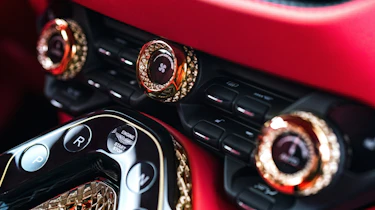
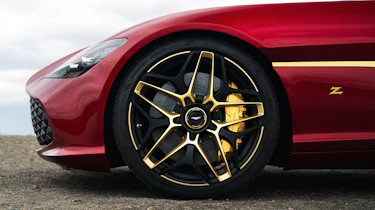
Exclusive to the DBS is Supernova Red paintwork, contrasting exposed carbonfibre accents, ‘twill’ carbonfibre shift paddles, Zagato ‘Z’ seat quilting, and gold... lots and lots of gold. The badges, front and rear, are solid 18-carat gold, the side strakes and centre-lock wheel nuts are anodised gold, and inside, the world’s first application of 3D-printed carbon and metal elements in a car adds a unique parametric, interlocking gold design. The printing can be done in carbon, aluminium or, with the Centenary Specification as seen here, gold (PVD).
Marek Reichman, chief creative officer of Aston Martin Lagonda, said: ‘This is a car that is not only focused around beauty, but drama too. Our dynamic grille gives us an opportunity to provide the car with two very different identities. When parked, DBS GT Zagato will almost look like it’s resting, but with the rear of the car still appearing muscular and primed for action. Only on start-up will the car truly become alert and ready to perform, delivering both an aural and visual treat for onlookers.’
As mentioned above, the pair will reach their respective owners around one year apart – the DB4 Zagatos towards the end of this year, and the DBS GT Zagato around 12 months later in 2020.