AC Cobra 289 review – British sports car with an American V8 heart built to fight Ferrari
A British sports car combined with American muscle proved a potent and intoxicating combination
By comparison to a Mercedes-Benz 300 SL Gullwing, the Cobra couldn’t be more different. Where the Mercedes broke new ground to exemplify what would now be termed a full OEM approach to building a world-beating road car, the Cobra sprang from US hot-rod culture. Created to win races and put noses out of joint, it excelled at both.
The ’60s saw a radical shift in sports car design, with Ferrari and Ford building mid-engined race cars to compete at Le Mans. Just as Cooper revolutionised Grand Prix racing by placing the engine behind the driver, so the 250 P – Ferrari’s first mid-engined car – and 250 LM, along with Ford’s GT, pioneered mid-engined design in endurance racing.
The switch wasn’t as complete as in single-seater racing, and it would take the rest of the decade for this technology to transfer to road car design, but the advantages of a low frontal area and centred mass were undeniable. When the 250 P won Le Mans at its first and only attempt in 1963, not only was it the first mid-engined car to do so but it began a mid-engined winning streak that remains unbroken to this day.
AC Cobra in detail
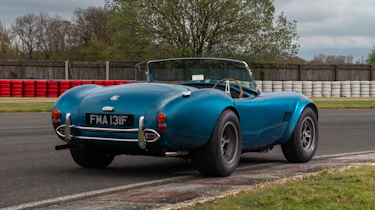
Though it appeared just a year before Ferrari’s mid-engined revolution, the Cobra sprang from simpler times. In seeking to combine the lightweight build and dynamic prowess of the best European sports cars with the blood-and-guts power of a large-capacity home-grown American V8, retired Texan racing driver Carroll Shelby paired the pretty but underpowered AC Ace with a small-block Ford V8, initially in 260 cu in (4.3-litre) for the MkI and then 289 cu in (4.7-litre) capacity for the MkII.
It made an immediate impact. When American magazine Road & Track tested the first 260 cu in prototype in the summer of 1962, it hit 60mph in 4.2sec, 100mph in 10.8sec and topped 150mph. This was big-league performance that immediately captured the imaginations of press, public and racers alike.
More reviews
The recipe was dynamite, so even though it was a production-based car rather than a pure prototype, the Cobra would enjoy international racing success. It passed through numerous iterations in the space of five years, including the dramatic Kamm-tailed Shelby Daytona that achieved the Cobra’s best results, and special Dragon Snake and Slalom Snake versions built for drag racing and autotesting respectively.
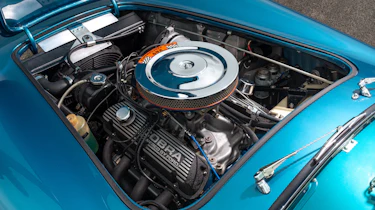
The quest for more speed then saw Shelby swap the 289 for the humungous 427 cu in (7-litre engine). This new MkIII required extensive modification to the chassis, including thicker tubing to add strength to the frame, and coil springs to replace the MkI and MkII Cobra’s transverse leaf-spring setup. It also featured much wider bodywork, with muscular wings, a larger radiator and dramatic side-pipe exhausts.
Packing 485bhp and 480lb ft of torque into a car with a dry weight of 1067kg meant the 427 was an absolute monster, though its rocket-sled straight-line speed came at the expense of the 289’s sweeter handling balance. It was a compromise that Shelby’s legendary test driver Ken Miles was quick to point out. Not for nothing did he christen the first big-block development car ‘The Turd’, but with time he would manage to polish the 427 into a race-winner, if not at the level of the 289.
In 1965 Miles drove a 427 for Car & Driver magazine, recording 0-100mph in 8.8sec, 0-100-0 in 13.8sec (with no ABS, don’t forget!) and covering the quarter-mile in 12.2sec at 118mph. Top speed? 165mph. It’s those numbers, not to mention the notion of such a huge engine in such a light car that ensure the 427’s reputation transcends its achievements. Much like the Blower Bentley, in fact.
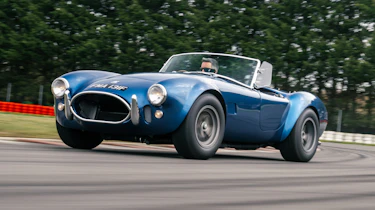
The car you’re looking at here isn’t a 427. Technically it isn’t even a Cobra, at least in name. Officially known as the AC 289 Sports MkIII, it is one of the rarest and least well-known of all the Cobra variants. Built not by Shelby in the US but by AC Cars in leafy Thames Ditton, Surrey, the arcane designation reflects a souring of relations with AC’s Stateside partners Shelby and Ford, yet denotes what true aficionados regard as the sweetest of all Cobras.
Built principally for the UK and Europe, it kept the 427’s much-improved coil-sprung chassis and more muscular bodywork (albeit with slightly less fulsome haunches) but replaced the sledgehammer 7-litre with the less explosive but far more exploitable 289. Just 27 of these models left the factory before Cobra production ceased for good in 1967.
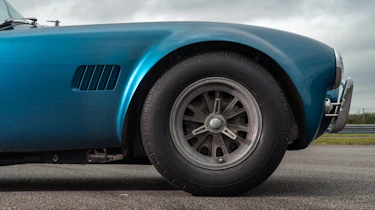
Of those cars, 17 were right-hand drive for UK customers. FMA 131F is the final one built. God it’s a sexy-looking thing. Compact and curvy with the arches filled to absolute perfection by the chunky magnesium Halibrand wheels and fat, generously sidewalled tyres, it’s the epitome of the ultimate 1960s sports car.
But supercar? Some might say no, but I would disagree. Especially if we consider the entire Cobra canon (including the monster 427), for there is no question that for a time both 289 and 427 occupied a space reserved for the fastest and most compelling cars in the world. More than 60 years later, that kudos still counts.
Driving the AC Cobra 289
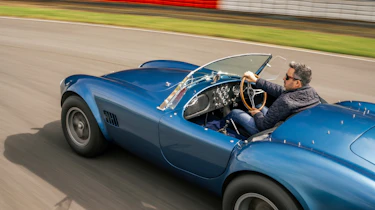
To climb in you reach into the cockpit over the curved top of the low-cut door, pull on the little ball-topped alloy lever, swing the alloy-skinned door open and tuck yourself into the snug bucket seat. The cockpit is beautifully simple with a wonderful view out through the screen, framed by a chrome surround and sitting atop the arched scuttle, and you gaze out over the curving bonnet and take in the rising flare of the wing on the driver’s side.
The array of gauges for oil temperature, amps, oil pressure and fuel and water temperature, along with a clock, are arranged like a pack of racked pool balls in the centre console, while an angled rev counter and speedometer are viewed through the lovely wood-rimmed steering wheel. The gearlever is stubby and topped with an indented ball that fills your hand perfectly. Below it, like a dagger’s quillons, are two protruding metal prongs that you tuck your fingers under and lift when selecting reverse.
The seat looks basic but has good under-thigh support, so you just settle in with your hips and ribs nestled in the scalloped back of the barrel-shaped bucket. The pedals are heavily offset – there’s enough room to get your left foot between the transmission tunnel and the clutch pedal, but the brake is where you expect the throttle to be, with the throttle even further to the right.
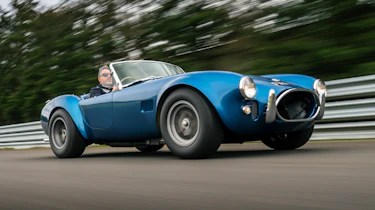
There’s a fly-off handbrake on the right of the transmission tunnel, just touching your left knee, plus some small brace-bars that run under the dash. A dinky little rear-view mirror sits on the top of the dash, and there are clear Perspex wind deflectors mounted to the A-pillars. You can also run with side-screens that simply drop into the tops of the doors, but it’s surprising how little buffeting you get without them. An ashtray – obligatory kit in the ’60s – sits in the centre console, urging you to light up a Marlboro and pretend to be Steve McQueen, who smoked like a chimney and dailied a Shelby 289 in the mid-’60s.
Start the engine and the Cobra begins to work its magic. The whole car pulses to its beat, rocking gently to the syncopated cross-plane rhythm of its 1-5-4-2-6-3-7-8 firing order. It sounds fabulous at idle, a rich and purposeful throb emanating from the two rear-exit pipes. The clutch and gearshift are positive with a well-oiled action that’s tactile and just physical enough to connect you to the process but not get in the way.
The steering is well matched to those control weights, hefty(ish) at a standstill but quickly freeing up once you’re moving. There’s not the immediacy that you get in a modern car, nor the sharp on-centre connection, but the setup of this particular car is deliberately pliant for road use and there’s undoubtedly some squidge in those plump sidewalls. Still, you quickly get dialled in to the sensation of feeling the car soaking up the load a fraction before it responds with a direction change. It’s like you’ve been driving it all your life.
Against expectations it feels neutral, compliant and nimble, changing direction really nicely with body control and progression that the earlier leaf-sprung Cobras didn’t possess. It’s brilliantly responsive to playing with the balance of the car on turn-in, too, so you have endless options.
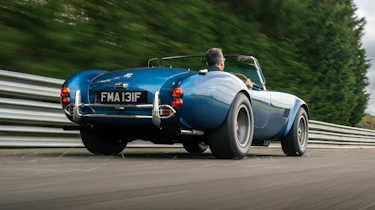
Drive in a conventional way – that’s to say get your braking done in good time then come off the brakes and try to carry speed to the apex on a balanced throttle – and it will settle into mild, stabilising understeer. But if you use that reactiveness off-throttle and bring the rear into play before you find the limit of the front tyres, then you have the Cobra in the palm of your hands and very much under your right foot.
With the steering wheel and throttle to balance the car and adjust it directionally you really get to enjoy the Cobra’s mix of small-car handling and big-car power. It’s old-school, but those coil springs make it playful and exploitable where the earlier 289s took some hanging onto.
The brakes – discs all round – are terrific. There’s a little bit of travel at the top of the pedal, but it just has a nice weight, feel and progression. We aren’t using it to its limit, but the brakes give you an encouraging sense of confidence with consistent bite and plenty of stopping power to squeeze into from higher speeds. Above all, the Cobra has a brilliant energy to it; the feeling of minimal mass being propelled by meaningful muscle is seductive and magnificent.
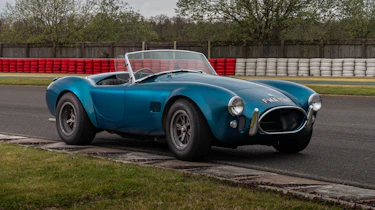
The engine is smooth and keenly responsive with ample torque but a strong top-end. The gearshift is slick with quite a long fore and aft throw but is tight and snickety across the gate, with a pleasing mechanical weight and feel, but also with a clean, delicate quality you wouldn’t necessarily expect.
Worked harder, the V8 pulls and pulls and pulls. We revved it respectfully to 5500rpm, by which time it’s done its best work, but this isn’t a race-tuned motor. Shelby would have claimed 300-ish bhp back in the day, but in truth an engine in this spec is more like 260-270bhp. A Goodwood Revival race engine belts out 400 wild horses or more, but it would be a bit angry for the road. From where I’m sitting 260bhp feels like just enough; a wonderful balance of capability and performance that suits the chassis to a tee.
No mistake, the Cobra is a glorious car. You feel so good driving along with that big-hearted V8 for company. And as you do it’s hard not to imagine living in ’60s California with a Cobra as your daily, taking it to a Sports Car Club of America race meeting, sticking some numbers on the side, hammering round Laguna Seca or Riverside with your buddies and then driving home again. That might not conform to today’s notion of a supercar, but back then? It was living the dream.
Specs
| Engine | V8, 4727cc |
|---|---|
| Power | 270bhp @ 6000rpm |
| Torque | 312lb ft @ 3400rpm |
| Weight | c950kg (c289bhp/ton) |
| 0-60mph | c5.6sec |
| Top speed | c135mph |
| Price new | £2951 (In today’s money £48,000) |
| Value now | £500,000-plus |