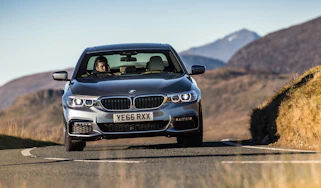
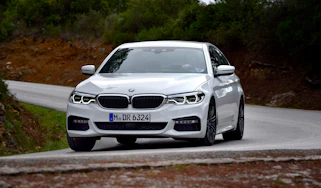
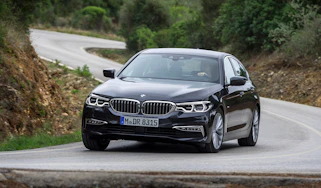
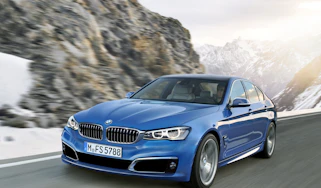
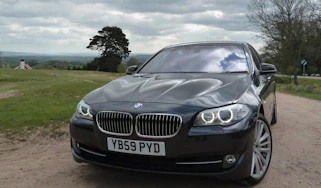
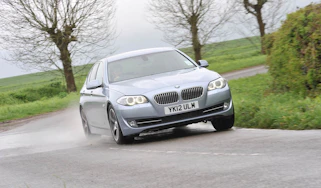
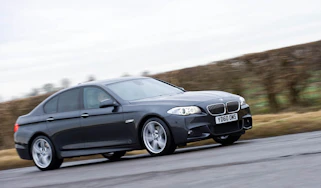
BMW 5-series review – the sportier Mercedes-Benz E-class alternative
The 5-series remains a core car for BMW – a model upon which the marque's credibility still depends

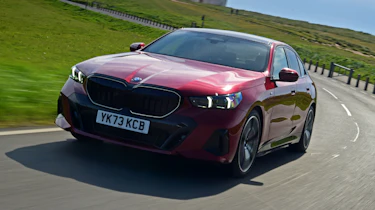
Saloons for BMW are like sports cars for Porsche; they’re what the brand is defined and measured by, and at the core of the range is the 5-series. Even if the myriad SUVs bulk up the profits, they do so on the back of the badge credibility that BMW’s staple saloons earn. That’s why the 5-series must be a standard-setter as all previous generations were, diminished though its role is in terms of raw sales volumes.
The BMW 5-series range covers plenty of bases with electric, petrol and hybrid options. The CLAR modular platform is a jack of all powertrains and makes electrification no longer a tack-on or token engineering effort. The downside? All new 5ers (including, infamously, the latest M5), are weighty things, that start at 1800kg and balloon as you climb the range, to in the region of 2.5 tons at their heaviest. In fairness, that’s also in part because the new 5-series is a physically broader machine than the one it replaced – too broad by our reckoning.
The result is as you might expect, a 5-series that puts distance between the driver and the traditional BMW driving experience, which is still there if you go digging for it. There’s inherent balance, a quality chassis and feeling of refined engineering, whether you’re pressing on or at a cruise. Digitised ergonomics, massive proportions and upped weight aside, the G60 ought not feel totally alien to the 5-series faithful.
Engines, gearbox and performance
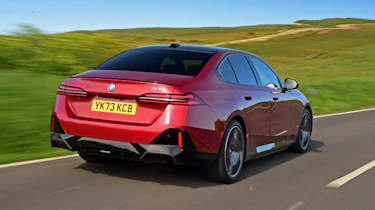
- Four-cylinder engines sound a bit lethargic, but the 530e's performance is adequate
- Only the six-cylinder is the 550e plug-in hybrid – fast and efficient to replace the old six-pot diesels
- Transmission and hybrid system are well-resolved and work seamlessly
More reviews
In the UK, the sole combustion-only (but still MHEV) BMW 5-series is now the 205bhp 520i. This is where the range begins, the car using the ubiquitous B48 2-litre four-cylinder turbocharged engine. Want more power and performance? Of course you do, but it comes thanks to electrification in the plug-in hybrid 530e, where the four-banger is electrically augmented up to 295bhp thanks to a 183bhp electric motor that’s integrated into the transmission. As a result, the 530e jumps in weight from the 520i’s 1800kg, to almost 2100kg.
If you’re a longer-serving member of the 5-series faithful a six-cylinder may be a requisite. Only the PHEV 550e features the B58 six, combined with a 194bhp electric motor for a sturdy 482bhp maximum system output. The downside, as with the 530e, is the added weight, with the 550e xDrive jumping up to over 2200kg. The rise can in part be put down to the non-negotiable xDrive all-wheel-drive system.
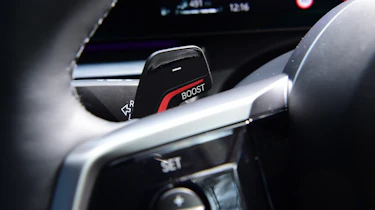
All ICE and hybrid BMW 5-series models utilise the now ubiquitous eight-speed ZF torque converter automatic transmission, that you can shift manually using steering wheel paddles. On the PHEV models, the single electric motor is integrated into the transmission rather than having motors on either of the axles.
Want all electric? The i5 range begins with the 335bhp i5 eDrive40 and rises to the ballistic 592bhp i5 M60 xDrive. The added punch comes courtesy of an additional 257bhp motor on the front axle paired with the 335bhp mill on the rear axle that it shares with the eDrive40. The electric i5s are as you’d expect, quite porky, with the eDrive40 weighing upwards of 2200kg and the i5 M60 clocking in at a honking 2380kg. It’s still lighter than the M5, mind… There are no diesel or pure ICE six-cylinder options in the UK.
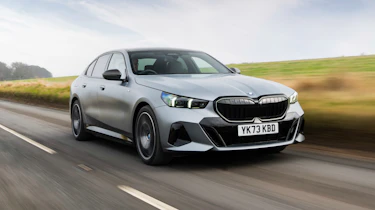
Motivation is a little thin on the ground with just the 520i’s 2-litre mill to call upon, even though the entry-level model is over 200kg lighter than the 530e. When it’s electrified in the 530e, though it still sounds strained, the combination of the engine and the instant torque of the electric motor gets the 5-series going up the road nicely. The figures are 7.5sec to 62mph and a 155mph top speed but most important is that it feels brisk enough.
It’s the 550e xDrive with its bulbous 308bhp 3-litre twin-turbo straight-six in combination with the hybrid drive for 482bhp, that has the slightly naughty ‘sleeper’ feeling – an overabundance of potency for a sharp-suited, non-M exec. As well it ought to, with almost as much power as an E60 M5 on tap and a whole lot more torque. It gets it onto the road without too much fuss too, thanks to xDrive all-wheel-drive.
The hybrids feature synthesised digital accompaniment to the engine sound, especially when in ‘Sport’. This demarcates the electric motor’s contribution with a little aural flare – a bit of a gimmick, truth be told. Especially in the 530e, where the sound effects are noticeably louder, presumably to mask the gruff four-pot as it’s wrung out. More carnival dodgem than Hans Zimmer’s finest work.
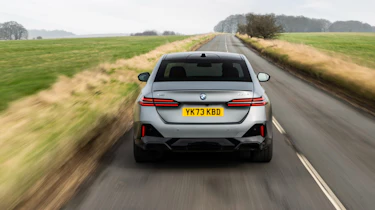
If the sounds aren’t the best integration of the electric element, happily, the power delivery itself is better. The combined outputs of both the 530e and 550e are notably lower than the maximum that the petrol engines and electric motors can provide at any one time. That’s because the power and torque delivery is engineered for linearity, the motors filling in before the engines come on song, delivering sharp throttle response as and when you ask for it.
Regeneration is well-integrated too, without the sharp transition from recovery to friction braking that some PHEVs suffer with. You can’t adjust the strength but the deceleration off throttle is akin to natural engine braking, so you don’t feel the need.
The i5, of course, offers instant performance but lacks the versatility and interaction of the hybrid powertrains – certainly of the 550’s six-pot. You’ll need the 550e to go any quicker, with even the i5 eDrive40 packing 335bhp and hitting 62mph in 6.4sec. Nothing bar an M5 will go quicker than the i5 M60. It has a ballistic 593bhp and 604lb ft and can get to 62mph in just 3.8sec.
Ride and handling
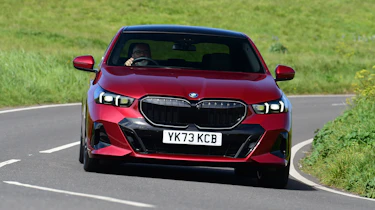
- This is a bigger, heavier 5-series, so can at times feel like a 7-series
- But its fundamental balance and the quality of its damping are good
- Steering a bit glassy, not helped by the obese steering wheel
All 5-series models ride on the latest BMW Cluster Architecture that underpins everything from the 2-series Coupe to the X7. CLAR II specifically, as it’s known, underpins the growing range of partially and fully electric 5-series models as well as the new plug-in hybrid M5. It’s also the platform on which the iX, X3 and the latest 7-series are based.
Famously, the new M5 is much heavier than it once was, with obvious blame aimed at the addition of a hybrid system. That said, the new 5-series family as a whole is heavier, to varying degrees, by comparison to direct predecessors. How BMW has gone about managing that weight will determine whether CLAR II is seen as an achievement in terms of versatility, or a compromise with superfluous mass leading to a hindered execution.
The 5-series has been subject to speculation about its identity. For while there’s a 5 on the boot lid, its girth, mass and its gait say 7. The superb ride is 7-series alike, with the adjustable suspension configurable through the MyModes menus (there’s a MyModes button, but the individual settings are on the screen). Even Sport+ is tolerable because of course, if you put too much spring rate into a heavy car, it’s going to pogo and crash its way along any imperfect surface. But no, the 5-series is a resolutely unflappable barge across ground.
While we had our concerns, straight away, the 5-series showed form, balancing its unexpected compliance with a good degree of control. It’ll over-rebound if you push too hard but there’s composure here that encourages you to explore the performance of the car and develop a flow at a higher average speed.
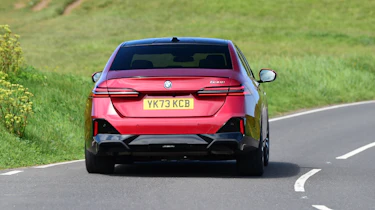
That performance is substantial in the 550e, so the AWD is a welcome addition. There’s an abundance of grip and being xDrive, motivation is biased towards the rear of the car, so the inherent balance and adjustability remains. Especially in less than perfect conditions, the rear end is more than willing to power into a wider line through a corner as you adopt an almost neutral steering position. The 530e being rear-wheel-drive, will step out under power in a more traditional sense, requiring more countersteer, but it’s far from a hot rod.
Steering feel is limited, however, and what little does come through, is usually not a positive, but a warning of the car’s mass. The gravelly sensation of the tyres struggling for purchase as the car’s momentum threatens to derail you is one you have once before readjusting how you approach driving the car. Not so much a problem in the lighter 530e and 520i, which while lighter overall and on turn-in, have lighter steering that’s more incongruous in feel relative to the sheer size of the car you’re at the tiller of. At low normal speeds too, the ratio of the rack can sometimes feel odd, as you often need to feed in a bit more lock to find the direction you intended.
Overall, it still drives like a BMW should. That’s to say, in a sophisticated and still-engaging way, appropriate of a car that’s been honed by keen drivers. It’s just, the G60 5-series is in relative terms, more remote than any that’s come before it, albeit still more willingly dynamic than a 7-series.
Interior and tech
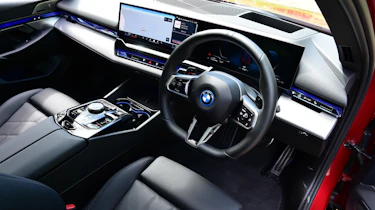
- Screens have hijacked plenty of core functions – the climate control is particularly frustrating
- Quality is decent if not peak BMW, per the previous-generation 5-series
- The ambient lighting will blind you at night and render the wingmirrors almost useless
The interior of a BMW 5-series is traditionally a place of rhyme and reason – a pallet cleanse marrying quality and common sense and excellent ergonomics. This generation slightly derailed that with its curved display and, with the Neue Klasse-inspired LCI facelift coming soon, will adopt BMW’s new cabin architecture with its panoramic display. For now though, the curved display remains.
It even features ‘AirConsole’ allowing occupants to play games on the display, using their phones as controllers, though ‘the ultimate gaming machine’ doesn’t resonate quite as much with us as ‘the ultimate driving machine’.
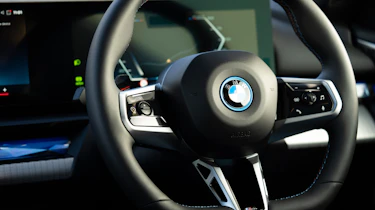
The main controller of a car, aside from the brakes and throttle of course, is the steering wheel and there’s change here too, with a revised set of controls either side that replace some buttons with a pivoting solid panel. Not quite the haptic touch nightmare as in some cars but a learning curve still. The stalks behind the wheel have been redesigned too – lighter and tinnier to the touch, which was a bit of a disappointment.
Disappeared into the screen, unfortunately, are the climate controls, which while there is a constant ribbon at the bottom where you can adjust temperatures, your heated seats and so on, where the air is coming from is still a few clicks away. Still physical are the direction controls for the vents, though it might take you a minute to find the recessed rollers that sit below the vents. They’re integrated into the luminous dash fascia, as is the hazard light switch, rear screen heat and blower strength touch controls, that are themselves thankfully backlit.
Speaking of luminous, let’s talk about interior lighting. The latest 5-series takes it to another level with the ‘interaction bar’, a thick strip of dense lighting that runs the width of the dash and onto the doors, that looks more like a rear light bar than interior set dressing. It flashes red when your hazards are on and, when they’re not, reflects in the side windows right in your line of sight for the mirrors at night. It’s a very aesthetically pleasing thing, especially as you can change it with the different ‘MyModes’ but before you turn it down, that’s a lot of light in your face at night.
Happily, like with the driving experience, a lot of reliable 5-series remains. The seats are good – not overly supportive but comfortable. The G60 is also one of the last BMWs to retain the rotary iDrive controller.
All in, the cabin of the new 5-series is a wonderful place to find yourself – high quality on the whole and relatively straightforward once you’ve gotten your head around it. It’s also well-insulated and refined – the consummate comfy cruiser at speed.
MPG and running costs
- Hybrid systems work well and offer decent efficiency...
- ... but you need to charge regularly to get the best out of them
- Hybrid system is regularly clecer but the instant ability to switch between electric and ICE would be nice
The B48 and B58 engines are both relatively efficient if you’re not greedy with the throttle. Even the heavier hybrid 530e will get 40mpg from its combustion engine on a level motorway cruise, while the B58 in the 550e will deliver over 30mpg if you give it plenty of high speed miles at a steady pace.
Swap between petrol and electric power with a flick of the drive selector and the angular rev counter on the BMW curved display will turn into a simpler energy dial. It’s useful to be able to switch between the two, when pulling into a town or village, as traffic develops, or any other scenario where you trade ICE-friendly consistent cruising speeds for stop-start trundling.
What would be nice is a bit more easily control of the hybrid system – the ability to instruct the car to charge the batteries on the move, on the motorway, say, when electric power is of the least use.
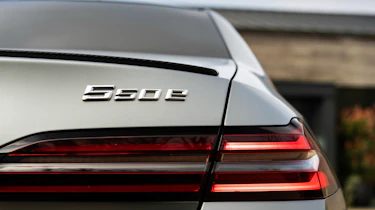
The electric range is a curious one. It’s claimed the 550e will go for up to 57 miles on a charge. In our testing, it was giving around 40 miles, though that was in cold conditions. That’s still enough for a solid commute if you’re charging the car overnight. The 530e is rated slightly higher, at a maximum of 64 miles, likely thanks to its lower weight. In practice, it was good for up to 45 miles or so.
Being a bit less slippery, the touring versions will return marginally fewer miles both on fuel and electricity. With the right box at home, both the 530e and 550e will charge at 11kW in under three hours. What would be nice is if the hybrid system were a bit more proactive in charging the battery when on the move. The M5 is quite good at building up charge on a long run but we didn’t find either PHEV 5-series to be as proficient.
The 81.2kWh battery in the floor of the i5 is claimed to allow for 315 miles of driving in the top-end M60 model. The reality we found was quite a way short of that, the i5 managing 235 miles, albeit in the biting cold, with plenty of EV-unfriendly motorways. It’s good for 205kW of charging, so can jump from 10-80 per cent in just 30 minutes. Range for the eDrive40 is claimed to be 361 miles, so a still useful 280-300 miles in real driving is more likely.
Price and rivals
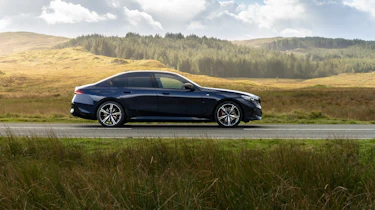
The BMW 5-series is a more expensive car than it’s ever been, starting from £53,110 for the most basic 520i, although even that’s an M Sport, the new base specification. The 530e M Sport saloon starts from £62,680, while the 550e xDrive M Sport starts from a much sturdier £76,830, though it’s worth mentioning the 550’s price has increased the least of all the G60 range these last couple of years.
In the same region is where prices for the i5 begin, at £67,795 for the eDrive40 Sport Edition. Prices rise for every respective 5-series by £2000 to £2300 for the equivalent Touring
The 5-series, as it ever was, is BMW’s mid-sized executive car, facing off against ever-present rivals in the Mercedes-Benz E-class and Audi A6. Like BMW, Audi has a solution for all tastes, albeit with much more distinct models (the A6 e-tron and combustion A6 are totally different cars) than the 5-series and near-identical i5.
Mercedes’ approach went a bit too far down the route of distinct models, with the amorphous EQE falling well short of expectations. The E-class remains as it ever was – the alternative to the 5-series that majors on plushness and luxury as a priority over dynamism, though it’s a perfectly competent thing to drive nonetheless.