From mechanic to racer and Formula 1 commentator: Ben Edwards' story
He’s called the action as it happens on every motorsport imaginable – from F1 to powerboats – but the consummate commentator gets as much fulfilment from behind the wheel as behind the microphone
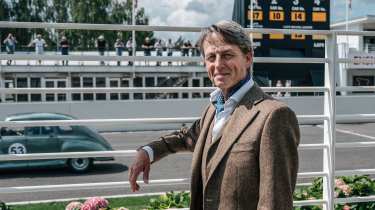
Even if you wouldn’t recognise Ben Edwards by sight, chances are you’ll know his voice. His alternately calm and excited but always clear and knowledgeable commentary has soundtracked many a petrolhead’s afternoon on the sofa, whether in front of the British Touring Car Championship, GT racing, rallying, speedway or countless other forms of motorsport – not least Formula 1 as lead commentator for various channels.
But Edwards’ life in motorsport began without a microphone, initially as a racing mechanic before making a serious attempt at becoming a professional racing driver, competing across Europe in single-seaters and racking up a couple of British titles in different championships.
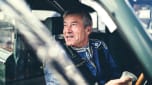
‘I grew up on a farm, and that’s what got me hooked on driving and cars,’ he says. ‘The first vehicle I ever drove on my own was a Renault 4, I think in my early teens, back across the field to sort something out. It was a lovely thrill to just be able to drive.’
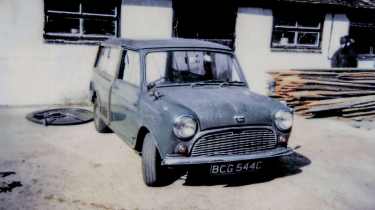
Before long he’d acquired a car of his own, a well-worn Mini Traveller, to embark on longer drives around the fields. ‘The first time I drove it, the fuel tank fell off and I had to engineer a solution with a little gallon-sized tank in the boot. But it was great fun. I had a couple of cars before I was old enough to drive on the road, including a Hillman Avenger, which had been prepped for grasstrack racing. I never did any racing in it, but it was fun around the fields.’
Having cut his car-control teeth, he began to hanker after a bigger stage: ‘Because of growing up on the farm, my initial love was rallying and I would have loved to compete. I did buy a Mk1 Ford Escort – I wish I still had it now! – and competed with it once at Goodwood, but the engine blew up and I didn’t have the money to continue. I managed to eventually rebuild the engine myself, then the car went for an MOT and they laughed at it, so it had to go…’
Meanwhile, in his mid-teens Edwards started working for a Brands Hatch-based Formula Ford team. ‘I was a sort of “help” mechanic for a guy called Rob Creswell, who ran a team in the Champion of Brands series and won the championship several times with different drivers. It got me involved in working on cars and really keen to have a go at it myself. I didn’t have much budget but once I’d been a mechanic for a bit and I could work on the cars myself, I gave up on university and decided, “Right, I’m going to throw myself in and give it a go.”’
In the mid-1980s, Edwards started racing in a championship for pre-1974 Formula Ford cars and, to help pay the bills, became an instructor at Brands. Through the grapevine he found out about a new, relatively low-cost single-seater category preparing for launch in 1987: Formula First. The cars, which mounted a Fiesta XR2 engine transversely in a Van Diemen chassis, looked a bit ungainly and their weight distribution gave them tricky handling, but it was a fast, good-value series for up-and-coming drivers. ‘I was very lucky in that I had a bit of help from other people to get into it in its first year,’ he says. ‘It was a pretty amazing time really.’
A very successful one too, as, rather neatly, Edwards became the first Formula First champion. ‘Of course, as a junior driver, you win a title and think, “Right, this is it, I’m going to make my way to the top.” I became very determined. I was lucky again because I had no budget of my own but I had some sponsorship from a local company, Blue Lamp, and through that stepped up to Formula Vauxhall Lotus.’
He raced in both the British and European championships against future legends such as Allan McNish, Mika Häkkinen and David Coulthard. ‘I did it for a couple of years and raced at some fantastic tracks like Zandvoort and Spa. It was really enjoyable but I never quite managed to get on top of it in the same way. I think it was a mixture of things; you learn in motor racing that everything has to come together just right. It’s not just how you drive it, it’s how everything operates with the car, the team, and it just didn’t come together particularly well for me.’
Sponsorship came to an end and continuing the single-seater journey was no longer an option. ‘It was a blow for me. But around the same time, I’d started to get into commentating…’ He’d helped with commentary at Brands Hatch, ‘to try to show that I could talk about racing, to appeal to sponsors as much as anything.’ But Brian Jones, stalwart commentator at Brands, encouraged him to take it further. ‘He said, “You’re quite good at this – you can help me.”’ So Edwards became second commentator for big events, working with Jones. ‘And that’s sort of what got me going. He was very encouraging to me, and I was at a point where I needed to earn money aside from instructing.’
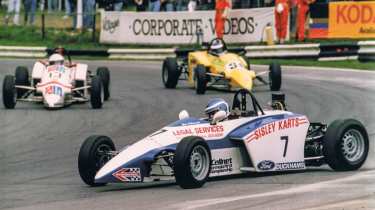
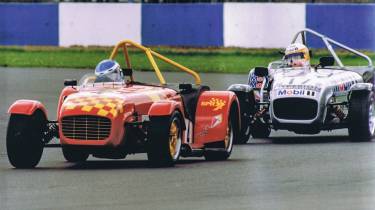
Although he hadn’t given up on racing and won the Caterham Vauxhall championship in 1992, commentating was becoming an increasingly viable career. Before long, an opportunity for TV work with Eurosport arrived, on the Champ Car series in the USA. Edwards became lead commentator, covering races remotely from Eurosport’s base in Paris.
‘I obviously did reasonably well because the main guy running Eurosport a year or two later said: ‘We want you to do Formula 1. I got the gig for two years, 1995 and ’96.’ His co-commentator was F1 race winner John Watson. ‘John would introduce me to people, and it was a more open paddock than it is now: you could go along to teams for a chat, bump into people and become a part of it all more quickly than today.’
Eurosport’s deal ended as ITV secured F1’s flagship coverage package from 1997. Edwards returned to Champ Cars – this time travelling to America for the races – and went on to also cover F3, GTs, Le Mans, even powerboat racing, plus a ten-year stint as lead commentator on the BTCC for ITV. A personal highlight was the A1 GP single-seater championship, billed as the World Cup of Motorsport. ‘It was very worldwide, going to places F1 often didn’t, like New Zealand. My wife Belinda got involved on the admin side after a couple of years, so we were able to work together on it, which was really nice. Then, suddenly, I got the chance to do Formula 1 again…’
Sky Sports had wrested live coverage of all Grands Prix from the BBC in 2011, complete with lead commentator Martin Brundle. For the Beeb’s own coverage, it chose Edwards to replace Brundle. ‘By that time I thought that my opportunity to do Formula 1 had gone. I’d been doing bits and pieces of F1 coverage but nothing regular, then suddenly there was the split between BBC and Sky and they brought me in. It was a bit of a dream come true, and I really enjoyed doing it.’
Alongside him in the commentary box was David Coulthard, with whom Edwards had been on the same grid in European Formula Vauxhall Lotus, and the two built a strong broadcasting rapport. ‘He was younger than me, and much more successful, but the fact that we had that connection from back then definitely helped.’
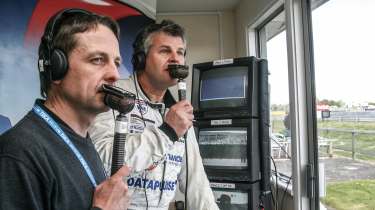
When Channel 4 took over F1 coverage from the BBC in 2016, Edwards and Coulthard transferred, along with much of the same crew. ‘It was a very good team with a nice camaraderie. I worked with some good people and it was good to do it for a decent period, but it was also something that I threw myself into, very committed,’ Edwards says. ‘Formula 1 is that way: whatever you’re doing, whether it’s a driver, a team member, a journalist, whatever, you have to really commit yourself to it fully. And I loved it. But it came to a point where I decided, “I’ve done that, I want to move on, and I don’t want it to control my life.” It is fantastic, but it is very full-on.’ Edwards took the decision to step down from full-time F1 commentary at the end of the 2020 season.
That’s left him more time to enjoy driving on the road. He has a very evo two-car garage: a quick estate car and a sports car. ‘I’ve got a slightly older BMW Alpina. It’s one of the more humble ones, a D3 Biturbo Touring. They later upgraded it to a more powerful version; this is one of the earlier, more basic cars but it suits me fine because it doesn’t use much fuel but it’s got a decent bit of grunt.’ In the sports car corner he has a Toyota GR86 – evo’s 2022 Car of the Year runner-up. ‘I’d been tempted by a GT86 for a long time, and then the GR came along. I didn’t think I’d get one, but I put my name on the waiting list and eventually an offer came through.
‘I’ve not been somebody who’s absorbed the finest road cars in the world, because as a racer you tend to put all your efforts into that. But road cars do matter, and I’ve had a real mix of things over the years. Nothing particularly mad, but I started on the road with a Suzuki SC100, which was a tiny little 2+2, pretty rare. My mum had it initially and passed it on to me because she felt it would suit me when I started driving. It did: I really enjoyed it, and drove it for several years.
‘I was quite into VWs at one time, and I’ve had a Scirocco, Golf GTIs, and later a Lupo GTI for a while. I planned to keep that as a future classic, but then the GR86 became available… I also ended up with a Mazda MX‑5 Mk1 for a while and really enjoyed that as a road and trackday car, too. They’re a good basic track car, the Mk1.’ In tune with his racing roots, he also has a classic Formula Ford car tucked away, in which he still competes occasionally. ‘I didn’t go out in it last year, but it would be lovely to get back out in it once or twice this year.’
There is an older car than the Formula Ford in the Edwards family, and an unusual one: a 1930s Railton 10HP. ‘There’s a remote family connection to Reid Railton, who created those Land Speed Record cars and Brooklands record cars in the ’30s. My official surname is actually Railton Edwards. My father bought the Railton car in the early ’70s and I got it restored quite a while ago. It’s a faint connection but a nice one, and there’s no doubt part of my interest in cars came from it.’
He’s recently returned to instructing, working occasionally at Snetterton. ‘I’ve been instructing on some MSV trackdays and I enjoy it: I like going out with people and helping them learn the circuit.’ He has a trackday booked for himself in the GR86, to enjoy the circuit from the driving seat too.
And although he’s stepped off the regular F1 merry-go-round, Edwards is still called back into the commentary box from time to time. ‘Last year was quite funny really, because I ended up commentating on all sorts of things, including Formula 1 for Radio 5 Live and the British Grand Prix at Silverstone for F1 TV. I also ended up doing Le Mans, and a Formula E race in Brazil.’ Alongside a regular slot at Goodwood’s various events, he also went back to his trackside roots for Snetterton, commentating on the BTCC over the circuit’s Tannoys.
I feel a little embarrassed telling Edwards this, but out of curiosity I’ve tried commentating on races at home from my sofa, just to see if I could do it. It doesn’t take much longer than a couple of minutes before I run out of things to say, or start repeating myself. It’s deceptively difficult, and pro commentators make it seem very easy.
Edwards smiles: ‘Commentating is a funny world. It’s something I got into quite naturally and it suited me – and it’s funny because I’m not a particularly talkative person in normal life. Murray Walker, for example, was a brilliant commentator, but he was also brilliant at just talking: if he was doing a bit of a stand-up or a speech somewhere, he would be fantastic. That isn’t my thing in quite the same way. I tend to be a bit of a quieter person – except when I’m talking about racing. Then I’m absolutely full-on about it, and it’s very natural to me – because it’s been a part of my life for so long.’