Ferrari 550 Maranello (1996-2001) review – an all-time great Ferrari for less than a new Porsche 911
The decision to revert to a front-engined layout for the 550 Maranello led to a seminal Ferrari grand tourer, which today can be yours for £100k
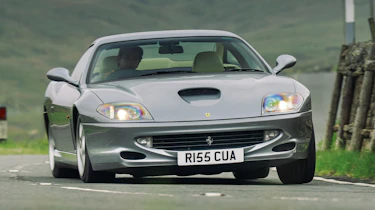
When the 550 Maranello was revealed to the press at the Nürburgring in July 1996, you didn’t need a deerstalker to work out where Ferrari had looked for inspiration. The long, thrusting bonnet and short, clenched tail; the four round tail-lights; just two seats in a sumptuously furnished cockpit, and a big, naturally aspirated V12 engine up front. Spiritually, conceptually and materially, the Maranello was the Daytona reborn.
It was president Luca di Montezemolo who had decreed that Ferrari’s new series-production flagship should be front-engined, bringing to an end a 23-year-long line of flat-12 mid-engined supercars that stretched from Berlinetta Boxer through Testarossa to F512M. His reasoning was that a front-engined super-GT would be more useable, more driveable than a mid-engined exotic, and he was absolutely right. So right, in fact, that today’s 12 Cilindri still follows the template set by the 550 Maranello all those years ago.

The name combined references to the 5.5-litre capacity of the V12 engine and, of course, Ferrari’s home town. The styling was by Lorenzo Ramaciotti at Pininfarina, and as well as borrowing cues from the Daytona, it also included a visual nod to that car’s predecessor, the 275 GTB, in the form of the gills in the front wings. This was Ferrari unashamedly summoning the spirit of its legendary 1960s berlinettas.
More reviews
As a road car, the 550 achieved greatness. The V12 engine was and is a wonderful thing, delivering a creamy torrent of power and torque, and the handling was so deft, more like that of a lightweight sports car than a GT. It’s one of Maranello’s best and a defining supercar of the 1990s – when you consider you can pick one up for less than £100k on the used market (the price of a basic 911 Carrera), it’s also a bit of a supercar bargain.
Engine and performance
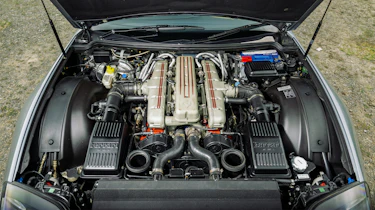
- 456-derived V12 is smooth and tractable but lacks some voice
- Only offered with an open-gate manual – it’s a paddle-free zone
- Less frenetic than modern V12 Ferraris
The 5.5-litre, 48-valve, quad-cam, dry-sumped V12 (codenamed F133A) was a reworked and more highly tuned version of the F116 engine that had made its debut in the four-seater 456 GT in 1992. The main changes were redesigned cylinder heads and what Ferrari called a ‘resonance effect’ induction system with 12 throttle valves and variable-length inlet tracts to boost both low-rev grunt and top-end zing. It’s a remarkable engine, blending abundant power – a peak of 478bhp at 7000rpm – with genuine GT refinement. Ferrari claimed 0-62mph in 4.4sec and a top speed of 199mph.
Supercars didn’t make noise for the sake of it in the ’90s but the Maranello is, sadly, particularly muted. The V12 is silk-smooth and apparently able to pull any gear at any revs. It still feels quick; maybe not spin-the-planet-backwards quick like a current-era Ferrari but still more than fast enough to make a serious impression.
Despite the F1 paddleshift gearbox having already appeared in the F355, the 550 was offered only with a traditional manual gearbox, a rear-mounted six-speeder that was combined with the limited-slip differential. That manual gearbox with its exposed metal gate is key to the car’s appeal. Although this was a thoroughly modern Ferrari at the time, it was also a front-engined GT in the classical idiom.
Driver’s note
‘Hugely potent but understated and calm. The engine has got an amazing sort of light, turbine quality: a big-hearted, effortless building of performance.’ – Richard Meaden, evo editor-at-large
Ride and handling
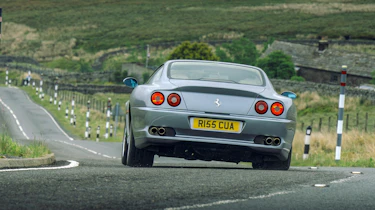
- As supple as a GT should be, with a surprisingly level of poise and sharpness
- Quick, power-assisted results in impressive agility
- Early days of electronically adjustable dampers
The 550’s steel structure was derived from the 456, although at 98.4in (2500mm) the 550’s wheelbase is shorter by 3.9in. Suspension is by double wishbones all round, with electronically adjustable damping and a Sport setting to stiffen its sinews. Magnesium alloy wheels and aluminium calipers keep unsprung weight down, while the optional Fiorano pack makes the handling tauter still, at the cost of a slight degradation in ride quality. The steering has variable power assistance depending on road speed; braking is by big, vented iron discs with anti-lock, and there’s ASR stability control that can be switched to a lower level of intervention or turned off altogether.
Despite the conventional front-engined layout, there’s still a vague hint of the long-arm, short-leg driving position you get in older mid-engined Ferrari GTs, like the Testarossa. Your knees are slightly splayed either side of the steering column, yet the wheel is somehow a little high and far away. It’s best if you slouch slightly and adopt a nonchalant attitude.
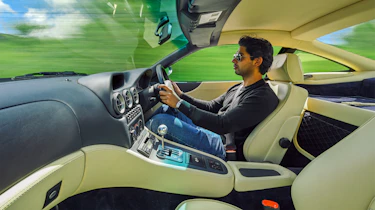
The fitment of power steering imbues the 550 with a real sense of nimbleness. It’s a quick rack at a little more than two turns lock-to-lock but there’s something else at play in the chassis set-up that gives it remarkable agility. It’s almost as if it has rear steering: as soon as you turn in – enjoying the speedy steering and blending off the short-travel brake pedal, which is full of feel – it yaws slightly at the rear. Not oversteer (though that’s there to be taken if you want), rather the Ferrari’s natural cornering stance is to subtly pivot its hips towards the apex.
It makes for a really intuitive and exciting car, one that’s much more wieldy than you’d expect given the big V12 in the nose. There’s a clear thread between the 550 and today’s 12 Cilindri, both being easy, refined and gentlemanly to drive, but emphatically thrilling when the mood takes you. It’s hard not to be bewitched by its character.
Driver’s note
‘It feels like a quantum leap from a Testarossa. The only thing that feels similar is the open-gate gearchange, which demands you be positive and precise cross-gate. Refined and practical yet incisive and agile, it’s a remarkable all-rounder.’ – James Taylor, evo Deputy Editor
Buying guide and price
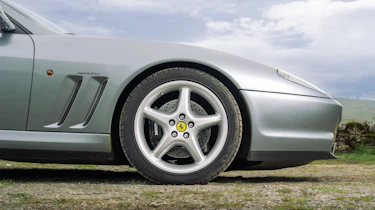
So, if you’re considering a 550, what do you need to know?
The first thing to check is the service history: not all 550 Maranellos have always been maintained as their maker intended, especially not when their values reached bargain level a few years back. The stipulated service intervals are 12,000 miles, but since most 550s cover only small mileages, ideally what you’re looking for is evidence of annual servicing, either within the dealer network or in combination with the leading specialists.. Every three years the cambelts need renewing, and new spark plugs are recommended every four to five.
Maintenance isn’t cheap, but you guessed that anyway. At least the 550’s engine did away with the 456’s hydraulic tappets, so no adjustment is needed there. In fact, properly maintained, the engine itself gives few problems. Oil leaks from the camshaft seals are fairly common but not a major issue and the cost-effective solution is to have them fixed when the cambelts are replaced. One potential problem is overheating, so check that the fans kick in when they should and the temperatures stay steady. Another thing to check is the gearchange. All the gears should select smoothly with no crunching, even from cold.
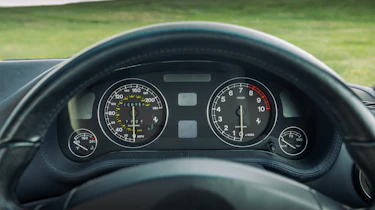
Most 550s are holding up well cosmetically, but look along the edges of the aluminium body panels for corrosion bubbling away, and also on the inside of the bonnet at its front edge. None of this is structural, but any remedial work is sure to be costly. Inside the cabin, the leather that covers the top of the dash can shrink and peel back, especially if it’s been exposed to intense sunlight. Apparently, some are more prone to this than others, as Ferrari changed glue supplier for a time! Also check the operation of the switches, which can get sticky over time.
If any of this sounds daunting, remember that official dealers and leading specialists alike are always happy to conduct a full survey for just a few hundred pounds, which has to be money well spent.
At their lowest point, early 550s could be had for around £60,000. The best cars then accelerated to over £150k, but today there are plenty of good, low-mileage models in the £115-135k range, with more well-used examples costing just under £100k. These aren’t necessarily trouble, but clearly you need to have them checked carefully. 550s are far more resilient than most exotics and take big mileages in their stride, but only if properly maintained.
Ferrari 550 Maranello
| Engine | V12, 5474cc |
| Max power | 478bhp @ 7000rpm |
| Max torque | 415lb ft @ 5000rpm |
| Transmission | Six-speed manual, rear drive, limited-slip diff |
| Steering | Rack-and-pinion, hyraulically assisted |
| Brakes | Vented discs, 309mm front, 310mm rear, ABS |
| Wheels | 8 x 18in front, 10 x 18in rear, magnesium alloy |
| Tyres | 255/40 ZR18 front, 295/35 ZR18 rear |
| Weight | 1716kg |
| Power to weight | 287bhp/ton |
| 0-60mph | 4.3sec (claimed) |
| Top speed | 199mph (claimed) |
| Price new | £143,685 in 1998 (£240,330 in today’s money) |
| Values today | £100,000-£150,000 |