Tesla Model 3 review – a sub-£40k alternative to the BMW i4
Better built, more refined and more efficient, the new Model 3 is a welcome step forward – and one of the best value EVs on sale today
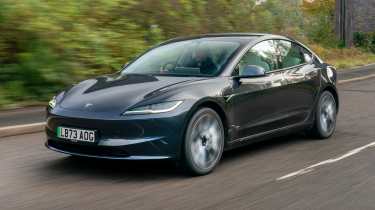
Electric car sales hit an all-time high last year with just shy of half a million registrations, and despite a crossover-heavy market, a saloon came second on the list of best sellers: the Tesla Model 3. Opinions on its maker have certainly taken a downturn in recent years, but that certainly hasn’t stopped people buying its cars. I sampled the updated Model 3 range, from the bottom to the top, to find out why.
With a swarm of rivals coming from all sides, Tesla gave the Model 3 a significant update a couple of years ago, and with the newly released RWD Basic model, it’s now more affordable than ever. Build quality, rolling refinement and efficiency were the focus for the facelift, but the usual Tesla quirks and idiosyncrasies – plus one or two new ones – still persist.
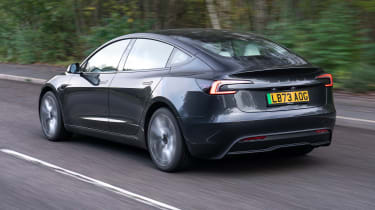
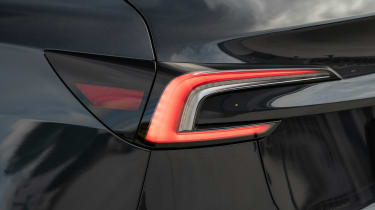
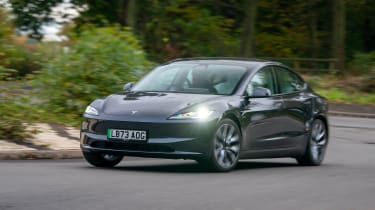
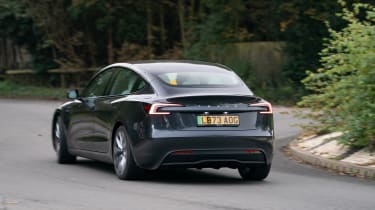
Overall design is virtually identical to the Model 3 launched almost a decade ago, with mild updates to the bumpers and lighting setting it apart. It’s not a bad looking car by any means, but it’s also not a particularly good looking one. The Model 3 is a neat package with some good attention to detail but it’s a device of function over form, that blends into everyday traffic without effort, and perhaps that’s the point…
More reviews
In-depth reviews
The question is, does the Model 3 still operate at the sharp end of the EV market, or have rivals from Polestar, BMW and Volkswagen caught up?
Powertrain and technical highlights
- Class-leading efficiency and range
- Rear and all-wheel drive options
- Two battery sizes
Having been developed from the ground-up as an electric car, the Model 3’s technical makeup is quite simple. The layout is of the same skateboard-style chassis that Tesla pioneered with the Model S, placing the batteries in a single, low-mounted sheet under the cabin. The updated Model 3 has a focus on improved rolling refinement and comfort with retuned suspension, acoustic glass, extra sound insulation and tighter seals, but the core platform remains the same.
All models feature a powered rear axle, with the motor and transmission sat between the rear wheels. Dual-motor versions pick up a second motor on the front axle for improved acceleration and traction. Both suspension systems are classified as multi-link, but differ from the usual layouts thanks to the inherently different requirements of the electric powertrain’s technical packaging.
What’s new for 2026 is the RWD Basic model, a stripped-back, entry-level model with a single rear-mounted 275bhp motor, less standard kit and an appealing £37,990 price point – despite being the cheapest, Tesla also claims this is the most efficient model it sells at 4.78mi/kWh, a figure we came very close to even on a cold, January motorway run. The result is a claimed 332-mile WLTP range that’s very easily achievable in the real world, but increase the budget and you can unlock even more. The equivalent BMW i4 achieves claimed efficiency of up to 4.2mi/kWh.
For £44,990 the 'Premium' long-range rear-wheel drive Model 3 gives you a more powerful 315bhp rear-mounted motor and a larger battery pack. Efficiency is marginally down on paper at 4.57mi/kWh, but the increase in battery size takes range to a class-leading 466 miles (WLTP), the highest of the Model 3 range and 86 miles more than the £59,465 i4 eDrive40 Sport, the BMW equivalent with the highest range.
For £49,990 you can have the 'Premium' long-range all-wheel drive model which pairs the entry-level RWD's 275bhp rear motor with a 212bhp front motor for a 4.2sec 0-60mph time. As you would expect, efficiency takes a hit with all-wheel drive, but that larger battery still enables a 410-mile range to beat any BMW i4 on sale.
Right at the top of the range is the Model 3 Performance, pairing a 406bhp rear motor with a 212bhp front motor to give it a claimed 2.9sec 0-60mph (note, not 0-62mph) time and a 163mph top speed. This shares the same larger battery pack as most of the range, and claims a WLTP range of 354 miles on a full charge. The 592bhp BMW i4 M60 is the closest on paper, but has a lower 338-mile range, 140mph top speed and 3.7sec 0-62mph time.
Performance, ride and handling
- Strong powertrain performance across the lineup
- Lacklustre brakes in some variants
- Relatively low weight, reasonable dynamics
There’s not a single Model 3 that feels lacking in performance. Each and every model in the range provides more than enough for everyday tasks, and plenty more should you opt for a dual-motor variant. Throttle mapping isn’t artificially sharp for jerky starts, either, and if you select ‘chill’ mode you get a well-measured throttle calibration to make the Model 3 an easy car to drive smoothly day-to-day.
Easing off the throttle gives you a default level of regenerative braking as standard, more than enough for one-pedal driving should you plan far enough ahead. ‘Low’ and ‘standard’ are the only two levels of regenerative braking to choose from here and while this is considerably less than most of its rivals, which have more granular control, Tesla has confidence in its initial setup, and it’s easy to see why. Every model in the range is immediately intuitive to drive.
If you ever need to use the friction brakes, you might be a little disappointed. Unlike on the Model Y we tested, the Model 3 has a long, soft pedal that fails to inspire confidence – these feel like early generation EV brakes that fail to seamlessly blend regenerative braking with friction brakes. Thankfully, you won’t need to use them much.
The biggest surprise with the Model 3 is not the acceleration, rather the way it handles at high and low speeds. It feels like the engineers really understood how to tailor the handling balance to the Model 3’s technical makeup. It doesn't ride with the calmness of a Volkswagen ID.7 – smaller intrusions aren't isolated as well – but body control is impressive considering the Model 3’s sometimes violently rapid movements, much more so than the Model Y.
The £37,990 RWD Basic is the latest addition to the range and while it looks near-identical to every other model on the surface, minus items like that rear passenger display and ambient lighting, changes do go further. This model gets cheaper dampers and the difference is very apparent, with even moderate surface imperfections resulting in a harsh shock through the cabin – a slow spring rate for reasonable primary ride at higher speeds helps make up for this, but if you frequently travel at lower speeds on less-than-perfect surfaces, you might want to opt for the next model up.
Tesla’s engineers have installed a very quick steering rack across the range, which combined with the acceleration makes driving quickly in pretty much all scenarios spookily easy. It can feel gloopy and synthetic in all-wheel drive models, but the steering is accurate and significantly more transparent than in a Model Y should you opt for a rear-wheel drive model – the front end is keen in these more basic models, and the relative lack of weight in comparison to a German rival is immediately obvious.
The heaviest Model 3 (the Performance) tips the scales at 1929kg, with the Premium long-range rear-wheel drive the lightest at 1822kg. 'Light' might be a strong word to use in this context but when the BMW i4 range sits in the region of 2200kg (2285kg at its heaviest), the Tesla seems reasonable. Not only does this help with dynamics, this will also contribute towards the Tesla's class-leading efficiency and range, amongst more technical measures.
Still, the Model 3's chassis can live with the pointy, alert responses, and it takes a lot of effort to unstick it. The only time it feels slightly wayward is if you're aggressive on the throttle out of tight corners, which pitches the weight on the rear axle and sends ripples through the steering as the front tyres hook up. Aside from that, you simply turn and the Model 3 sticks with minimal roll, fuss or drama – even on efficiency-oriented Michelin Primacy tyres. Driving a Model 3 yourself is also very much advisable, as ‘Autopilot’ in the UK will happily automatically pilot you into a central reservation should you let it – the system is convincing, until it’s not, and while we can’t yet legally enable the latest versions of the system, it’s probably best to go without entirely for now.
It’s worth adding that performance extends to beyond how it drives, as charging performance is better than anything else on the market. Tesla Superchargers are ubiquitous and seamless to use, given payment is handled automatically through the car, and automatic battery preconditioning when you set a charger as your destination ensures truly rapid charging – 5 minutes is enough to add 70 miles of range. Combine this with 350 miles of real-world range and the Model 3 is one of the first EVs you can truly use like a combustion car, without concern for range.
Interior and tech
- Minimal options, but good standard kit
- Clinical design has its benefits, but is divisive
- Strong build quality
The Model 3’s interior is perhaps the single biggest area where Tesla differentiates itself from more traditional rivals. The interior layout is beyond simple, even austere to some. Beyond the lack of physical controls, it’s the digital interfaces that shape the way you interact with it. Nearly every function is bundled into one interface, and for the latest Model 3, that includes the gear selector on a vertical swipe controller on the side of the display. Even the indicators had been relocated to haptic buttons on the steering wheel, but these were quickly swapped for a physical indicator stalk on the left-hand side of the steering column.
Thankfully, the Tesla Model 3 utilises one of the quickest, more intuitive user interfaces of any infotainment system on the market. There are endless features (and gimmicks) should you look far enough, but a customisable, static dock system and split windows for vital controls make it surprisingly easy to operate and live with day-to-day. Even the screen-based gear selector becomes intuitive, with the slider operation smooth, reliable and handily, in the same place each time.
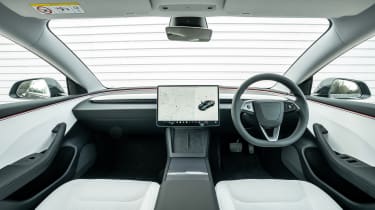
There’s no dash display behind the steering wheel whatsoever, which is perhaps jarring at first, but does provide benefit. What this unlocks is the interior’s real party piece, with utterly fantastic front visibility due to the lack of obstructions and its very low scuttle. It really is an almost panoramic view down the nose of the car, something augmented by the large front window glass. All models (even the RWD Basic) also come with a glazed roof, made up of an unusual combination of a large single-pane rear windscreen that runs right up to the centre beam of the roof and a second piece of glass then fills in the gap to the header rail and front windscreen, leaving a cabin that feels open and luxurious with light.
Quality has taken a notable step up with the latest Chinese-built Model 3, and while there aren't many of the high-end, tactile surfaces you'll get inside a BMW i4, most of the materials are pleasant. An ambient lighting strip around the base of the windscreen adds a touch more visual interest, but the look and feel is as clean and minimalist as ever. The entry-level RWD Basic model does get downgraded speakers, no ambient lighting, an uncovered cupholder, no screen in the back and partially manual steering wheel adjustment, but these are clever areas in which to cut costs – you don’t miss out on the Model 3’s key USPs.
Price, specs and rivals
The Tesla Model 3 range now starts at the lowest point in its history thanks to the £37,990 RWD Basic variant. For £7000 more you can have the Premium Long Range Rear-wheel drive for more power, standard kit and the highest range of the lot. The Premium long-range all-wheel drive variant costs from £49,990 for more performance and marginally less range, while the £59,990 Performance tops the range with stats to eclipse BMW's best alternative.
An enormous 15.4-inch touchscreen comes as standard, offering access to Tesla's feature-packed infotainment system and key vehicle functions. Refreshingly, there aren't many optional extras to choose from when ordering a Model 3 – aside from paint colours, wheel choice (18 or 19-inch alloys) and interior upholstery, the range is rather homogeneous. The biggest additional costs come with the Full Self-Driving ‘Capability’ option, which is now available only for a subscription of £99 a month.
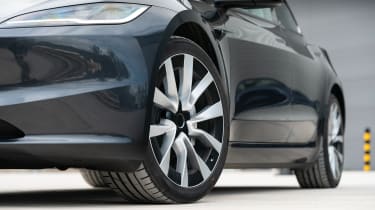
The Polestar 2 is a close match for the Tesla in its layout and body style. In single-motor form it delivers similar performance (0-62mph in 6.2sec) and slightly more range (344 miles) than the base Model 3, but costs substantially more at £45,210. The Hyundai Ioniq 6 is another contender, majoring on cruising refinement and efficiency. It's an accomplished saloon that achieves 338 miles from a charge in base form, but at £47,800 it's priced closer to the dual-motor, 390-mile Model 3 Long Range.
Speaking of which, the Long Range is most closely matched to the £54,220 BMW i4 eDrive35, which remains the driver's choice in this class. The i4 feels more conventional than the Model 3 and has a more cosseting interior, but in raw performance terms it's a good distance behind the Tesla. The eDrive35's claimed 311-mile range is significantly shorter, too.
Tesla Model 3 Long Range RWD specs
| Powertrain | Single-motor, rear-wheel drive |
| Power | 315bhp |
| Torque | TBC |
| Weight | 1822kg |
| Power-to-weight | 173bhp/ton |
| 0-60mph | 4.9sec |
| Top speed | 125mph |
| Range | 466 miles (WLTP) |
| Basic price | £44,990 |