Hyundai is ramping up development of Europe-specific models, including a new i30N
New state-of-the-art test facilities in Germany will speed development of Hyundai's Europe-specific models

Showing its commitment to the European car market, Hyundai Motor Group recently opened a 25,000sq m extension to its test facilities at the Hyundai Motor Europe Technical Centre (HMTEC) in Russelsheim, Germany. The investment of €150m, plus €50m in equipment, brings state-of-the-art testing facilities including one of the largest semi-anechoic chambers in Europe, a powertrain dynamometer with partially robotised driver and a four-wheel-drive rolling road with up to 162mph (260kph) capability.
Tyrone Johnson, managing director of HMTEC, says the investment will help speed development of European-specific models and also produce data that will be shared with Hyundai’s other operations. Many of the test cells, including the rolling road, can be run at temperatures between -40 and +50deg C, reflecting the extremes found in Europe, from the Nordic states to Turkey in the south. The investment recognises that cars created for the diverse demands of Europe – including UK roads, which are described as ‘a very special thing’ – will work all around the world.

The semi-anechoic chamber is an impressive 200sq m space with a rolling road built into the floor. Conditions inside are equivalent to standing in an open field in complete stillness, perfect for testing NVH and simulating drive-by noise testing: ever tighter legislation has seen the limit drop by 6dB in six years. The chamber allows testing in perfect conditions around the clock.
The extension to the campus also features a powertrain dynamometer that can test a whole car or just the drivetrain, suspended between four vertical units with a 1500bhp capability. It can run different programs simulating various tracks and multiple factors, so it could recreate the demands of the Nürburgring with an eco tyre or a performance tyre, and with a smooth driver or an aggressive driver. It can also run with a robot driver installed, pressing pedals, selecting drive modes, changing the A/C settings and the like, allowing engineers to leave it running 24/7.
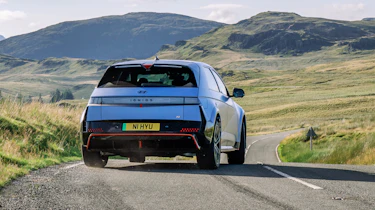
There are some EV-specific labs, researching areas like security and over-the-air updates (OTA), and it’s not all one-way. Customer feedback and analysis of driving styles shows that customers are adapting their driving style to EVs’ abilities, for instance using more of the instant acceleration to exploit gaps in traffic. Even more interesting is feedback on the sporty EV, the Hyundai Ioniq 5 N. Stefan Fuchß, director of vehicle development, says that with the simulated gearshift ‘we really hit the nail on the head’. It’s not only appreciated by customers, though, Fuchß revealing that pro drivers lap the Ioniq 5 N quicker with simulated shifts than without.
A dynamic driving simulator will also bring humans into the development loop. The chosen simulator is not the usual 6DOF (six degrees of freedom) design with a real car cockpit supported by hydraulic jacks and riding on a frictionless bedplate. Instead, Hyundai has opted for a concept from UK specialists Ansible Motion, which has the cockpit mounted on a longitudinal rail for fore (braking) and aft (accel) motion, which is itself mounted on three lateral rails to simulate cornering force. This should be operational next year, allowing chassis changes that physically would take weeks to be made in minutes. Also, with the same simulator in the main test centre in Namyang, Korea, engineers could drive the same virtual car, saving time and resources – it takes eight weeks to ship a car to Korea.
It’s not all virtual testing, though. Earlier this year Hyundai invested €13m and doubled its workshop space at the Nürburgring to support testing on the track and surrounding roads, while Klaus Köster, director of projects, regulations and evaluation, said he couldn’t envisage a time when humans were not a key part of the development and sign-off process.