Donkervoort P24 RS swaps iconic Audi engine for Ford power
The Dutch pseudo supercar maker’s latest creation is its most powerful thanks to a 3.5-litre twin-turbo Ford V6

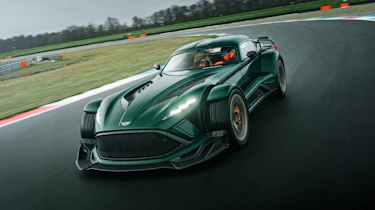
That Dutch proprietor of wild left-field pseudo supercars, Donkervoort, has revealed its latest model. Called the P24 RS, it represents a new era for the company, as it moves away from use of the Audi RS3's 2.5-litre five-cylinder turbocharged engine and adopts a version of Ford's 3.5-litre ecoboost V6.
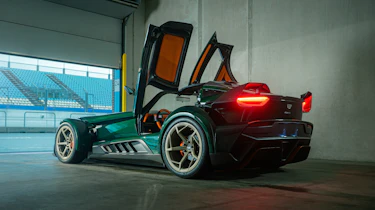
The P24 has undergone some general design changes compared to the F22 with the incorporation of that V6, including side-exit exhausts that sprout from behind the front wheels, rather than closer to the rear wheels. Otherwise, visually, it’s Donkervoort madness as usual, with optional extra downforce that we’ll get to in a moment.
First, the engine and performance. The P24 features switchable power outputs, with either 400, 500 or 600bhp available, while torque output is 590lb ft. That’s 100bhp up on the Audi-powered F22. Curiously, Donkervoort has skipped the 0-62mph convention and jumped straight to quoting a 0-124mph figure, of 7.4sec – the time it takes some hot hatches to hit 62mph. Top speed is said to be over 186mph.
While the core is Ford-based, Donkervoort has modified the engine with billet ball-bearing turbochargers from fellow Dutch firm and F1 supplier Van der Lee. Even at full tilt, the P24 is running less boost than the less potent Audi engine - 1.2 bar as opposed to 1.5 - though there are of course now two turbochargers. The engine breathes in via a new carbonfibre inlet and out via 3D-printed exhaust manifolds. The water-to-air intercoolers are also 3D-printed.

Even the lowest 400bhp figure will make the P24 feel brisk, given it weighs a claimed 780kg – not much more than the battery of a Taycan. That’s thanks to a tubular alloy and ‘Ex-Core’ carbonfibre construction. The patented system presses carbonfibre sheets against moulds from the inside with expanding foam. It’s a faster, cheaper and more flexible carbonfibre component manufacturing process.
The front subframe is now made of Ex-Core too, a single 9kg piece inspired by endurance racing prototypes. The ‘Fort-Ex’ subassembly, as Donkervoort calls it, consists of carbon crash cones, front suspension, brakes, aero and cooling once all built up.
With the full 600bhp, Donkervoort claims a 770bhp per ton power-to-weight ratio. Managing that performance, sent exclusively to the rear wheels via a torque-sensing limited-slip diff and sturdy five-speed (with auto rev matching) manual transmission, is an adjustable traction control system. Power steering and ABS are optional.

It’s no one-trick pony either. That’s the beauty of being lightweight – it helps everything. Donkervoort claims the P24 is good for cornering forces of 2.3G, while the car’s track capability can be elevated further still with the removable aero kit.
This consists of an aggressive front splitter with clever channelling around the sides and individual wing elements that sit over the rear lights. The result is an extra 90kg of downforce at 155mph without clipping the car’s top speed. You can have carbon ceramic brakes too for improved track performance, while an adjustable ride height and adaptive dampers give it versatility.
Speaking of versatility, there are some other curious party tricks for what would otherwise sound like quite a track-focused car. It’s a targa, with removable carbonfibre roof panels, so a breezy summer cruise is well within reach, even if the musicality of that Ford V6 leaves a little to be desired. With a 290-litre boot, you could also raise the ride height, soften the dampers and take the P24 touring. There won’t be many P24 RSs. Just 150 are set to be built, with Donkervoort saying the first 50 are already spoken for.