Lotus wants to save its Norfolk factory by developing and building other company's sports cars
The Emira will live on and there's an Esprit supercar on the way, but Lotus has another plan to keep Hethel active


July 17, 2026, marked exactly 60 years since Colin Chapman laid the foundation stone for the Lotus Cars factory at Hethel in Norfolk. It’s had its ups and downs, not least recently, with speculation about the future of parts of the facility, but today Lotus is pivoting and Hethel is safe – for now – and not simply because of the Emira’s stay of execution and the new Esprit V8 hybrid supercar (known officially as Type 135) waiting in the wings.
Lotus’s production capacity at Hethel is 10,000 cars per year, so you don’t need to be a world-class mathematician to work out that the 2000 cars it sold in 2025 didn’t keep the staff as busy as they’d like. The new Hethel Performance Hub is intended to capitalise on both the uniquely impressive vat of brainpower and manpower at Lotus’s disposal and the array of facilities it has accrued.
HPH will see Lotus offering out effectively anything it does for itself (which is almost everything) to anyone willing to pay. The result, hopefully, will be that those often-idle hands, unsure of whether layoffs were in their future, can now turn their talents to new projects courtesy of HPH clients, across OEMs, suppliers, technology companies and even educational institutions.
So a small sports car start-up that would otherwise need to spend many millions to get the kind of resources at Lotus’s disposal can simply buy the services from Lotus. Remember, the Hethel facility is a near end-to-end ecosystem, with ideation, prototyping, development, testing and manufacturing resources, as well as strong supply chain and distribution relationships.
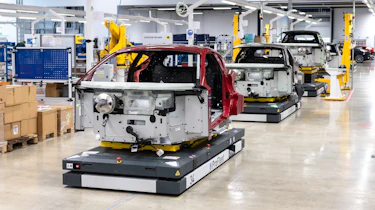
The initiative currently has the interest of five clients, including revived low-volume sports car maker Zenos, and Charge Cars, the creator of carbonfibre-bodied electric Ford Mustang restomods. Given HPH is good news for jobs, there’s also the emphatic support of the government, with Industry Minister Chris McDonald officially opening the hub.

Gavan Kershaw, director of attributes and product integrity at Lotus Cars, explained the offering to us: ‘If you’re a start-up, you can’t invest in this kind of facility. To set up a Hethel you’re talking £200million probably – if you’re allowed to even do it. Here you can have sketches done, engineer it, make a model, test it, hold a press event and manufacture it.
‘We’ve got prototype labs with milling machines, a clay facility, 3D printing, fabrication, welding… We’ve got engine builders, a dyno, an emissions lab and a test track. Even a canteen – one thing we notice is, you go round some of the smaller businesses and the facility for their staff is a bank of eleven microwaves and a set of patio chairs outside the fire exit.’
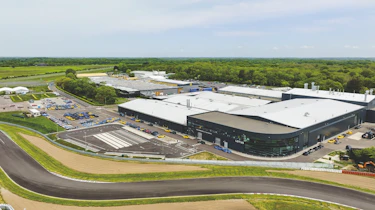
‘We have one of the most sophisticated paint facilities in Europe,’ one of Lotus’s bright young minds told us during our tour of the factory. ‘We even designed and manufacture our own bespoke fuel tanks at Lotus Advanced Structures, front and rear subframe and monocoque structures, and we can now do that kind of thing for others. If we’re not doing it for ourselves at full capacity, it just makes sense.’ And that’s to say nothing of the EV expertise the group has accrued over the years.
It’s well known among enthusiasts that subsidiary company Lotus Engineering has conducted development work for other companies for decades. There are widely known collaborations such as the Tesla Roadster and Lotus Carlton, and Lotus Engineering played a key role in Aston Martin’s early extruded aluminium underpinnings for the original Vanquish and DB9. HPH goes further, with a wider reach of capabilities and more visibility. Lotus Engineering will continue its work, both inside and outside the Hub, using its traditional consultancy model.
I have a feeling that Colin Chapman would have approved of HPH, that he’d have welcomed leveraging Lotus’s impressive resources and self-sufficient infrastructure – its inimitably skilled workforce and cutting-edge facilities – to generate revenue outside of the traditional car sales model. Although, fiercely competitive as he was, I wonder what he’d have thought of the idea of ‘helping’ potential rivals. The only true test now, of course, is whether it’ll pay off.