How shouting can actually help you in an emergency on the road
It could be – if you know how to use it effectively. Ripley explains the power and the pitfalls of anti-lock
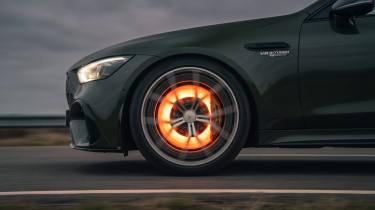
Just how good is ABS? Based on the fact that doubling your road speed means you are quadrupling your braking distance, it’s worth becoming fully familiar with the advantages and the potential shortcomings of ABS braking, and how to get the best results from it.
Let’s start with the basics. ABS prevents the road wheels from ‘locking up’ under extreme braking and thereby allows you to retain steering control, as wheels must revolve before they can steer a car. However, developing familiarity with the use and feel of ABS is important to ensure the know-how, confidence and precision to use it effectively should the need arise.
> How crashing a Lotus Cortina turned Paul Ripley into a driving guru
When using ABS in an emergency, drivers often don’t hit the brake pedal hard enough. Those who do may feel the vibration of the ABS in operation and reduce their pressure on the pedal, thinking something is wrong when in fact the system is operating at its optimum. The remarkable advantage of being able to steer under intense braking is also lost on many drivers at the crucial moment due to a response known as ‘Panic Freeze Syndrome’, where the driver’s ability to think and act decisively self-destructs. Yes, the driver will brake… but they will then freeze and smash into the hazard directly ahead, because that’s where their visual fixation lies.
With confidence gained through practice – which should always take place in a safe, controlled environment – a driver should be able to think and act clearly, exerting maximum pressure on the brakes, whilst steering to safety around any stationary object ahead.
When coaching a high-speed ABS lane-change manoeuvre we create an imaginary scenario, simulating driving along a motorway at 70mph. We pretend that, through a lack of concentration or distraction, the driver has momentarily taken their eyes away from the road scene and now has an immediate need to brake as hard as possible and change lanes, automatically adding a rearward awareness safety check.
At this point it helps to shout out ‘BRAKE and STEER!’ – this triggers the correct thought/action processes of applying the braking and steering almost simultaneously, embedding the ABS braking protocol process into your skillset forever.
- Here’s how to maximise ABS braking efficiency in a real-life emergency:
- Hit the brakes very hard. Do not reduce the pressure on the brake pedal until you need to.
- Don’t ‘Panic Freeze’ – keep alert and plan your response.
- Look where you need to go and steer there. Beware target fixation and steering into the very thing you’re trying to avoid!
- Shout ‘Brake and Steer’ if that helps your thought/action processes.
Whilst ABS is a wonderful safety invention, it’s not foolproof. Never rely on it in icy conditions or when driving on loose surfaces, as you’ll soon find its limitations. If the tyres can’t grip the road surface, then no electronic wizardry will help. In these circumstances, more than ever, your key safety measure is prevention – choosing appropriate speeds to match/manage the risk.
Of course, the ultimate way to avoid the need for emergency braking is to always pay full attention to driving, using visual scanning as your risk radar and developing the ability to match peak concentration with peak risk.
Remember: drivers only crash when they run out of space or time.
This story was first featured in evo issue 336.