Tesla Roadster (Mk1, 2008 - 2012) review – the original electric sports car
With a second-generation Tesla Roadster finally on the horizon, we revisit the fascinating original that sparked what is now one of the world’s largest car manufacturers
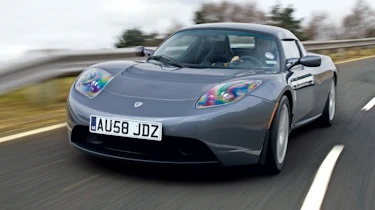
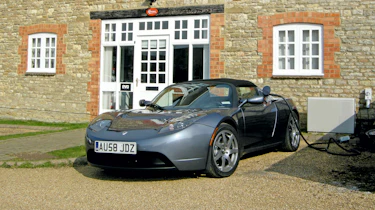
Tesla hasn’t always been the near-£1 trillion powerhouse it is today, as back in the late 2000s it had just one model on its roster: the first-generation Roadster. Given it was the marque’s very first car and one of the very first electric sports cars to make it to market, it was a fascinating prospect to us, so we spent plenty of time getting to know it.
The long (long) -awaited second-generation Roadster will no doubt be built in one of Tesla’s numerous town-sized ‘Gigafactories’, but the same couldn’t be said for the original. Manufactured in collaboration with Lotus, final assembly for European cars was undertaken at the Lotus factory in Hethel, Norfolk.
> The Tesla Roadster is finally arriving, with SpaceX rocket tech?
It’s a somewhat modest offering on paper next to even an entry-level Tesla Model Y crossover of today, but the original Roadster was a surprisingly well-executed proof of concept. Being so radical, the production run was limited to around 2450 units, and one of those is currently orbiting the sun 50 million miles from Earth courtesy of a SpaceX test flight – just over 30 remain registered in the UK, and you won’t find one for less than its near-£100k list price.
Powertrain and technical highlights
- Single-motor, rear-wheel drive
- Output of 248bhp and 280lb ft
- Planned two-speed transmission swapped for single-speed
More reviews
The company had hoped its Roadster would hit the streets in 2007, but durability problems with the unique two-speed transmission units the car was originally going to use put a stop to that. In the end the two-speed unit had to be abandoned and replaced with a single-speed gearbox design that could be built in-house, alongside a bespoke 248bhp, 280lb ft, 14,000rpm electric motor.
The only problem then was figuring out how to meet the original performance targets without the two-speed ’box. The solution was to raise the maximum current released from the battery pack from 600 amps to 850, enabling a 0-60mph time of 3.9secs, an impressive figure for 2008 and nothing to be sniffed at even almost two decades on. Top speed stands at 125mph.
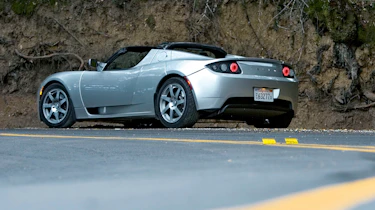
As is quite clear from its design, its basic underpinnings came from Britain in the form of the Lotus Elise. Tesla thoroughly reengineered the platform for this application though, lengthening the wheelbase by two inches to accommodate the 53kWh battery pack, redesigning the rear subframe, wishbones and strengthening the aluminium tub to handle the additional weight too.
Performance, ride and handling
- Thrillingly fast yet surprisingly quiet driving experience
- Expensive battery pack with thermal efficiency drawbacks
- Exceedingly cheap to run versus ICE equivalent
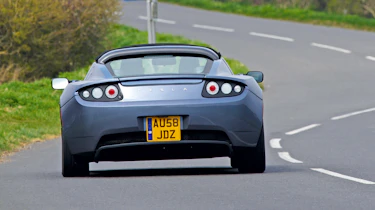
These seem like bold performance claims, but having now driven a Tesla in anger, we can confirm that this car is laugh-out-loud fast. Think of an Elise into which someone has installed a 5-litre V8 equipped with the mother of all silencers and you’ll have some idea of what it is like to drive. It’s also surreal how no-one takes any notice of the car in traffic because of its silent progress and tiny dimensions.
Perhaps the best news is that the steering still feels like that of the Elise it is based on and that joyous Lotus sensation of minimal inertia still filters through to the driver, despite the massive 450kg battery pack strapped on top of the electric motor.
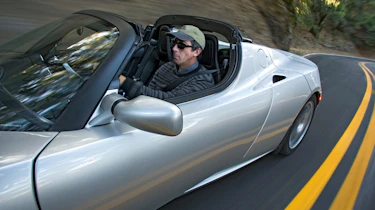
That power pack is made up of 6831 lithium-ion cells that, according to Tesla’s senior vice president at the time Darryl Siry, cost around £11,000 to produce. One problem with this type of battery is that it only operates efficiently in a narrow temperature range, so energy has to be expended to keep its temperature constant.
The idea of charging it overnight (it takes eight hours to get a full charge from a domestic supply) at minimal cost for a claimed 220 miles of motoring is still massively appealing, though. Pity the car’s original £92,000 price tag meant only the wealthy will be able to benefit.
How does it compare to its petrol-powered equivalent?
In 2009, John Barker put the Tesla Roadster head-to-head with the Lotus Elise SC to find out just how much stood between the two
'The contrast is stark. Experimentation shows that the optimum start in the Elise involves dropping the clutch with the engine sitting at a thrashy 4500rpm. Then there’s a crunchy, rushed shift into second at 8000rpm (which handily goes to just over 60mph) and then, up around three figures, the Lotus finally starts to feel decisively the stronger of the two. The figures bear this out: the Elise manages a snappy 4.5 to 60 and 11.4 to 100. That’s chuffing quick.
However, when we line them up for a drag race for the camera and the pressure is on, there’s much less in it. The Lotus makes an initial break but when you change gear the Tesla comes back and then seems hard to shake. Seats swapped, it’s amusing to be in the peaceful Tesla, hearing the gnashing of the Elise’s engine and the wailing of its tyres and having an easy time keeping up. It’s then that it dawns that not only does the Tesla deliver its full performance every time with negligible driver skill, but it’s also possible to use it when you like without attracting the attention high engine revs would.
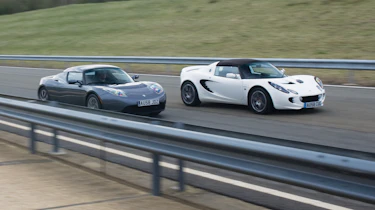
Intrigued, Catchpole and I head up onto Millbrook’s hill route and then on to the back- roads that lead to the Bedford Autodrome. First off I’m in the Tesla chasing the Elise, and with Catchpole primed to show the ultimate pace of the Lotus, I am watching – and listening – intently.
We’re ambling at around 30mph when I hear Catchpole select a lower gear, so I’m ready for when the rump of the Elise dips slightly and it scoots forward. I nail the Tesla’s accelerator and the kick is huge, bigger than from rest because the drivetrain is protected against maximum torque from zero but doesn’t need to be when the car’s rolling. The Elise isn’t going anywhere… until we get to about 70mph, still accelerating. Now the Lotus starts to ease out a gap, and a series of well-sighted corners gives it a few more yards. The Tesla handles very tidily, with heftily weighted but clean, direct steering and good poise, but it feels much heavier than any other Elise-type vehicle I’ve driven. It works its brakes hard and is a bit more reluctant to change direction. When we pop both cars on the corner-weight scales later, the Elise comes in at 914kg, fully fuelled, the Tesla at 1283kg. That’s a lot more, the equivalent to having five more 75kg people like me in the car.
Driving the Elise feels like when you take a heavy rucksack off, and as well as having lighter steering and a greater feeling of nimbleness, the Lotus also has a light and snappy gearshift that’s a delight to use. I know where to make easy yards to close up on the Tesla’s tailpipe-free rump – under strong braking for tight corners and through, long, high-g, bumpy corners – but it’s still hard work because of the Tesla’s instant response. To stay with it when it snaps forward you have to be in the right gear at the right revs or you’re left for dead, and that’s a bit stressful after a while.
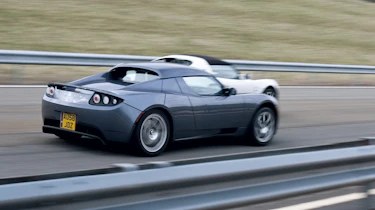
Driven to their strengths, these two sports cars make their speed in different places for very similar cross-country pace, the Tesla gaining every time there’s a low-speed acceleration opportunity, the Elise maintaining speed with little effort. On track, however, the Tesla doesn’t feel as punchy, and its mass tells against it. Traction control is off and we have a slight tail slide out of the hairpin but halfway through the second flying lap it feels like it’s lost some of its urge. It has – there’s a message on the screen by my left knee that says ‘Motor getting hot. Power reduced’. We’ve managed a lap of 1.32.6 which is trim-able, I reckon, to around 1.31.0, but even that is a long way off the Elise’s outstanding 1.27.7sec.
On road is where the Tesla is at its best, where it can best exploit the weaknesses of internal combustion cars. This car has drivetrain version 1.5 and version 2.0 is on its way, with a tougher transmission allowing greater off-the-line performance. Tesla claims that one-up it will give a 0-60 time of around 3.5sec, which will make it as fast as any supercar up to the legal limit, with none of the attention-grabbing aural drama. I’m not sure if that’s good or bad but I do know that (whisper it) electric cars can be fun.’
Living with a Tesla Roadster Mk1
Back in 2008, Peter Tomalin took it home to live with. Here's what he found
It’s my first journey in the Tesla, and I’m absolutely in its thrall. You would be too. Because being blokes we’re intrigued by new technologies. We want to experience them, want to find out whether they’re going to enhance our lives. And on a more practical level, we need to know that they actually work, which is why we’re spending a couple of days with the Tesla, just driving it between home and work and back again, getting a feel for what it would be like to live with.
The driving bit is painless. In fact it’s rather better than that. As I head home to Cambridge after the Autodrome shoot, I’m blown away first by the fact that it all just works so beautifully, then by the sheer pace of the thing and finally by the fact that it gels so well with the Lotus chassis. It might not be quite as delicate and balletically agile as an Elise, but it’s pretty damn close, and the steering’s wonderfully organic in feel – a digital engine in an analogue chassis.
But something’s nagging away at me, and it’s the tiny touch-screen display tucked away in the bottom left-hand corner of the facia. When I left Bedford it promised an ‘ideal range’ of 91 miles – more than ample for the 40-mile drive home. But with around five miles still to go it’s down to just 20 miles and warning me that the battery’s low so it’s going into reduced power mode. Hmm. When I eventually park up, it’s down to 13 miles, so that’s 78 miles worth of juice spent in around half the distance. And okay, I was driving in a spirited fashion, but hey, it’s a sports car.
What it does mean, of course, is that if Mrs Tomalin and I were planning an evening on the town, we’d have to take another car. Because the Tesla now has to be recharged for six-eight hours (if you’ve had the high-power converter socket fitted) or considerably longer if you’re running off a regular mains socket.
Electricity pumped back into its 53kWh battery pack and I find I’m missing the business of heeling and toeing, dipping the clutch and changing gear. Didn’t expect that. I’m also pining for the sounds of a petrol engine: the fire, the soul. The spooky linearity of the Roadster’s power delivery and the jet-engine soundtrack are a novelty all right, but novelties have a habit of wearing off. By the time I arrive at work, the range has dropped by 63 miles to 71, even though I’ve actually covered just 38. It’s delivering about 60 per cent of what it promises, and this time I wasn’t even driving particularly briskly. Next day Harry Metcalfe drives the Tesla home, and gets an almost identical result.
So range remains the electric sports car’s Achilles heel. Treat every journey like an economy drive, and yes, you might see 150-180 miles. But drive it as you would, say, an Elise, and in our experience 100-120 miles is more realistic. Which, given that you might then need to spend 12 hours recharging it, isn’t very far. And you’d never dare risk going much below 20 miles (even though there’s a 30-mile ‘reserve’), because if you do run out, there’s no hitching a lift to the next garage for a gallon of electricity.
Tesla Roadster Mk1 specs
| Powertrain | Single motor, rear-wheel drive |
| Power | 248bhp |
| Torque | 280lb ft |
| Weight | 1283kg |
| Power-to-weight | 196bhp/ton |
| 0-60mph | 3.9sec (claimed) |
| 0-100mph | 14.3sec |
| 1/4 mile | 13.9 |
| Top speed | 120mph |
| Basic price | £92,000 |
| Price today | £100,000+ |