Best fast family cars 2026 – practical performance cars for everyday thrills
A family car doesn’t need to be dull – some of our favourite performance models deliver the thrills of a purpose-built sports car

Some of the most talked-about performance cars of the last 12 months are also cars you could conceivably run as your primary family daily driver. Hybrid, estate and SUV are not categories to stir a car enthusiast’s soul like ‘supercar’ or ‘sports car’. But some recent fast family cars are some of the best that we’ve ever driven.
In part that’s because car manufacturers are able to package more speed, more tech and more fun into family cars than ever before. Many practical, multi-purpose driver’s cars on sale today can now show a clean pair of heels to some bespoke sports car machinery, and while modern performance SUVs have stolen a march on this area of the market, the last few years have also produced some cracking fast estate cars

The SUVs we’ve included on this list don’t just drive well for their size and weight; they’re compelling in their own right, delivering memorable driving experiences irrespective of the genre they compete in. With that said, equivalent fast estate cars will always have a higher ceiling of performance, dynamic ability and – for us – desirability.
This is not an ordered list, rather a collection of brilliant-to-drive performance cars that place just as much emphasis on the way they drive as they do Isofix points.
Best family cars 2026
- BMW M3 CS Touring
- Alfa Romeo Stelvio Quadrifoglio
- Mercedes-AMG E53 Estate
- Porsche Cayenne GTS
- Range Rover Sport SV
- Skoda Octavia vRS Estate
- Porsche Taycan Sport Turismo
- Audi RS5 Avant
- Land Rover Defender Octa
- BMW M5 Touring
- Cupra Leon 333 Estate
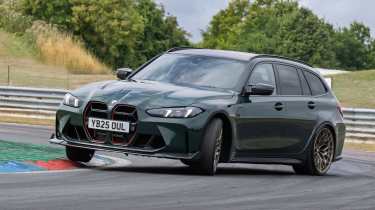
BMW M3 CS Touring
Prices from £126,275
-
Pros: Incredible all-weather performance; genuinely agile
-
Cons: Not cheap
-
evo rating: 5 stars
The BMW M3 is more usable than ever in its current G80 incarnation. It’s bigger than its predecessor with wide-opening doors and a generous boot, but most significant is the fact that you can buy an M3 Touring, which like all M3s comes with four-wheel drive as standard. It’s one of the most versatile performance cars you can buy – and even better in CS form.
The CS Touring is just about the best fast estate you can buy, with a crazy turn of speed, immense capability in the bends and a level of engagement that’s a match for almost anything with four doors. The CS gets stiffer engine mounts and bespoke suspension calibration on top of the extra bracing in the rear structure the M3 Touring gets as standard, to achieve the kind of precision and finesse you would expect of a CS. The M3 Touring was a long time coming and surely worth the wait and then some. The CS Touring is the cherry on the cake.
‘It’s a lovely road car, with more grit and precision than a normal M3 but enough compliance to work with the road surface. The Cup tyres drum up a fair bit of noise on rough tarmac but, coupled with the suspension changes and a CS-specific aluminium front strut-brace, give the steering fantastic clarity. It’s measured, precise and relays surface detail to your hands through the (overly fat) suede rim.’ – Yousuf Ashraf, evo Senior Staff Writer.
Alternatives to the BMW M3 CS Touring
The M3 CS Touring is without a direct rival for the moment. Perhaps the closest in concept was the last-generation Audi RS4 Competition, with its trick manually adjustable coilover suspension. It was a great sendoff for the B9-generation car but even with its Audi Sport differential, there’s no matching xDrive for its blend of traction and throttle adjustability. At M3 Touring prices, let alone CS prices, there’s also the option of a lightly used Audi RS6, should you crave a V8. Especially given Mercedes-AMG no longer offers one in the latest hybrid C63. A good alternative to a CS for a lot less money, let’s not forget, is a standard M3 Touring...
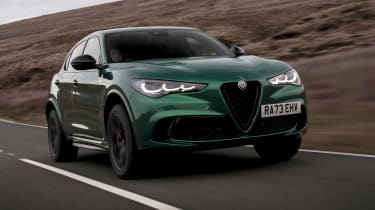
Alfa Romeo Stelvio Quadrifoglio
Prices from £96,090
-
Pros: Updated diff works well; genuinely fun to drive
-
Cons: Interior less polished than rivals’; less fun than a Giulia
-
evo rating: 4 stars
The Alfa Romeo Stelvio Quadrifoglio is on this list not just because it’s a more practical version of the brilliant Giulia, but because it has an exciting driving experience all of its own. This is underpinned by the Stelvio’s all-wheel-drive system, an element that fundamentally changes the way this car drives in comparison to the rear-drive Giulia.
The steering is quick and precise in the usual Alfa style, and the chassis balance almost makes it feel like a tall and Italian Nissan GT-R. It has a generous rear bias that gives this Alfa a high level of adjustability, especially in slippery conditions. And while the extra weight of the Stelvio is noticeable compared to its three-box relative, it’s not a deal breaker as the superb twin-turbocharged V6 still pulls with almost the same intensity.
> Alfa Romeo Stelvio Quadrifoglio review
‘The steering has a direct, pointy feel with a strong self-centring action, and that’s reflected in the Stelvio’s dynamics generally: it’s an agile car, which can change direction keenly and hunkers down under power, eking out traction and summoning a great deal of lateral grip. It feels far more nimble – and more fun – than the vast majority of performance SUVs.’ – James Taylor, evo Deputy Editor
Alternatives to the Alfa Romeo Stelvio Quadrifoglio
The Stelvio Quadrifoglio isn’t long for this world, yet it has outlived some of its fiercest competitors, namely the BMW X3 M, which is yet to be replaced for the new generation. Nor is there anything like the old Range Rover Velar SVAutobiography, which brought a gargling supercharged V8 to the party. In a class of one, the Stelvio Quad’s most compelling alternative still sits alongside it in Alfa showrooms – the Giulia Quadrifoglio.
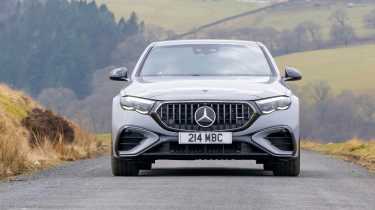
Mercedes-AMG E53 Estate
Prices from £96,365
-
Pros: Looks like an AMG, goes like an AMG, drives like an AMG…
-
Cons: Doesn’t sound like one
-
evo rating: 4 stars
Mercedes-AMG has lost its way a bit in recent years. Charismatic V8s are no longer a staple throughout the range and its move towards hybrid power hasn’t been as successful as some (the less said about the four-cylinder hybrid C63, the better). But that doesn’t mean there aren’t still compelling performance cars in its lineup. Take the E53 – on paper it’s more complex, heavier and two cylinders down on the old E63, but it’s a very effective supersaloon, and in estate form, one of our favourite fast family cars.
Compared to the BMW M5 you’ll also find on this list, the E53 is a more straightforward proposition. Not as powerful or advanced (its six-cylinder plug-in powertrain develops 577bhp), but easier to get along with without a befuddling array of drive modes to tweak. It deploys its performance with zero fuss and manages its 2.4 ton mass well, with precision and a good amount of adjustability built into the chassis. It’s not as outright fun or exciting sounding as an old E63 but it’s a competent do-it-all performance car, with the breadth of ability a fast estate needs.
‘Wound up into its most aggressive settings and the E53 will respond in kind to the levels of aggression you present it with. You can build a satisfying flow or throw it around, at which point it’ll start to dance with shades of the E63’s flamboyance still present, it just requires a little more digging to unleash it.’ – Stuart Gallagher, evo Editor-in-Chief
Alternatives to the Mercedes-AMG E53 Estate
The obvious alternative to a fast E-class is BMW’s M5, but the E53 sits on a lower plane of performance and price than previous E63s. As such the M5 Touring is a more serious proposition, with substantially more power and more configurability in its drive modes. Not necessarily for the better, however, the M5 sometimes feeling confused and overly complicated, and hard to build a connection with. There’s also the new Audi RS5 to consider, also a hybrid and packing 630bhp, a playful four-wheel drive system and broad-shouldered styling.
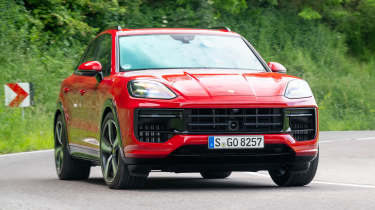
Porsche Cayenne GTS
Prices from £108,300
-
Pros: Class-leading dynamic quality
-
Cons: Not as plush as you’d expect for the price
-
evo rating: 4 stars
In everything from its steering, balance and responsiveness, the Cayenne GTS is shot through with genuine Porsche DNA. It’s capable, polished and adjustable when the mood takes you, yet is adaptable enough to never be a hardship in day-to-day driving. The latest GTS gets a vocal 4-litre twin-turbocharged V8 with a nice, round 500ps (493bhp), and while it’s not as explosive as some of its rivals, it’s refreshing to drive a fast SUV that isn’t all about ripping up the road at the fastest rate possible.
As a family car, the latest Cayenne perhaps isn’t as sumptuous and luxurious as you’d expect inside, but the slightly clinical cabin is at least very well built, coming with Porsche’s latest suite of tech. This includes an optional infotainment screen ahead of the front passenger, with media streaming to keep them occupied on longer drives.
‘On tighter routes you appreciate the speed and directness of the steering, plus the torque vectoring diff’s ability to overdrive the outside rear to hold a tighter line. And since the V8 doesn’t catapult you between corners at warp speed, you can get into a rhythm with the GTS.’ – Yousuf Ashraf, evo Senior Staff Writer.
Alternatives to the Porsche Cayenne GTS
None do a ‘lite’ version of their super SUV like Porsche does, so in a sense the Cayenne GTS is without a proper alternative. Audi’s SQ8 is more or less cut from the same cloth, albeit without much of the Cayenne GTS’s dynamic polish. For the money, a used RS6 would be too tempting to ignore.
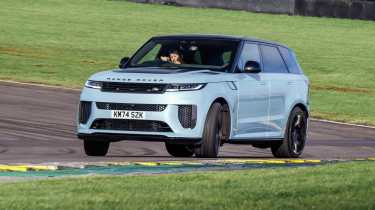
Range Rover Sport SV
Prices from £139,000
-
Pros: Dynamic quality has sports car level of detail
-
Cons: Expensive, the answer to a question no one really asked
-
evo rating: 4.5 stars
The Range Rover Sport SV isn’t as shouty, wild and aggressive as the Sport SVR it replaces, but it is emphatically more rounded and capable than its predecessor ever was. It’s a performance SUV that can stand toe-to-toe with the best that Porsche or Lamborghini have to offer, even giving one of the best examples of the breed – the Aston Martin DBX707 – something to think about.
At the SV’s heart lies a 4.4-litre twin-turbo V8, which generates the kind of colossal numbers we’re used to from today’s super SUVs – in this case, 625bhp and 590lb ft of torque. But it’s the Sport’s dynamic ability that really impresses, with hydraulically cross-linked suspension (the kind of tech you’ll find on a McLaren) keeping its body composed and controlled while remaining supple over poor surfaces. It’s as happy crossing continents in comfort as it is belting around a race track – at least while the tyres, fuel and brakes last… A point worth noting in 2026 for the SV? Now the Edition 1, Edition 2 and other introductory models with lots of standard features are sold out, it’s cheaper: a basic SV now starts from £139,000.
‘There is, of course, no need for a 635bhp, 2.5-ton SUV that’s as competent on track and the road as the SV is. But you can say that about so many cars, and the SV showcases technology that really does transform the driving experience for the better. Making such big cars more precise, and therefore easier to control and manage, has to be a good thing.’ – Stuart Gallagher, evo Editor-in-Chief.
Alternatives to the Range Rover Sport SV
The Range Rover Sport SV is punching upwards at badges with a higher standing than Land Rover’s own: those of Aston Martin (DBX707), Lamborghini (Urus SE), Porsche (Cayenne Turbo E-Hybrid) and even Ferrari (Purosangue). If your want is for a car that can perform impressively alongside them, that’s less outlandish (extraordinary to say of an RRS, we know) and more comfortable in its SUV skin, then believe it or not, the SV is a great choice.
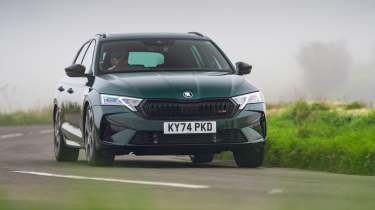
Skoda Octavia vRS Estate
Prices from £41,715
-
Pros: Everyday performance; practicality; price
-
Cons: Interior materials; steering feel
-
evo rating: 4 stars
We’re not sure there’s a more understated performance car on sale than the Skoda Octavia vRS Estate. Hiding beneath its hire car-spec exterior is an engine, gearbox and platform derived from the Golf GTI, with 261bhp being delivered to the front wheels in its latest facelifted guise.
To drive, the Skoda isn’t quite as sporty as it could be, but it has a wide range of ability thanks to optional 15-stage DCC dampers. In its softest setting the vRS settles into a relaxing stride, but there’s more control – and fun to be had – in its sportier modes. You can drive it like a big hot hatch, and on the inside, the Octavia is solidly built and comes with all the modern tech you could ask for.
‘Apply throttle and the vRS picks up keenly in both estate and saloon guise, pulling you down the road and up to good pace without much thought – it’s not quite as quick as its lighter Golf GTI relative, but you don’t feel like you’re missing out on that extra performance.’ – Sam Jenkins, evo Senior Staff Writer.
Alternatives to the Skoda Octavia vRS
The Octavia’s keenest competitors are its Volkswagen group stablemates, the Cupra Leon 333 Estate and the Volkswagen Golf R Estate. The Cupra is the more flamboyant entertainer of the three, while the Golf is arguably more understated. Both have all-wheel-drive over the Skoda’s front-drive setup. The Skoda trumps both in terms of value, with its £41k starting price below the £48k price point of the Golf and the Leon.
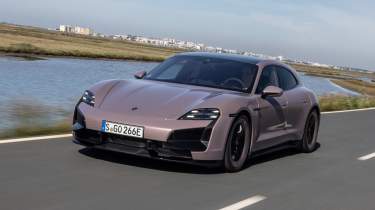
Porsche Taycan Sport Turismo
Prices from £89,400
-
Pros: Exceptional performance, range and dynamic ability
-
Cons: Hefty price; not roomy enough; inconsistent brake feel
-
evo rating: 4.5 stars
In this list we’ve explored today’s best fast family cars, but the Porsche Taycan Sport Turismo might just be the best fast family car of tomorrow. The Taycan has already proven itself to be a superb, fast and luxurious EV, handling with more composure than just about any rival, and it’s faster, more capable and more usable than ever in its latest Gen 2 guise.
With four-wheel drive, 590bhp and up to 383 miles of range, the 4S Sport Turismo would be our pick for a fast electric family wagon. It’s not as spacious inside as its size would suggest, but the Taycan is extremely well judged for comfort and composure. Specify Porsche’s Active Ride suspension system and its long distance credentials go up a level, with an uncanny ability to swallow bumps and keep the body stable. It’s hard to think of a more rounded and deeply talented electric car.
‘Its combination of style, polished driving dynamics and build quality – not to mention its ability to time travel when you plant the throttle – make it one of the most rounded EVs you can buy, more so than ever in Gen 2 guise.’ – Yousuf Ashraf, evo Senior Staff Writer.
Alternatives to the Porsche Taycan Sport Turismo
Direct alternatives to the Porsche Taycan Sport Turismo are relatively few, given there are no estate versions of the Audi e-tron GT or Lotus Emeya. The Audi S6 avant e-tron sits on the Premium Platform Electric (PPE) architecture that’s also the basis for the Macan EV, but doesn’t have the dynamism of the Taycan. There are plenty of alternatives powered by hydrocarbons (and some with a bit of electric), from the new BMW 550e and M5 Touring to the Audi RS5.
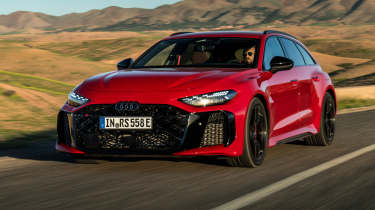
Audi RS5
Prices from £92,050
-
Pros: More balanced than ever
-
Cons: Doesn’t sound as good as the pipes promise
-
evo rating: 4 stars
Audi has been the king of fast estates for some time, but with BMW getting a piece of the action with its M3 and M5 Touring models, Audi Sport has been forced to up its game. With the latest RS5 it’s done exactly that, using a V6 hybrid engine and sophisticated chassis tech to be faster, more efficient and more dynamically capable than ever.
It’s still no M3 Touring, but the RS5 – available as a saloon or Avant estate – has a compelling blend of talents. With 630bhp and quattro four-wheel drive (this time with a Dynamic Torque Control rear axle powered by an electric motor) it covers ground extremely quickly, despite being a heavy beast at 2370kg. The handing is alert and willing, and the trick rear axle gives it newfound playfulness at the limit. A muted and drab exhaust note is the only real snag in what is a compelling, practical everyday performance car.
‘Some of the same sensations that were in the surprising RS6 GT are present in the RS5, particularly that connection to a back axle that feels alert and ready as soon as you turn into a corner, willing to be adjusted with more or less throttle as necessary. I wouldn’t say the big Audi feels delicately fleet of foot, but rather as the Revuelto cleverly doesn’t feel heavier than the Aventador, so the B10 with its new tech doesn’t give you the sense that it’s carrying around 30 per cent more weight than the B9.’ – Henry Catchpole, evo Contributor
Alternatives to the Audi RS5
The most obvious rival to the RS5 comes in the form of the BMW M3 Touring. The M3 is lighter, simpler and more dynamic but the Audi still holds plenty of appeal as a daily proposition, with the benefit of hybrid power and 54 miles of EV range. Another alternative is the Mercedes-AMG E53, a car from the class above but with similar power to the RS5, for a similar price. Or you could venture into the used market and pick up a previous generation RS6, which is what we’d be inclined to do…
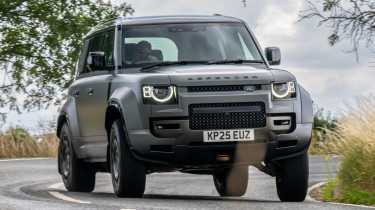
Land Rover Defender Octa
Prices from £148,245
-
Pros: Dynamic qualities to rival a sports car
-
Cons: Where can you explore them fully?
-
evo rating: 4.5 stars
When you think Defender, you perhaps think family car – not fast and definitely not fun in the evo sense of the word. The Octa however, has come along as the farm hand turned Cheshire school run express that’s been strong-arm engineered into one of the most interesting performance cars of 2025. And yes, that’s without losing much – if any – of the practical appeal.
Powering it is the familiar 4.4-litre BMW M V8 good for 626bhp, that’ll rocket it to 62mph in 3.8sec. But raw numbers don’t really do the genius of this car justice. The joy of the Defender Octa is facilitated by what’s going on underneath chassis wise. While wider to accommodate the longer wishbones and knobbly tyres, it’s the 6D suspension tech that’s the secret sauce. This is a hydraulically linked continuously variable semi-active damper system, that affords the Octa a sense of balance and control normally entirely alien to a Defender.
Able to control pitch as well as roll, the system adds a level of capability and pliancy you’d never expect. Off-road in Octa mode you can speed across a rutted green lane at speed like a trophy truck, while the more road-focused modes keep it tied down up to a point, allowing roll and yaw to a natural extent. It might sound odd but there’s an Alpine-like sense of carefully-curated body movement that makes the Octa a joy to thread up a road. And the rest of the time? Potholes and speed humps are a breeze. In some ways, it’s the perfect performance car for modern Britain…
> Land Rover Defender Octa review
‘This is a luxury super SUV that could dispatch a middling Pennine as a house spider would a shagpile rug; a performance car with a breadth of yobbery that includes being able to jump over a roundabout, as well as drift around it.’ – Ethan Jupp, evo Web Editor.
Alternatives to the Land Rover Defender Octa
Picking alternatives to the Defender Octa is difficult, given there’s nothing quite like it. For ostentatious urban presence, the obvious alternative is a Mercedes-AMG G63. In terms of off-road ability, not much comes close – a Lamborghini Sterrato or Porsche 911 Dakar could be considered rivals as off-road supercars, rather than the distinctly road-biased Urus or Cayenne Turbo E-Hybrid.
BMW M5 Touring
Prices from £116,160
-
Pros: Enormously capable; better-looking than the saloon
-
Cons: Range Rover weight; more ‘M550i’ than M5 in feel
-
evo rating: 4 stars
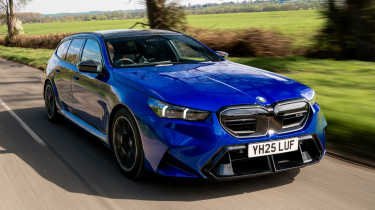
We had hoped that BMW's M5 Touring might be all the supercar and family car one could ever need rolled into one. As it stands its weight, ride and how deeply buried its true M car character is within it stand somewhat in the way. Nonetheless the M5 Touring remains one of the most devastatingly effective and versatile performance cars money can buy right now. For its imperfections, the amount of sense it makes for a number of buyers, with its hybrid capability, business rate-friendly stated emissions and family-sized cabin is enormous. The 500-litre boot volume is a 34-litre upgrade compared to the saloon, with a much larger aperture through which to access it. What’s worth remembering however is that, thanks to the M5’s hybridity, it’s not as capacious as a lesser, non-hybrid 5-series Touring, which has a 570-litre boot unsullied by a big battery pack.
With 717bhp coming from a 4.4-litre twin-turbo V8 augmented by an in-transmission electric motor, the M5 Touring is monstrously fast, good for 0-62mph in 3.6sec. Unfortunately, while the battery (and motor) adds power, it also adds weight, on top of robbing boot space. Weighing in the region of 2550kg, it’s heftier even than the Defender Octa above.
It’s an infinitely configurable machine, though, which, set up just-so on the right road, can deliver proper M car thrills. The ride can be a bit crashy but the steering is well-judged and the brakes heave it to a stop to good effect. On top of being blisteringly fast, its rear-wheel steering and M differential bestow it with a rate of response you simply wouldn’t expect of a c2500kg car. You can also choose to send all of that grunt to the rear wheels for some typical M5 hooliganry.
‘Set the powertrain to Sport or Sport Plus and you get everything the V8 and electric motor can give, all the time, and the kick in the back is noticeably more savage. Just how well judged the base settings are is revealed when you switch the drivetrain to the more dynamic MDM. This sends more drive to the rear and on other 4wd M models is the setting of choice for setting lap times, giving an adjustable but effective dynamic balance.’ – John Barker, evo Editor-at-Large
Alternatives to the BMW M5 Touring
BMW’s M5 Touring returns to a marketplace that’s thinned out since its last outing. The Mercedes-AMG E53 estate doesn’t really fill the tyre tracks of the dearly departed E63 V8s. Fast estate masters Audi are still around with the RS6 Performance, the finest entry to the segment it’s ever devised. This year, that’ll make way for a new-generation RS6 with plug-in V8 power, to fight the M5 on equal terms.
Cupra Leon 333 estate
Prices from £48,120
-
Pros: Point-to-point pace, chassis balance, interior materials
-
Cons: Steering feel, price
-
evo rating: 4 stars
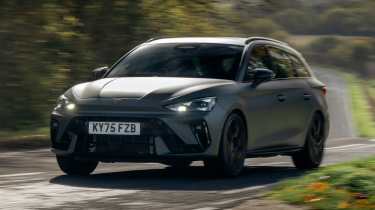
If the Octavia vRS is almost perfect but a little staid for your tastes, might we recommend you consider its spicier Spanish cousin? The Cupra Leon estate in top-spec VZ trim comes with the hottest 326bhp EA888 you can currently buy, as well as the torque-splitter rear differential we enjoy in Audi’s RS3. It also gets some serious Sabelt bucket seats.
Add all that together with the impressively versatile DCC 15-way adjustable dampers and steering that’s more pleasant and direct than that on Volkswagen’s Golf R, and you have a package that surprises with its appeal. It’s agile, engaging and eager – it won’t thrill like a Civic Type R of course but its talents always confound relative to expectations.
> Cupra Leon 333 Estate review
‘Everything about the Leon just feels a bit keener, a bit more eager and more intuitive than the People’s Car equivalent. It’s more expressive and offers a clearer dialogue at speed, offering more clarity on how it wants to move around under braking or with agitated steering inputs. The four-wheel drive might make it more grown-up than the hatch but there’s still great fun to be had.’ – Ethan Jupp, evo Web Editor
Alternatives to the Cupra Leon 333 Estate
The Cupra’s price of over £48k might be a little jarring but consider this: the next best things, an Audi S5 Avant, BMW M340i Touring or Mercedes-AMG CLA45 S Shooting Brake, start at over £70,000. For similar money you can opt for the mechanically similar (but less entertaining) Volkswagen Golf R Estate, or save £6k and opt for the less powerful, front-wheel drive Skoda Octavia vRS.