Mercedes-AMG E53 review - sub-BMW M5 performance but still a strong alternative
With a new V8-engined E63 still 12 months away, Mercedes-AMG E53 has more than enough to take on BMW’s M5 and Porsche’s Panamera.
evo verdict
It has the impossible task of replacing the much-admired and covetted AMG E63 S, but even with the loss of two cylinders, gaining an additional battery pack and electric motor and associated weight the Mercedes-AMG E53 remains a super saloon (or estate) that has every right to wear its AMG badging. Impressively agile with smart damping and tight body control it’s effortlessly fast and refined. Just like its V8 predecessor.
Its hybrid powertrain adds a versatility and capability the old V8 couldn’t hope to replicate, but there’s no ignoring that the E53 doesn’t inherit the old car’s charisma and personality. For the time being this is the Mercedes-AMG flagship supersaloon and estate, one that remains as fast, capable and technically impressive as its rivals. Some will ignore it for not having eight-thumping cylinders, but the E53 rarely leaves you wanting anything else.
If you’ve been left cold by BMW’s M5, which requires a physics degree to extract the best from its drive modes, the E53 offers a more straightforward approach to the supersaloon recipe, giving up outright performance for a more engaging driving experience.
Mercedes-AMG E53 in detail – background and model range
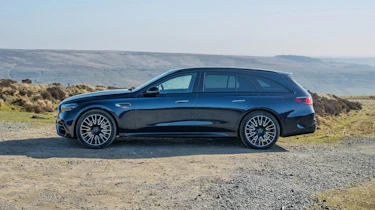
For now the E53 in saloon and estate form is the most potent Mercedes E-class you can buy. At least until Mercedes-AMG finishes the development of its next-generation hybrid V8 powertrain (as revealed in the new S-Class) and resurrects the E63 nameplate. Although this won’t be until 2027. In terms of pricing and performance, it's positioned between the top-end BMW 5-series that is the M550e and the full-fat M5, with the saloon starting at £93,965 and the estate from £94,390.
More reviews
In-depth reviews
Long term tests
Reviews
- Used Mercedes-AMG E63 (W213, 2017 - 2023) review – a V8 supersaloon for hot hatch money
- Mercedes-Benz E55 AMG (W211, 2003 - 2006): review, specs and buying guide
- Mercedes-AMG E53 2021 review – brimming with tech, but missing the charisma of an M550i
- Mercedes E-class 2020 review – new E450 a smooth operator
- Mercedes-Benz E-class review – executive tour-de-force still one to be reckoned with
The E53 is AMG’s first long-range hybrid, a plug-in with a total power output of 577bhp (more in ‘Race Start’ mode) and a claimed 57-mile all-electric driving range. While a fast car, it’s also an easy-going, refined one. We covered more than a thousand miles in both body styles using every permutation of road and scenario you can think of.
The E53 sits at the head of the current E-class range that starts with the E200 AMG Line saloon at £56,650 all the way to this near-600bhp AMG. The E-class is unique among its rivals in 2026 in that it still offers a number of diesel options, including long-range plug-in hybrids, with the 390bhp E450d the long range king and chief bladder tester. It, along with the E53 are the only six-cylinder models in the line-up, with the lesser e300e and e300de fitted with four-cylinder petrol and diesel engines respectively.
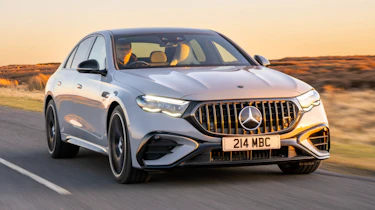
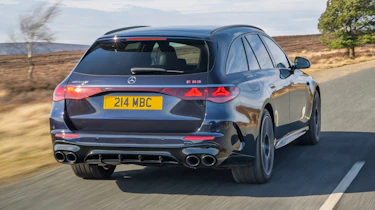
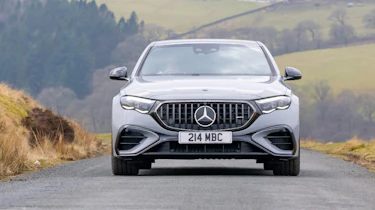
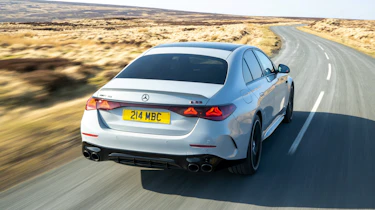
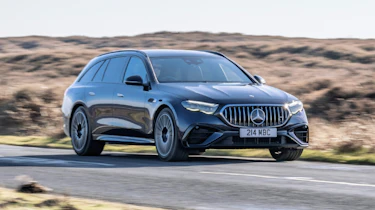
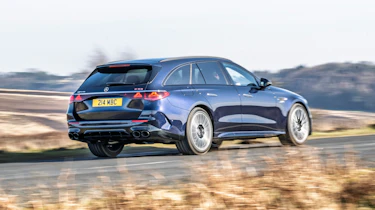
While the E450d is a delightfully torque-rich esoteric option, it’s the AMG-spec E53 flagship that is the E-class of most interest to evo. It certainly looks the part, with its broader stance, larger air intakes, AMG detailing on the crest and grille, quad exhausts and larger diameter wheels. Does its bite match the visual bark?
Engine, gearbox and technical highlights
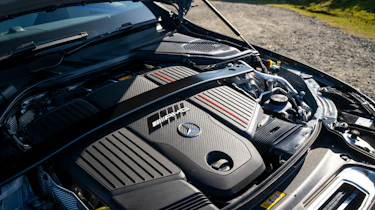
- Combined 577bhp and 553lb ft includes 134bhp from the gearbox-mounted e-motor
- 28.6kWh battery allows 57-mile electric range, pads out c2400kg kerb weight
- E53 manages that weight with adaptive damping and rear-wheel steering
The 577bhp E53 combines a 443bhp 3-litre straight-six petrol engine with a 120kW electric motor, integrated into the transmission between the engine and gearbox (a nine-speed auto). An electronically controlled limited-slip differential can be fitted at the rear as an option (also part of the AMG Performance pack, more on which later), while the front diff is open but assisted by torque vectoring. The drivetrain, engine, damping, steering and traction systems are fully adjustable and affixable to the rotary dial on the bottom left of the steering wheel, for quick swaps between modes on up to two of those adjustable elements. You can configure your preferred choice, or select any of the modes, via the large central screen.
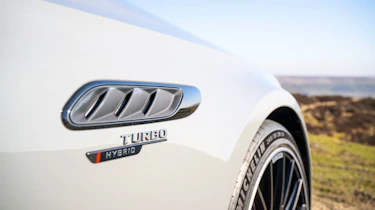
Red borders to the E53 badge on the bootlid identify this as a plug-in AMG, as they do on the now defunct four-cylinder C63. The hybrid powertrain makes this a heavy car, with the saloon weighing a claimed 2315kg, the estate 2380kg. To manage the mass and afford the E53 the level of control and composure you’d expect of a high-performance executive car, it employs steel springs and Bilstein adaptive two-valve dampers, with three different selectable modes.
The E53 is a bit wider than a normal E-class, with a 17mm wider front track and 265mm wide tyres at the front. There are totally different suspension kinematics compared with a regular E-class for this AMG version, too. It’s a large car at almost five metres long and over two metres wide, with a near-three-metre-long wheelbase.
To keep the E53 wieldy, it comes as standard with rear-wheel-steering, therefore below 62mph the rear wheels turn in the opposite direction to the fronts by up to 2.5 degrees for manoeuvrability at parking speeds and increased agility on the move. Above 62mph they turn in the same direction as the fronts, at up to 0.7 degrees to aid stability.
Underbody stiffness is increased compared to a standard E-class, and there’s a strut brace between the front suspension turrets. There are additional measures beneath the engine to alter the front load paths and stiffer mounting solutions for the rear suspension too, for greater precision.
Power, torque and 0-62mph time
| Model | Power | Torque | Weight | 0-62mph | Top speed |
|---|---|---|---|---|---|
|
Mercedes-AMG E53 saloon Mercedes-AMG E53 estate | 577bhp | 553lb ft |
2315kg (saloon) 2380kg (estate) |
3.8 - 4sec 3.9 - 4.1sec |
155-174mph 155-171mph |
The M256 combustion engine is essentially the same as that in the Mercedes-AMG CLE 53, barring a few tweaks here and there, but the big difference is that the E53 is a plug-in hybrid with a considerable electric-only range, whereas the CLE 53 is classed as a mild-hybrid. It also features in a lesser state of tune in the CLE 450. In AMG specification there’s increased boost pressure, revised piston rings and revised combustion chambers.
Total system output from the turbocharged engine and motor working together is 577bhp and 553lb ft. Switch to Race Start mode – available as an option with the AMG Performance package and AMG Driver’s Package – and the peak power figure increases temporarily to 612bhp, albeit only when launch control is also activated.
With this potency fully deployed, even in spite of the weight, the saloon takes 3.8sec to get from 0-62mph, with the optional Race Start system (or 4sec without). The slightly heavier estate takes 3.9sec and 4.1sec with/without the Race Start system. Top speed is electronically limited to 174mph for the saloon (with the optional AMG Driver’s Package; otherwise it’s limited to 155mph, as is the estate). The E53 estate’s top speed is 171mph with the option pack.
Both the motor and engine power all four wheels, and in theory the E53 features a ‘fully variable’ torque split via an electromechanical clutch, although in practice, a certain amount of torque is always sent to the front wheels, for the purpose of torque vectoring without delay. A minimum level of charge in the battery is always set aside by the powertrain management software for this purpose.
The 400V, 28.6kWh battery is located under the boot floor, meaning a slightly smaller ultimate boot capacity compared with other E-class variants. While 26.8kWh is the gross capacity, everyday usable capacity is 21.6kWh – partly because the aforementioned need to set aside a certain amount of charge for performance and torque vectoring. All UK cars get the 60kW DC fast-charger system as standard (models in Germany have an 11kW AC charger as standard, with the 60kW kit an option).
The E53 can travel at 87mph powered by its electric motor alone, and a quoted 59-mile range means plenty of average users’ average journeys can theoretically be completed purely in electric ‘EL’ mode. In electric mode, there are also three different regenerative braking modes which can be toggled by the driver: a heavy regen mode, akin to one-pedal driving; an auto setting, where the amount of regen is continually altered on the fly; and a minimal recuperation mode for less abrupt deceleration.
In our hands during the winter a maximum charge provided 44 miles of electric range, which depleted at around two miles of range of every mile covered. The regen braking puts very limited amounts of charge back into the battery in Comfort mode, but in any of the Sport modes you boost the charge and add meaningful range back.
Performance, ride and handling
- Powertrain is laden with potency if not personality
- Damping, body control and overall agility are impressive
- Brake consistency and feel and steering feel less so
When you first switch the car on, the EL electric mode is the default setting. Pulling away using its electric motor only. After all, it can deliver its maximum torque of 354lb ft from effectively 0rpm.
If you need more power, or the battery’s running low, it automatically - and smoothly, it must be said - brings the engine into play and switches to the Comfort drive mode. Sport and Sport Plus do what they say on the tin but we found being able to vary different configurable elements in ‘Individual’ worked best, pairing for example the Sport damping with more aggressive and responsive powertrain settings.
When the engine is in play, its power delivery is unexpectedly calm and smooth, the V8’s bombastic throb and sharp throttle response replaced with a linear delivery from low rpm to the redline, boosted by the electrified powertrain. There’s not much drama to the engine’s delivery, with no frantic rush to the top end or barrel chest to its vocal range, but it is far more flexible and refined than the V8 it replaces but lacks that crisp throttle response and free-revving nature.
In a world of gas particulate filters your only hope of increasing the decibel level is to artificially enhance the sound via the option menus, but it sounds at its best - and most like a classical straight-six - when left to its natural sound.
It’s at its enhanced noisiest in Sport+ mode, but you can toggle the sound off, via the touchscreen or configurable shortcuts on the wheel and save your preference in Individual mode. Under heavier acceleration, the exhausts make that slightly flatulent (and slightly contrived) sound on upshifts that’s a hallmark of cars such as these.
Given the considerable amount of torque, and the interplay between motor and engine, the E53 doesn’t always allow manual downshifts as freely as you might expect on the paddles, and you sometimes need to let the revs drop a little lower than feels natural before you call on a lower gear. It’s a similar trait the last E63 models had; shifts from the nine-speed ’box are imperceptibly smooth and as swift as you need them to be. Naturally if you want to use the paddles for some interaction, you’re met with a pair of tiny earlobe-style switches.
Refinement is near S-class levels: this is a very quiet car at a cruise, with a little road noise from those wide Michelins but with impressively well suppressed wind noise and powertrain noise – a benefit of ditching the V8 we guess.
The damping is a big step up from the E63. It’s still firm at very low speeds but as you pick up speed it settles into itself with a high-quality control of the body’s movements and how it manages directional changes. Even in its firmest Sport+ setting, the E53 is a comfortable car on most surfaces.
The roads on the German and Austrian route we initially tested the E53 on were relatively smooth, however further testing on more revealing road types and surfaces has revealed the E53’s damping to stand up to the rigours and ruts of potted highways, the mega Merc shrugging off all but the nastiest bumps, fissures and holes it passed over. The E53 copes well with diagonal inputs through the car at higher speeds, for example crossing a ridge in the road surface during cornering, too.
The standard rear-wheel steering boosts the E53’s agility considerably, and while you can feel the system in operation, it’s not as obtrusive as in some cars, feeling relatively natural, working in the background rather than being a distraction.
The physically broad E53 should by rights feel like a prize atlantic tuna in a garden fishpond on skinny, sweeping and unsighted lanes but the rear-steering - and crucially its calibration and integration - render the E53 a natural and wieldy machine to thread around to the point that on the occasion you give more than a passing glance to the sprawling real estate of cabin behind you, it takes you by surprise. At autobahn speeds you can feel a bit of lift at the front, but that’s not unusual for a car like this and overall stability is confidence-inspiring.
From the moment you sit behind its chunky (not BMW M chunky, don’t worry) steering wheel and make those first few turns the E53 portrays the E63 sense of muscularity with enough heft to leave you in no doubt that this is an AMG.
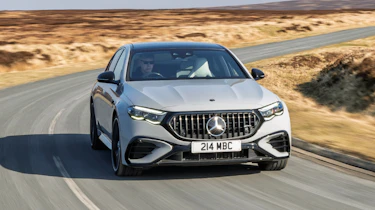
All the same it exacerbates the slightly numb-feeling steering, which is not particularly communicative especially at low to medium speeds when you can at times feel the front tyres are struggling to find any purchase from the surface when you commit to a turn-in. It is very well insulated from kickback and cambers, however, and it’s very accurate – it’s quite a fast steering set-up, and you don’t need much lock for tight corners, particularly at low speeds, with the rear-steer in action. It feels lighter than it really is; a little like the AMG GT, in fact.
The brakes blend regular friction braking and motor regen and use a vacuum-independent electromechanical brake booster to combine the two braking elements. It varies the braking power of the hydraulic system on the fly, the aim being consistent brake pedal pressure from the driver with the ratio of hydraulic braking and motor braking being adjusted behind the scenes without affecting the feel through the pedal.
Pedal feel is certainly less vague than some hybrids and the E53 stopped well during our testing, but you don’t quite have the total consistency and feedback you get from a traditional pure friction brake system. There’s also an initial deadspot that requires a decent shove to push through before you can modulate retardation, once you do the required pedal pressures are more feelsome than you expect and with more experience of them you can use the brakes more when navigating a challenging road to get the car into a corner.
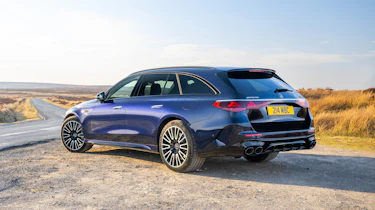
The 45kg difference in mass between the saloon and the estate is negligible in the grand scheme of these cars, especially given even the saloon is almost 2.4 tons. Making more of a difference is the AMG Pro Performance Package, which comes with a rear limited-slip diff that adds another level of precision to the E53’s chassis that allows you to balance it cleaner through and out of a corner.
You’d be forgiven for assuming a four-wheel-drive hybrid AMG weighing 2395kg would be more reserved, or at least be possessed of undefeatable grip. You’d be wrong.
Wound up into its most aggressive settings and the E53 will respond in kind to the levels of aggression you present it with. You can build a satisfying flow or throw it around, at which point it’ll start to dance with shades of the E63’s flamboyance still present, it just requires a little more digging to unleash it.
MPG and running costs
- Electric range is reasonably impressive
- Petrol engine is dependably efficient in normal use
- Purchase price rather than emissions yields the biggest tax penalty
Plug-in hybrid fuel economy is always open to conjecture, and highly dependent on use scenarios, but Mercedes-AMG’s official fuel consumption figures with the battery discharged on a combined route (urban and extra-urban) are 29.7-32.8mpg. We managed mid-to-high 30s on a 160-mile round trip consisting of every type of road the UK has to offer.
In terms of the E53’s electric range, while the car’s indicated figures for a full charge don’t quite match the claimed 57-mile figure, the car is true to its own predictions of 40-50 miles depending on how you’re using it and with each overnight the battery gauge displayed a consistent 44 mile electric range each time.
Company car buyers will see the appeal of the PHEV E53, as it falls within the relatively palatable ten per cent for 26/27 and 11 in 27/28. Being a £90,000+ car from new, the E53 is liable for the government’s ‘expensive car supplement’, adding £425 per year to the VED bill for its first five years on the road. The base tax bill is low however, falling into the 1-50g/km bracket of £110 for first registration, rising to £195 per year at the beginning of its second year.
Predicted depreciation is at around 16 per cent for the E53, leaving it within the region of £78,000 at the end of the first year. The Mercedes-AMG E53 is insurance group 50, typical of high-performance models, making it predictably expensive to insure.
Interior and tech
- Solid fit, finish and material quality
- Partly due to fewer individual pieces thanks to vast, relatively intuitive ‘superscreen’
- Steering wheel oddly shaped with some background low-quality plastics
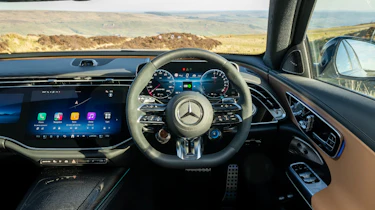
Interior fit and finish are very good, not something we’ve been able to report of late when it comes to Mercedes interiors. Rap your fingers against the back of the drive mode controllers on the steering wheel in time with a song and you’ll be met with a tinny plastic rattle, however. There are different steering wheel options, with leather standard and a carbon/microfibre combo an option but a 100 percent microfibre option would be our choice.
The test cars were equipped with the ‘MBUX super screen’ option, which means a giant central touchscreen alongside the digital instrument panel behind the wheel and a third screen for the front-seat passenger to play with. The E53 gets various AMG-specific displays, hybrid-related extras such as a charging menu, battery status and so on.
Seats and boot space
There are multiple seat options, and our test cars were fitted with the optional AMG Performance seats, with a racerish shape and perforated man-made leather upholstery. They look great, and felt great on a long journey too, with support in all the right places for our tall-ish testers. Seats are a very subjective thing however and these buckets won’t be to all tastes so try before you buy. And some of our testers were frustrated with the seat height and that its lowest setting wasn’t low enough.
Head and legroom are generally strong in both the E53 saloon and estate, with plenty of space for four adult passengers. Boot space is compromised on the hybrid thanks to the battery being under the boot floor. Where non-PHEV E-class models boast 615 litres of boot space, the E53 is way down, with just 460 litres. In the real world, it’s still a long, comparatively practical boot space, with split folding rear seats.
Price and buying options
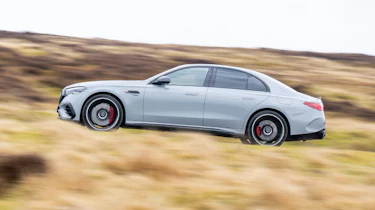
The Mercedes-AMG E53 is not a cheap car, with an RRP of £93,695 for the saloon and £94,390 for the estate. Two trim levels are offered in the UK: Premium and Premium Plus Night Edition, different Night Package options swap the usual chrome for black trim and 21-inch forged alloy wheels are standard in the UK.
Options can inflate the price dramatically, as usual with the £1500 super screen, £1695 Driving Assistance Package Plus and £695 worth of Manufaktur alpine grey paint just a few of the options fitted to our test car.
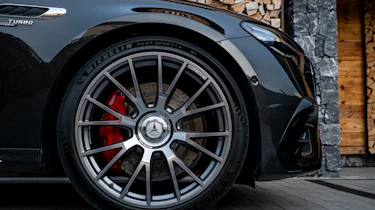
Then there’s the AMG Performance Package, which costs £7500 and bundles together: The Dynamics Plus package, which includes bigger brakes (390mm front discs with six-piston calipers, compared with the 370mm four-pots as standard, and red calipers), active engine mounts and an electronically controlled limited-slip diff at the rear; AMG Driver’s package, which also includes the top speed increase; AMG Performance seats and steering wheel trim; ‘Night Package II’ that includes a dark grille and other black exterior trim bits and the Race Start function.
The package is available for both the saloon and estate in Night Edition Premium Plus trim, and priced the same regardless of body style and worth considering if you enjoy driving and an E53 is to be your only performance car.
Rivals
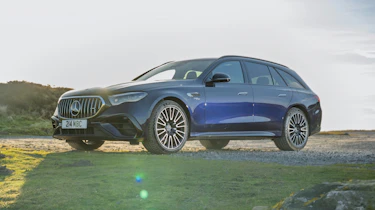
The E53 is a hard car to position in a traditional sense. Though it packs a visual punch, by the numbers – both in terms of performance and price – it’s not a direct BMW M5 rival, but outright performance aside is stronger in almost every area.
Then again by those same numbers, it’s something altogether more potent and capable than the BMW M550e. If the latter isn’t enough but an M5 is too much, the E53 is the ideal middle ground if you want a refined, comfortable, swift performance saloon or estate that is finished to a suitably high standard to match the price tag, unlike the M5 that feels cheap in comparison. There’s plenty to enjoy here.
Porsche’s saloon-coupe Panamera slips in here, too, with the 463bhp 4 E-hybrid the closest match at £99,100. If you’re coming from an E63 you will miss the V8 but will appreciate the step up in refinement, tighter and more responsive chassis and broader bandwidth of ability to go from hot rod supersaloon to near-silent limo. Or, you can dip into the nearly new, last of the line RS6 market or stick with your E63.
| Model | Power | Torque | Weight | 0-62mph | Top speed | Price |
|---|---|---|---|---|---|---|
| Mercedes-AMG E53 | 577bhp | 553lb ft | 2315kg-2380kg | 3.8 - 4.1sec | 155-174mph | From £93,695 |
| BMW M5 | 717bhp | 737lb ft | 2435kg | 3.5sec | 155-189mph | From £111,885 |
| BMW M550e | 482bhp | 516lb ft | 2230kg | 4.3sec | 155mph | From £76,825 |
| BMW M3 Touring | 520bhp | 479lb ft | 1940kg | 3.6sec | 155-174mph | From £91865 |