Alfa Romeo Giulia review – get one while you still can
Alfa Romeo's 276bhp saloon might be long in the tooth, but it's still a compelling alternative to the German establishment
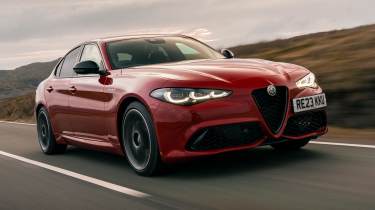
Initially launched in 2016 as Alfa Romeo’s most potent standard model, the Giulia Veloce applied some of the Quadrifoglio’s magic to a more affordable, practical saloon. The Giulia received a mid-life update in 2023, and while its design and interior tech were given an overhaul, the mechanicals remained unchanged. With its £43,750 price tag it goes head-to-head with the likes of the Mercedes-Benz C-class, BMW 3-series and Audi A5.
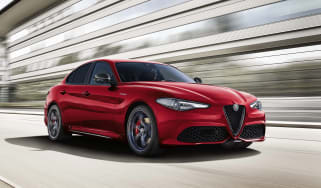
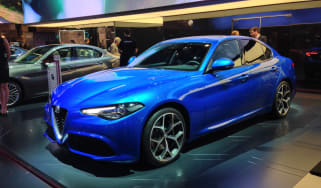
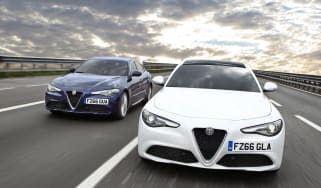
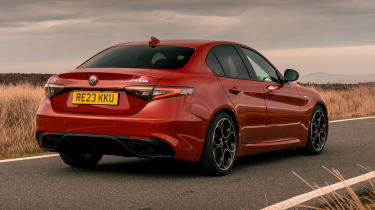
While the Giulia is starting to feel long in the tooth now almost a decade on from its debut, it does still hold great appeal over those rivals in some key areas. The exterior design is familiar, with tasteful changes to the front and rear bumpers, wheel designs and light units setting it apart from previous cars – the Giulia’s new headlight design features three individual elements in reference to Alfa’s models of the past.
> Alfa Romeo Stelvio Quadrifoglio Fast Fleet test – living with the 513bhp SUV
It’s not long for this world, with a replacement expected to offer electric and hybrid options, based on Stellantis’ STLA Large platform that underpins the new Dodge Charger. There’s uncertainty about how that’ll turn out, and thus an unspoken feeling that we should all be buying the current car while we still can.
Engine, transmission and technical highlights
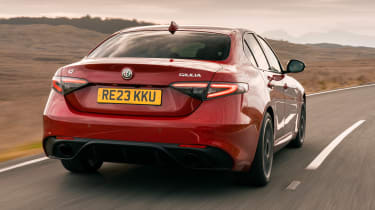
All UK cars come with the same 2-litre turbocharged petrol GME T4 four-cylinder, all in an identical state of tune – a diesel is no longer an option. While there are three trim levels (Sprint, Veloce and Tributo Italiano and Intensa), every Giulia sends the same 276bhp and 295lb ft of torque to the rear axle through an 8spd ZF automatic, operated through the same tactile column-mounted paddles found in the Quadrifoglio.
More reviews
While its closest rivals have turned to hybrid assistance, the Giulia bucked the industry trend and stuck to combustion power alone. Thanks to this, an aluminium block and thoughtful weight saving measures (it even comes with a 7kg carbonfibre prop shaft to trim 15kg), kerb weight stands at 1429kg (DIN) – over 400kg less than the BMW.
Performance and 0-62 time
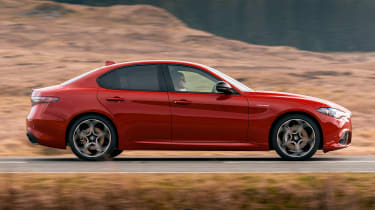
The Giulia immediately feels more spritely than its power figures suggest as a result, with its ZF transmission snappy and that peak torque figure served up from 2250rpm. A 5.7sec 0-62mph time and 149mph top speed are near-identical to its rivals, and rarely are you left wanting more from its boosted four-cylinder; it feels genuinely quick. At low speeds and from a standstill, the gearbox can be a tad clunky, but swift shifts and those tactile paddles help make up for it.
Power-to-weight stands at 193bhp/ton, considerably better than its hybrid BMW and Mercedes rivals at 156bhp/ton and 152bhp/ton respectively. An identical output to the 2016 original might be a head scratcher for power junkies out there, but it’s not an issue in our eyes.
In terms of efficiency, Alfa Romeo claims between 34 and 56mpg on the WLTP cycle. During our extensive testing, we’ve seen more like 31 on average over a few thousand miles.
Ride and handling
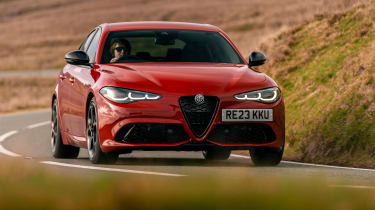
On the move, the benefits of the Giulia’s weight figure and 50:50 weight distribution are clearly felt, inspiring huge confidence with fantastic balance and reassuring feedback through the chassis. While occasionally crashy, its damping is well suited to a spirited drive on some of the UK’s bumpier roads, handling tricky marred surfaces and undulations quickly and without fuss. It’s more softly sprung than some rivals, but the Giulia retains a good level of body control while generating strong traction and a ride suitable for everyday duties.
The brake-by-wire system provides a firm pedal and good consistency at everyday speeds, with Dynamic mode increasing firmness and reducing pedal travel by 15 per cent. While this is a nifty feature that does seem to improve feel, the brakes don’t inspire huge confidence when you pick up the pace on a challenging road.
While not as hyperactive as in the Quadrifoglio, the Giulia’s steering is quick, offering plenty of accuracy and off-centre response – there’s little feel, but the way in which the chassis communicates helps make up for some of that lost information. The seating position is good, if a little high, and once in Dynamic mode, the sharpened throttle allows for fantastic mid-corner adjustability that’s lacking in most of its rivals.
We also spent time in the range-topping Competizione (now off-sale), and while most of its underlying hardware is identical to the rest of the range, the fitment of standard adaptive dampers made it an attractive option. Tributo Italiano spec took that car’s place and now the Intensa will take over from that again, both having adaptive suspension as standard. In the default mode, it’s virtually indistinguishable from the Veloce, but enable the soft damper mode and it’s night and day. While there are only standard and soft modes to choose from, the latter has a similar function to Ferrari’s bumpy road mode, taking the edge off harsh surfaces and providing more compliance. It’s an adds a level of sophistication to the feel of the Giulia.
Interior and tech
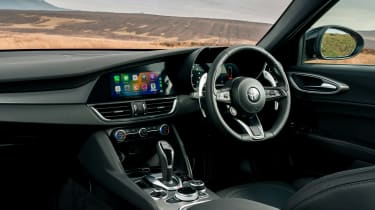
Inside, it’s a familiar story. The 12.3-inch digital dashboard was the only notable change in the update and, while it’s still functional in terms of connectivity, it’s starting to look a little dated next to BMW’s swanky (if at times irritating) curved display.
There’s some curious Italian ergonomics too, the wireless phone charger not recognising when a phone is plugged in and therefore, always trying to engage, failing and popping a warning up on the central display. The digital dash is also near-impossible to navigate with the bewildering array of steering wheel controls on the move.
The faux-carbonfibre trim won’t be for some and its German rivals still have the edge in terms of overall build quality, but there are very few hard plastics, with main touchpoints high quality. It’s not exactly roomy inside, the Giulia. The cabins of its larger German rivals feel more airy. Truthfully, it’s because they’re all a generation ahead of the Giulia, for better in this case, and for worse in others.
Prices and rivals
Costing from £43,800 in Sprint form, the base Giulia is actually a tad cheaper than it has been in the past. The Veloce is available from £48,800 and while the range-topping Intensa was previously available from £53,150, it's no longer on sale at the time of writing. The Giulia plugs a gap in the market for a reasonably-priced, entertaining rear-drive saloon.
The Veloce trim is the Giulia in its most desirable spec, without jumping into the Quadrifoglio supersaloon. For a £5000 premium over the entry-level Sprint, you get a standard limited-slip differential, striking 19-inch wheels and a whole host of other niceties. The Intensa, while pricier, is an appealing thing with its adaptive suspension and special visual touches, like the gold-highlighted 19-inch wheels and optional Montreal Green paint. The Italian flag on the mirror caps might be a bit much, mind…
Stump up an additional £10,000 and the likes of the BMW M340i xDrive and Audi S5 come into reach, but if you can do without their headline power figures, you can’t go too far wrong with the Alfa. It’s a thoroughly pleasant, refreshingly simple and focused sporting saloon.
Living with the Alfa Romeo Giulia Veloce
The Sunday Morning Test must be one of the simplest barometers of a car’s appeal. If you feel inclined to get out early on a Sunday, to enjoy some favourite roads before the garden centre fanatics start bumbling around and the speed camera vans pitch up, chances are the car’s a good ’un. When I took a turn in our Giulia for a few days recently, I didn’t particularly expect it to be one of those cars. But after a few short local drives in it, I found my mind being changed.
I’d clearly underestimated the Veloce, written it off as ‘not a Quadrifoglio’ and because it has ‘only’ 276bhp. What I’d half forgotten is how light it is. With a claimed kerb weight of 1429kg, it’s not as heavy as your instinct tells you a mid-size saloon will be, especially these days. And the result is a power-to-weight ratio slap-bang in decently rapid hot hatch territory. Think i30 N or Focus ST.
But here, of course, you’ve also got rear-wheel drive. And while, as we may have mentioned once or twice, you can’t switch off the stability control and throw some shapes on corner exit, you can still enjoy the sensations of a car being pushed rather than pulled, of uncorrupted steering, of both axles working to balance the car through a turn.
On the right kind of twisty-turny B-roads – the kind that would suit a hot hatch, funnily enough – it can make for a genuinely absorbing drive. So much so that the 90-minute drive I headed out for during my weekend with the Giulia ended up becoming twice that.
The Sunday Morning Test? The Giulia passes. – Richard Meaden, evo issue 318
Alfa Romeo Giulia specs
| Engine | Four-cylinder, turbocharged, 2-litre |
| Power | 276bhp @ 5250rpm |
| Torque | 295lb ft @ 2250rpm |
| Weight | 1445kg |
| Power-to-weight | 193bhp/ton |
| 0-62mph | 5.7sec |
| Top speed | 149mph |