Alfa Romeo Stelvio Quadrifoglio – engine, gearbox and technical highlights
Twin-turbo V6 is a hugely exciting engine, complemented by an excellent gearbox
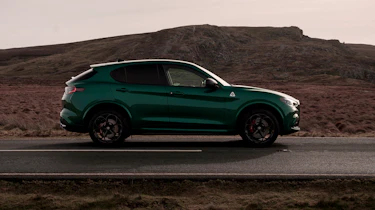
Beneath the Stelvio Quadrifoglio’s aluminium bonnet is the 2.9-litre, twin-turbo V6 as found in the Giulia Quadrifoglio. Like the Giulia, for 2024 power has been increased from 503bhp to 513bhp (following a similar upgrade for 100th Anniversary special editions in 2023). Torque, too, is identical to the Giulia Q’s at 442lb ft, but the eight-speed ZF gearbox has been recalibrated to suit both the increase in kerb weight over the saloon and the four-wheel-drive transmission.
Default mode for the Stelvio Quadrifoglio is rear-wheel drive, and it’s only when the system detects an angle of slip or a loss of traction that it will direct up to 50 per cent of the engine’s torque to the front wheels through a carbon propshaft. A rear limited-slip differential, active torque vectoring and Alfa’s Pro-DNA switchable drive mode system are all standard.
> Alfa Romeo 4C – the car world's greatest misses
The Quadrifoglio comes fitted with cast-iron brakes, although carbon-ceramics are an option. Both 20- and 21-inch wheel packages are fitted with a Pirelli P Zero tyre by default. A set of Pirelli winter tyres has also been homologated for the Stelvio Quadrifoglio.
Aluminium features extensively throughout the vehicle’s structure and chassis, keeping its weight comparatively low compared to rivals at 1830kg (1850kg for 2024-on models). If that sounds like a lot (and it is), for reference the all-aluminium F-Pace SVR weighs in at 1995kg, despite only being marginally bigger on the road.
The suspension has the same engineering-first layout as the Giulia saloon, pairing a set of forged aluminium double wishbones at the front to a four-and-a-half-link system at the rear. The doors, brake carriers, wheelarches and the engine are all made of aluminium too, and the bonnet is made of carbon.