The Audi Nuvolari is the marque's fastest model ever, with a Lamborghini heart
The R8 recipe is making a return with a significantly higher level of performance, and price tag...
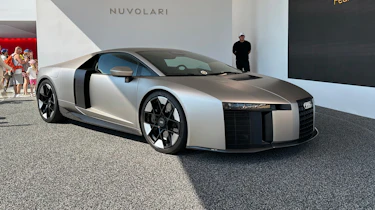
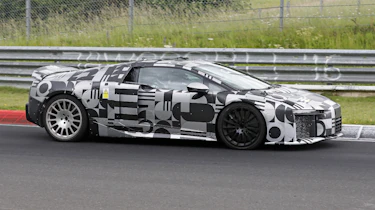
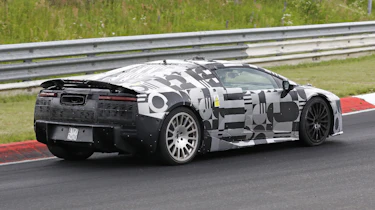
Audi has bucked the trend with the Nuvolari, stepping away from an endless drip-feed of teasers and launching its incoming flagship supercar all in one. In fact, just a few weeks after it was unveiled at the 2026 Monaco Grand Prix, production test mules were spotted out in the open at the Nürburgring. We had a closer look at the near-production model at Goodwood Festival of Speed.
‘The greatest driver of the past, the present and the future.’ That’s how Ferdinand Porsche once described Tazio Nuvolari, the man who has now unknowingly given his name to Audi ’s big comeback supercar. That’s some blockbuster billing to live up to. Just don’t call it a reborn R8, even if the new car, like the R8, shares fundamental components with a contemporary, mid-engined Lamborghini. Limited to 499 units and priced from around £500,000, the Nuvolari treads uncharted ground for Ingolstadt and sits much further apart from its Temerario cousin than was the case with its forebears.
> Audi RS4 (B7, 2006 - 2008): V8 executive gives the BMW M3 a run for its money
It’s the fastest Audi road car in history – perhaps naturally – and not just by our usual parameters. We were there to witness the covers being pulled from the Nuvolari a mere 405 days after the ‘outstanding idea’ was first raised with CEO Gernot Döllner. He quickly commissioned a joint design, engineering and aerodynamics team and the finished car – this is no mere concept – melted social media at its Monaco world premiere ahead of the 2026 Grand Prix. You didn’t expect Audi to produce an ultra-high-performance hybrid and not link it to its shiny new Formula 1 programme, did you?
The Nuvolari’s rapid development is an example of the ‘think faster, act bolder’ mentality that Audi wants to blanket across its entire operation as its famed ‘Vorsprung durch Technik’ philosophy returns to help fend off swelling Chinese competition. Calling upon decades of performance car expertise and applying the name of a legendary Auto Union racing driver to the resulting product is certainly one way to assert your heritage.
The aluminium spaceframe chassis and petrol-electric powertrain of the Temerario lie at the Nuvolari’s core but are enhanced and evolved for higher performance and – perhaps – fidelity. Its combination of 4-litre twin-turbo V8 and three electric motors produces 80bhp more than the Lambo’s total, peaking at 987bhp (or 1001 PS) to tally exactly with the Bugatti Veyron of two decades ago. Its engine outputs – 789bhp and 538lb ft alone – match those of the Temerario, meaning the Nuvolari’s electrical elements are the source of its extra muscle.
So we should anticipate the same 10,000rpm red line, too. There are a host of boost and recuperation strategies integrated within its five drive modes. Utilise some of their accrued energy via Launch Control and you’ll achieve 0-62mph in 2.6sec (a tenth quicker than a Temerario) and 0-124mph in 6.8sec, the latter figure besting even the hallowed Veyron.
Its top speed exceeds 217mph to underscore its position as Audi’s fastest road car yet, though keen stattos might point out the 2.5sec acceleration claim for the current RS e-tron GT Performance saloon. We suspect the process feels a mite more thrilling behind the Nuvolari’s wheel… As with the Temerario, there are two e-motors applying torque vectoring to the front axle, plus a third motor slotted between the engine and twin-clutch transmission.

Here they work arm-in-arm with a new ‘quattro Predictive Ride’ system that sees steering angle, yaw rate, grip and acceleration data fed continually to a control unit to keep the car alert and precise. ‘With it, we are defining the next generation of all-wheel drive,’ says Audi’s chief technical officer, Rouven Mohr, familiar to evo for his work across numerous Lamborghinis. ‘The system anticipates potential loss of traction based on highly precise sensor data and predictively coordinates the powertrain, brakes, torque distribution and aerodynamics as an integrated system.’
Going up through the Nuvolari’s five drive modes (E-Hybrid, Balanced, Dynamic, Dynamic+ and Track) increases its agility, with Track mode allowing you to dial back the traction control entirely should you wish. ‘It’s the first time we have traction control adjustable on the steering wheel,’ Mohr tells us. ‘We have four different traction levels that the driver can choose from, adapting to the surface but also to achieve maximum agility and maximum driving fun. This was super important to us.’ It’s a clear (and welcome) hint that the Nuvolari will allow its driver some mischief.
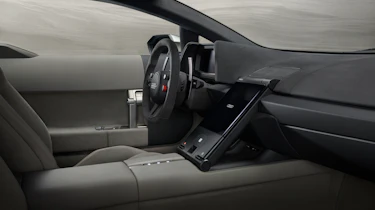
Its interior is billed as ‘a study in clarity and control’ where ‘everything supports the act of driving’, and our first sit inside reveals plenty of promise. The carbon-backed seats drop your backside appropriately low, while ahead of you sits a big, central starter button. Long, metallic paddleshifters feel a decisive step on from the R8’s meeker items and are complemented by tactile metal dials on the Alcantara-rimmed wheel for toggling through the drive and traction modes. The instruments are (of course) digital, the large central rev-counter going all the way to 12.
There’s more metal for the air vents, which are operated by supremely satisfying sliders. Recognisable Volkswagen group switchgear is notable by its almost complete absence. And don’t expect the useability of an R8 on a long trip, with luggage space limited to whatever you can squeeze behind the seats and into the passenger footwell. Oh, and the Nuvolari is left-hand drive only.
Claims of 25mpg and 270g/km of CO2 might go some way to alleviate any ire at the shift from everyday supercar to expensively hewn trinket, though the switch from a glass canopy allowing onlookers a peek at the engine to a more monolithic, sculptural deck perhaps leans too much into exclusivity. That said, witnessing one of the small handful of Nuvolaris out in the wild will remain a startling experience, we’d wager.
Braking is by wire, allied to ‘Audi Ceramic Pro’ with enormous 420mm discs up front (410mm rear) clamped by ten-piston calipers (four-piston rear). Audi claims the system’s energy absorption capacity of 2.8 megawatts is aligned with current F1 car abilities. The brakes are cooled through vents beside the slim headlights and sit behind staggered 20/21-inch forged wheels with Audi-first centre-locks.
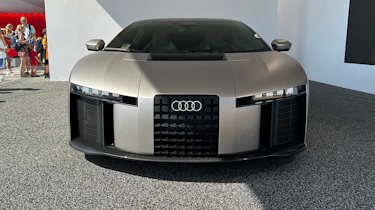
Helping distance the Nuvolari further from the Temerario are its active aerodynamics. There’s an S-duct at the front, feeding a rear wing that adjusts automatically through three positions on the move (and as you explore drive modes), while a manually activated DRS mode resides on the wheel for a tangible link to F1. Mohr claims over 400kg of downforce and points to the fully flush, milled aluminium Audi rings embedded into the carbon rear wing, which ensure a bit of design chutzpah doesn’t come at the cost of clean airflow.
Another point of difference compared with the Lambo is the Audi’s entirely carbonfibre body. Its panels are fitted by CPC Group in Modena as part of the Nuvolari’s final assembly process – and the point at which its wealthy buyers can go and greet their car at the end of its production journey, one that begins almost 500 miles away at the Audi Sport GmbH facility in Neckarsulm.

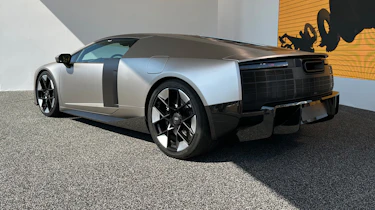
While carbon construction has helped speed up the car’s development process, it doesn’t notably chip away at its weight, Audi claiming ‘sub 1750kg’ dry (versus 1690kg for the Temerario). The artful detailing of the Nuvolari hardly screams of a pursuit of extreme dieting; the single-piece metal grille at the rear tings beautifully when you run your finger across it, though its multiple slats do play a vital cooling role. The tailpipes are positioned higher for clean underbody aero.
The use of carbon has instead helped simplify tooling (which in turn helped increase the pace of development) while allowing more nuanced curves. ‘Against other supercars, what should set us apart?’ poses chief creative officer Massimo Frascella. ‘The importance and elevation of materials is paramount for Audi in any segment that we’re in.’
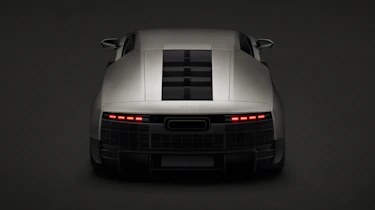
You can specify the body panels in visible carbon, though this launch car is painted in Audi’s new signature Titanium hue, one also worn by its F1 competitor and the recent Concept C – a car that the Nuvolari pips as the first production example of Frascella’s new design direction. He promises that every visual element here also carries a function. ‘The perfect example is the vertical frame on the front,’ he says. ‘Those 64 tiles are precisely angled to help the air flow all the way back to the wing.’
The reimagined sideblades, a knowing nod to the first-gen R8, were carved by CFD (computational fluid dynamics) and play a vital aerodynamic role by allowing Frascella to mould similarly nostalgic rear haunches, free of interruption. ‘It’s not about looking back to be retrospective,’ he affirms. ‘It’s about looking back to understand where you’re coming from, where you belong.’ The blades aren’t as deft as those that inspired them, and their appearance borders on the brutal as they swing outwards, solidly fixed to the doors.
That said, the drama of slotting in your hand to pull their hidden handle feels like genuine supercar theatre. Can we thank Audi’s F1 venture for enabling a project of this ambition? ‘It could stand on its own without Formula 1,’ CEO Döllner assures us, though once the race team was established ‘there was an internal feeling that we have to do a sports car,’ he admits. Know-how from the paddock has made its way into the project, and both Audi Revolut F1 Team drivers – Nico Hülkenberg and Gabriel Bortoleto – have rolled up their sleeves and got involved.
‘Running the Nuvolari at Nardò and working closely with the development team on the setup was a really great experience,’ says Bortoleto. ‘What stands out immediately is how clean and predictable the car feels on turn-in. There’s basically no understeer, which is impressive given the level of performance. The balance stays very neutral and precise, giving you the confidence to carry speed through the corners. You can clearly feel how the different systems — especially the aerodynamics and torque distribution — work together as one. It’s a very complete package and a car that responds exactly the way you expect as a driver.’
Crucially, we’re promised a tangibly different experience to the Temerario, though Döllner is only too happy to credit the Nuvolari’s established Lamborghini core for assisting the speed of the Audi’s development. ‘I don’t have to use the phrase “China speed” anymore,’ he smiles. ‘From now on I can say we’ll do the next project at Audi speed. We are accelerating technological progress and demonstrating that the company is picking up the pace — in development, decision-making, and innovation. Of course there are components from the Lamborghini cosmos, but there are also things that are being shown here for the very first time.’
A compact, focused team also proved crucial. ‘A designer, an engineer and an aerodynamicist would all draw three different cars,’ he acknowledges. ‘This is why we co-located them into one team. They had the right mindset in that they would fight for their own position, but ultimately everyone fought for the perfect product. They didn’t need an escalation to top management!’

Those shocked by the Nuvolari’s rather robust pricing – not least in comparison to the two generations of R8 obliquely preceding it – may be less surprised to learn that Döllner needed the car to turn a profit. ‘The R8 was a great car but it also had some volume ambitions,’ he says, ‘whereas this car is a showcase of what Audi is capable of when it comes to innovation, when it comes to design, when it comes to materials.
There have been projects like this in automotive history which ended up a financial disaster, and our team was capable of delivering both the result plus the economics behind it. We are in tough times right now in automotive, so there’s no “funny money” to spend on a project. It has to contribute to Audi’s future success story from a financial side. We need to transport our identity and position Audi in the automotive world, and I believe that nothing does that better than products. Only we can do a car like this.’
Production begins in early 2027 ahead of deliveries in the first half of the year, and the Nuvolari inevitably offers a new, more bespoke customer experience to match its price tag. Döllner promises its big-pocketed buyers ‘very, very personal treatment’, starting with their invitation to configure the car alongside one of its designers. ‘You can come here, talk to Massimo’s team for exterior and interior colours and individualisation, and of course it’s possible to be a more integral part of our Formula 1 story too. Creating this special Nuvolari community around Audi represents new territory for us, but again it’s an important journey when we talk about the future and elevating the brand; it’s good for the team to think differently.’
It’s an approach Audi hopes to establish beyond this 499-car run, and while the boss says we shouldn’t anticipate a new supercar ‘every other year’, it’s easy to imagine his team assessing the feasibility of a Nuvolari Spyder next. Following in short order from the Mercedes-AMG GT 4-Door and Ferrari Luce, the Audi Nuvolari sets a different tone for a plug-in halo product. Partially due to its rudimentary 10 miles of electric range, though more notably for the unashamed glance back through history – by almost a century to the period in which Tazio Nuvolari’s victories helped pioneer Auto Union’s radical mid-engined racing cars.
‘In some fields, history or legacy is a burden,’ concludes Döllner, ‘but there are areas where it’s very, very strong. Tazio Nuvolari was known for his fearlessness, his ingenuity and his will to succeed. When we looked closer at his story, we found that it’s the perfect name for this car.’ Wonder what he’d make of it...