Audi RS4 (B7, 2006 - 2008): V8 executive gives the BMW M3 a run for its money
Still the iteration by which all others are measured, Audi's second RS4 surprised us all with its exceptional engine and handling when it was launched in 2006. We revisit it
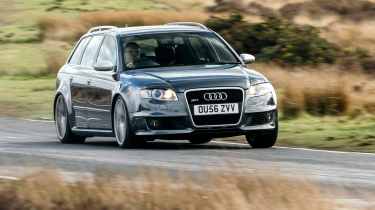
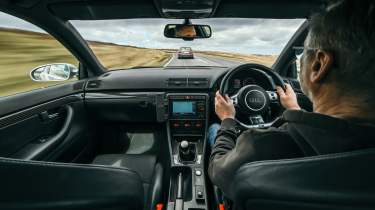
The B7 RS4 is an anomaly. When it arrived in 2005 there was nothing new on the surface. We’d seen four-wheel-drive, muscle-bound Audi RS products before, but the B7 was sewn from different DNA than its forebears. The Lamborghini Gallardo steering wheel is the first hint of its intentions. The rev counter, with red paint starting at 8250rpm, is the second. The final revelation comes when you take the RS4 to the edge and it gives back with supreme control and interaction. It all feels decidedly ‘un‑Audi’.
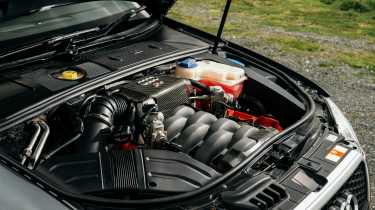
Conceived at a time when supersaloons and estates came in all manner of forms, from the supercharged V8 Mercedes E55 AMG to the V10 E60 M5, Audi settled on a naturally aspirated 4.2-litre V8 for the B7. The 414bhp unit has a hunger for revs but also offers breadth and range, pulling hard no matter where you slot the ball-topped gearlever – it’s no surprise that the motor found a home in the R8 a couple of years later. Even in 2026, the RS4 is not to be messed with, dispatching the 0-62mph sprint in 4.7sec.
> Audi RS3 Competition Limited review – can a hot hatch ever be worth £93k?
But the raw performance is just one element that drives home the B7’s brilliance, a supplement to the wonderful rhythm and balance that seems to be there no matter which road you point it at. The contemporary M3, the E46, is more expressive and perhaps even more exciting, but the RS4’s compliance and monstrous traction invite you to dig deep into its ability. The chassis will dance to your tune with fine tweaks of the throttle, and while smokey slides are off the menu, the trade-off is indomitable performance in all conditions. With most of today’s equivalents adopting four-wheel drive to pull a similar trick, the B7 was in some sense ahead of its time.
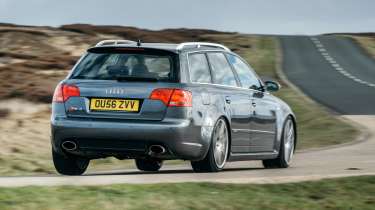
In evo issue 346's V8 executives test, John Barker revisited the B7 RS4 Avant through a 2026 lens: 'Almost immediately you appreciate the composure, the confident heft of the RS4, and while there’s more detail to the ride, the control and poise are really impressive. Diagonally cross-linked dampers are the RS4’s secret weapon.
More reviews
Group tests
In-depth reviews
Reviews
A flat-plane-crank V8 might be inherently better suited to delivering high-rpm performance but I’ve never forgotten the first time I drove this traditional, cross-plane V8. I was used to traditional V8s fading at 6000rpm but this one just revved harder, all the way to 8000rpm with a howl to die for. Who’d want the plain, in-line four-like thrum of a flat-plane V8 when you could have this? On paper, it’s similar to the [E9X] M3 V8, but it gets going sooner and delivers strongly and enthusiastically all the way through, in a very linear fashion, so it doesn’t seem to matter where the rev-counter needle is when you floor it.
The RS4’s steering isn’t the most lucid or connected-feeling of its kind, but when you have a chassis that grips so hard and responds so keenly yet so calmly, it’s not something you ever miss. You turn, the car takes the exact line you’ve chosen, the damping soaks up and neutralises any potential deflection, and the V8 powers you through with guts and character. It’s all very contained, very satisfying.
Even before you fire up the RS4 you can’t help but be impressed. 20 years ago, Audi interior quality was at its peak, besting Lexus, showing that Mercedes had rowed back, and making BMW look a touch budget. So the cockpit of the RS4 starts as the highest quality of its kind and then builds on that with (optional) near-bucket seats with seriously deep leather bolsters and inserts in a sort of carbon cloth with a hint of yellow that matches the weave of the deeply glossy carbonfibre trim. Then there’s a small steering wheel with the perfect rim diameter, quality switchgear and stylish red displays and needles. It all adds up to a feel-good ambience and, as you’d hope, even over punishing surfaces, this 20k-miles example feels utterly solid, box-fresh.'
Buying guide
Today, a B7 is a solid buy. Leggy examples start from around £14,000, but values are rising – expect to pay over £25,000 for a well-maintained sub-60,000-mile car, paying a small premium for the Avant. The very best cars are now on the market for excess of £30,000, so if you're looking for a clean example, now is your time to make a move.
Engine
The motor was also built to a high standard, but trundling around at low revs can allow oil to gather in the inlet tract, leading to carbon build-up and blue smoke from the tailpipes. Best to nudge that high-reaching red line when you can, then. Some RS4s can suffer from coil pack failure, too, resulting in a misfire. This can prove more costly if neglected, with the unburnt fuel potentially damaging one of the car’s two catalysts.
The RS4 can also suffer occasional coil-pack failure, so beware of misfires. The engine management warning light should alert the driver to this but doesn’t always do so. The actuators for the exhaust bypass valves can seize up too, so check you get the right rush of sound in Sport mode.
Audi’s quattro system is pretty robust with no known weak spots, but check for clutch judder and bite, especially on a car which has been enjoyed on track days. All B7 RS4s are equipped with a six-speed manual gearbox that has no trouble coping with the loads put through it, with even early examples proving largely fault-free.
Suspension, brakes, tyres
One problem unique to the RS4 pertains to its ingenious Dynamic Ride Control suspension, fitted as standard and responsible for the car’s impressive composure. The system hydraulically links each diagonally opposed damper to alter the degree of support in different scenarios, but the nature of the set-up can potentially spring a large bill. If one damper is leaking and in need of replacement, you should also renew its linked counterpart at the other end of the car. You won’t want to mix old and new dampers on the same axle, though, so what begins as a single faulty unit can necessitate replacing the whole set. Some owners convert from the DRC set-up to conventional coilovers, but there’s a risk of losing the RS4’s trademark compliance with this route.
Body
Corrosion is extremely unlikely, so stone chips and poorly repaired accident damage are the main checkpoints here. Panel gaps should be tight and consistent everywhere.
Interior and electrics
The cabin hides mileage well. Wear on the driver’s seat bolsters will be the first sign of intensive use. Note that you have to sit in the rear seats to check the heaters work, if fitted, because they use occupant sensors.
Audi RS4 (B7) specs
| Engine | V8, 4163cc |
| Max power | 414bhp @ 7800rpm |
| Max torque | 317lb ft @ 5500rpm |
| Transmission | Six-speed manual gearbox, four-wheel drive |
| Tyres | 255/40 ZR18 |
| Weight (kerb) | 1650kg |
| Power-to-weight | 255bhp/ton |
| 0-62mph | 4.7sec (claimed) |
| Top speed | 155mph (limited) |
| Price when new | £49,980 (2005) |
This story was first featured in evo issue 346.