Volkswagen Golf GTI review – once the definitive hot hatch, is it still one of the best?
The latest Golf GTI is fast, capable and easy to live with, now with improved if not perfected HMI and driving dynamics

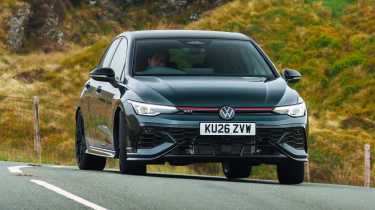
Life hasn’t been easy for the Mk8 Golf GTI. After the heights of the Mk7, which was superbly rounded and one of the best GTIs there’s ever been, things came tumbling down when Volkswagen decided that the Golf needed more digitisation and more screens to move forward into the current decade. We won’t beat what is a very dead horse here, but if you’ve ever tried to tap, poke and stroke your way around the eighth-gen Golf’s interface, you’ll know just how much of a blunder that was.
But it wasn’t just the HMI system. When it launched in 2019, the Mk8 Golf no longer felt like the class benchmark for quality, while as a hot hatch there was a sense that it had lost some of the polish, slickness and personality of its predecessor. Yes it was more powerful and could carry immense speed down a road, but it somehow wasn’t as satisfying to own, live with and drive as the Mk7.
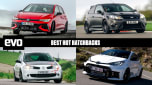
Perhaps we would’ve looked at the Mk8 GTI more fondly if Hyundai hadn’t come out of nowhere to produce the outstanding i30 N a year earlier. In many ways Hyundai’s first hot hatch felt like a modern reincarnation of the Mk5 Golf GTI, with an addictive, pugnacious attitude and all the sensibilities you need in an everyday car. An archetypal hot hatch, in other words, and so much more exciting (and significantly cheaper) than the Golf. Shame it’s no longer on sale.
More reviews
Group tests
In-depth reviews
- Volkswagen Golf GTI review – once the definitive hot hatch, is it still one of the best?
- Volkswagen Golf Mk8.5 review – still the hatchback benchmark?
- Volkswagen Golf R (Mk8.5) review – a better hot hatch but not the best
- Used Volkswagen Golf GTI (Mk5, 2004 - 2009) review – one of the best VWs of the last 30 years
Reviews
Volkswagen hadn’t given up, however, launching an updated Mk8.5 GTI in 2024. The changes were mild, but Volkswagen addressed some of the original Mk8’s issues, while producing one of the most focused Golfs ever with a new GTI Edition 50. Is that enough to put Volkswagen back on top of the hot hatch market it used to dominate? Read on to find out.
Engine, gearbox and performance
- EA888 engine producing from 261bhp up to 321 in the Edition 50
- Seven-speed DSG is the only gearbox option
- Engine is punchy and flexible, if not the most tuneful or exciting
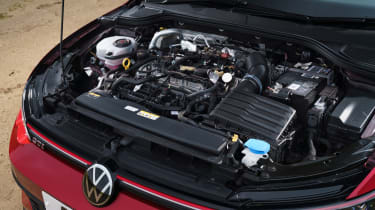
It seems like everything is powered by an EA888 engine these days. The 2-litre lump first appeared in a GTI for the Mk6, and this latest evo4 unit is the most powerful ever fitted to a base GTI. Now producing 261bhp to the old car’s 242, it punches harder yet retains the slightly flat and one-dimensional character it’s always had. To be fair there’s only so much you can do with four cylinders and a turbo, but Honda, Mercedes-AMG and Hyundai (dearly departed) have managed to squeeze more character out of theirs.
There’s nothing offensive about the GTI’s motor, though, and its linear delivery and effortless flexibility suit the package. At no point do you wish for extra urge, and it revs out cleanly to the 6500rpm red line. Pull for the next gear and the shifts are swift, but they can be laggy when going down the ’box – annoying when you’re relying on engine braking to slow into corners. Sometimes this is because there aren’t enough spare revs available to slot into a lower gear, even though it might feel like there are.
The GTI Clubsport gets an uplift in power, sharing its state of tune with various Cupra models from the Leon, Formentor and Ateca ranges. It gets 296bhp, with a less dramatic rise in torque to 295lb ft available between 2000 and 5200rpm. The Edition 50, meanwhile, is the most powerful GTI to date and gets 321bhp and 310lb ft. A seven-speed DSG is the only gearbox option across the range.
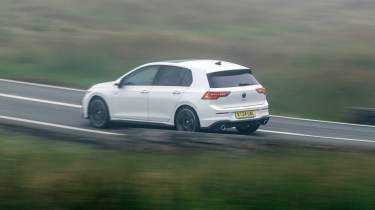
For the base GTI, Volkswagen quotes a limited top speed of 155mph, with the 0-62mph sprint dispatched in 5.9sec. This isn’t far off more powerful rivals, due largely to the fact this power is so easy to come by in the rev band. It’s a feeling that’s reflected in everyday driving, with torque plentiful in any gear accessed with minimal turbo lag.
GTI Clubsport models shave the 0-62mph time down to 5.6sec, and get the option of a raised 167mph top speed. With its extra power and stickier tyres – more on which later – the Edition 50 is the quickest GTI of all, taking 5.3sec, with the raised top speed coming as standard.
Driver’s note
‘The Edition 50 is really, really quick. Very positive front end, chomps into the tarmac immediately and then the rear is so mobile. Surprising for a modern car. I found it genuinely exciting to drive on road and on track – it covers ground so quickly and from point to point, I think you'd have to work very hard to keep up with a well-driven Edition 50, in any car.’ – James Taylor, evo Deputy Editor
Ride and handling
- Standard car is well balanced and capable, if not truly entertaining
- 15-stage DCC dampers offer a wide bandwidth
- Edition 50 is the most focused and involving Mk8 yet, but you need the Performance pack
First impressions of the GTI are encouraging, the GTI feeling gutsy, alert, yet requiring little effort to pedal along quickly. Still, it's worth diving into the driver menu screen to experiment with the Individual setting to isolate and sample different aspects of the car’s behaviour. The more aggressive engine map feels like an essential for the extra dose of character and response it brings, and while the low-effort steering is fine for normal driving, some may want to bring in some increased weight for reassurance when pressing on. It doesn't chatter in your hands in any mode, however, and the weight build up feels artificial under hard cornering loads.
What the GTI doesn’t deliver are the ‘wow’ moments you get during your first few miles in a Civic Type R or i30 N. It’s calmer and less communicative than either of those, but if you take manual control of the gears, use more revs and go up three or four notches on the dampers, you might be in for a surprise. The GTI has really, really high limits. The way the front holds a line when charging at an apex is impressive, and you don’t need to be aggressively trailing it in on the brakes for it to bite.
In Comfort mode the steering is light and a little indistinct, especially around the straight-ahead, and Sport adds extra weight without necessarily improving the sense of connection. Volkswagen says it has fine-tuned the Mk8.5’s steering, but it can feel remote unless you’re really leaning on the tyres, at which point subtle messages begin to come through. As you feed in the power the wheel can lighten in your hands as the diff pulls you through corners, and it shuffles around slightly when putting down maximum torque on a bumpy road.
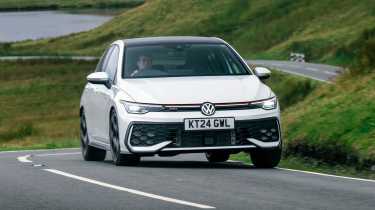
The diff is an electronically controlled XDS+ unit with a multi-plate clutch. It’s managed by the GTI’s ‘Vehicle Dynamics Manager’ and the locking factor seems less aggressive than in some hatches, including the technically related Skoda Octavia vRS. You don’t feel it fighting to pull the nose tighter under power, and while this means it blends in with the natural cornering process, driving to the strengths of the diff is part of what makes the best front-drive cars so much fun.
The calibration of the DCC dampers has been reworked for the Mk8.5, too, and the 15-stage adjustment gives you an enormous range to work with. Fully stiff is far too reactive and almost unusable on the road (it may be helpful on a dry track), but swiping all the way down to the softest setting allows the GTI to eat pretty much anything you throw at it. Bumps roll under the wheels without jostling the body around and you can carry impressive speed, but there’s a laziness in the way it reacts that doesn’t feel very GTI-like.
Comfort strikes a good balance between absorption and control, but when the surface allows, somewhere near the middle between Comfort and Sport feels best. The extra support gives the GTI more precision and agility without taking the ride to pieces. You could argue that these settings are another thing to distract you from the job of driving, but once you’ve figured them out, optimising the car for the road and conditions can be quite rewarding.
The Clubsport feels more dialled in and more positive at the front end, its diff working a little more aggressively and effectively to pull you out of corners. But it’s a step forward from the standard car rather than a leap, and still not a match for a Toyota GR Yaris or Honda Civic Type R in terms of tactility and involvement.
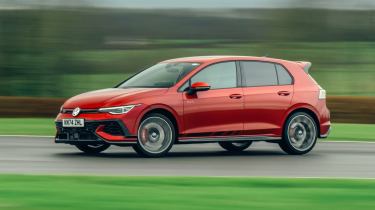
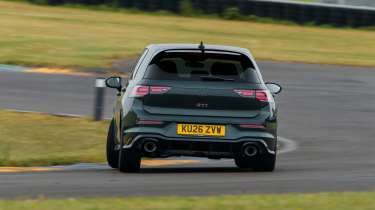
For that, you need the Performance pack-equipped Edition 50. Not only is it a leap on from the Clubsport in terms of capability, it has a sense of focus that no Golf since the Mk7 GTI Clubsport S has matched.
The steering relays finer detail from the tyres and road surface, the body is more tightly controlled and its grip and balance – aided by uprated Bridgestone Potenza Race tyres – are truly impressive. Even in damp conditions the front end stays nailed on line, and you can easily bring the rear into play with a lift, at which point the Edition 50 is mobile yet controllable.
It still doesn't have the bespoke feel, involvement and tactility of a Civic Type R but its raw capability is hard to argue with. It’s officially the fastest front-wheel drive production car around the Nürburgring, and in our hands at Anglesey Circuit it beat the latest Civic Type R by a whole second, getting within half a second of a 2014 Nissan GT-R.
Driver’s note
‘On the sticky Potenza Race tyres the Golf even more bite than a Type R. And just as other hot hatches like the i30N and Focus ST have shown in the past, there's something to be said for a more expressive balance – the Golf has the more authentic hot-hatch character in being a little more throttle-adjustable and on its toes.’ – Antony Ingram, evo contributor
MPG and running costs
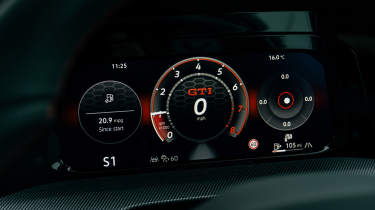
One positive of the EA888 engine is how shockingly efficient it can be in gentle running. The GTI will easily sit in the high 30s and even low 40s in motorway driving. The GTI’s official fuel economy is 40.2mpg, with the more powerful Clubsport offering a claimed 38.5mpg. The Edition 50, meanwhile, drops to 37.1mpg.
The turbo-four has proven to be a very resilient engine over the years, and the same can be said about a majority of the GTI’s fundamental mechanicals – apart from the DSG ’box. It can be a source of pain, especially if driven hard. While not as fragile as the early units, which frequently need fresh (and expensive) clutches, actuators can also go pop.
Interior and tech
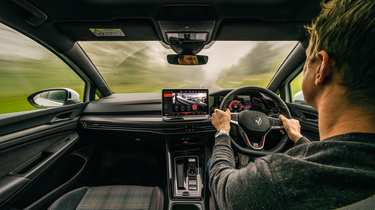
Elements of the GTI’s interior are encouraging. The instrumentation is clear and the driving position is great, your shoulders virtually in line with the B-pillar like in an old Super Tourer and your backside about a metre lower than in a fast Ford. The bucket seats feature retro cloth centres with Alcantara sides and are incredibly supportive, too.
The Mk8.5 gets improvements to its infotainment system, too. The layout hasn’t actually changed much compared to the Mk8 – the dash is still dominated by a touchscreen and a bank of haptic controls beneath, only this time everything is bigger (the screen measures 12.9 inches) and the touch sliders for the volume and temperature controls are (finally) illuminated.
The steering wheel now has physical buttons rather than haptics, and Volkswagen has made an effort to improve the speed and functionality of the touchscreen with more processing power and a new UI. It’s definitely quicker to react than before, but accessing some functions is still more complicated than it needs to be.
Clearly some effort has gone into rectifying the Mk8’s ergonomic issues, and even if the job's not fully done, that effort deserves commendation.
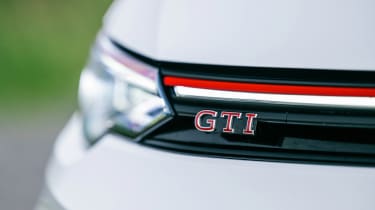
Price and rivals
The 8.5 is certainly stronger than the 8 in some key areas, but it isn’t a car transformed. Perhaps it doesn’t need to be, given the state of the dwindling petrol hot hatch market. The GTI and GTI Clubsport cost £41,860 and £44,270 respectively, and their main rivals come from within the Volkswagen Group, in the form of the Cupra Leon 300 (£44,315) and Skoda’s Octavia vRS (£41,765). The Cupra is a little sharper and more charismatic than the base GTI and the Clubsport, while the Octavia serves as a practical value alternative.
The Edition 50 costs from £48,075, putting it into battle with Toyota’s GR Yaris (£46,195), the Mercedes-AMG A35 (£48,030), Audi S3 (£49,070) and BMW M135 (£46,230). With that said, the £3,675 Performance package is essential to bring the best out of it, which makes it a very pricy hot hatch indeed.