Rolls-Royce Phantom review – the epitome of excess and British engineering excellence
Despite its age, the eighth-generation Rolls-Royce Phantom remains in a class of its own as the most luxurious way to travel by road by a significant margin
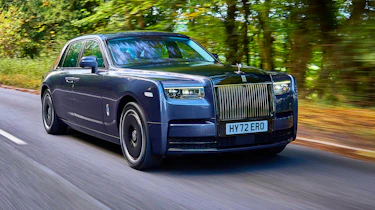
Theatre is something we usually associate with supercars. Visceral sound tracks and lateral acceleration typically associated with a NASA training programme are what most believe to be responsible, and so rarely is theatre something associated with cars from any other segment. As it turns out though, there’s one virtually silent saloon car that has it in abundance: the Rolls-Royce Phantom.
The eighth-generation car we have here has been on sale for almost a decade now, but even so, there’s quite literally nothing that has come close to its position at the absolute peak of the luxury segment. Rolls-Royce certainly charges you for the privilege though, with this particular car optioned to just shy of £500,000, so we lived with one to find out if it can ever be worth the price tag.
> Bentley Flying Spur review – the ultimate driver’s limousine
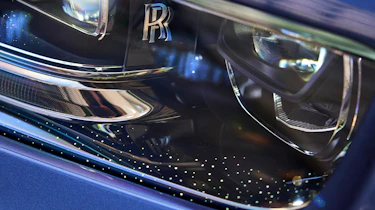
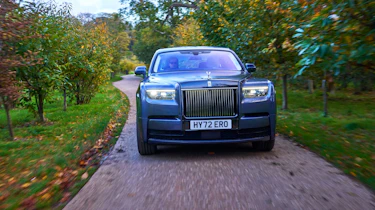
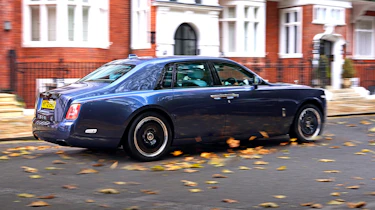
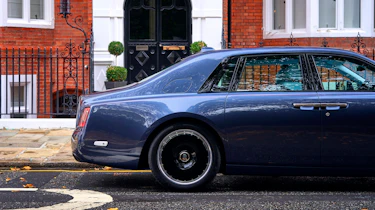
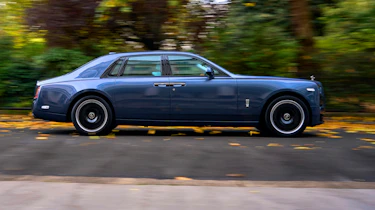
With the body-coloured aero wheel covers on this car, it at least has the presence to match its price, which shouldn’t be a surprise given it’s one of the longest production cars on sale. Stately is the first word that comes to mind, but some passing pedestrians referred to it as having ‘aura’, which on this occasion I have to agree with. It looks as if it shouldn’t be out on the road without a convoy of support cars, and the level of finish is beyond anything else you can buy now. The incredible chrome detailing on this car is a particular highlight, with the vertical slats in the grille reminiscent of turbine blades in a jet engine. Funny, that.
Engine, gearbox and technical highlights
- Twin-turbo V12 defies modern trends
- Advanced active 'Planar' suspension system
- Unique calibration for its eight-speed ZF transmission
More reviews
There’s a theme with the Phantom VIII, and it begins with the powertrain. The Rolls-Royce Phantom is officially 100 years old, and given the current position of the industry, it feels as if its engine might not be far off. That’s to say, it has a 6.75-litre twin-turbocharged V12 based on BMW’s N74 unit, in a world where Mercedes-AMG put a 2-litre hybrid four-cylinder in its ‘63’ products. It really is a step back to the past, but performance isn’t harmed in the process.
An output of 563bhp and 664lb ft of torque give it more than enough performance for the task at hand, with that torque figure available from a stunning 1750rpm for low-effort grunt. The 0-62mph sprint happens in 5.5sec before a 155mph top speed, and while that’s no match for some much less pricey luxury saloons, frankly, it would be inappropriate for a Phantom to be any quicker. Its primary purpose is to cover ground at a good pace, with as little sensation of movement inside as physics allows – key to this is an eight-speed ZF automatic, calibrated specifically for as little interruption in forward drive as possible.
For the same reason, Rolls-Royce developed one of the most advanced suspension systems on the market with its ‘Planar’ air suspension and active damper setup. The system is designed to read upcoming road conditions based on GPS and camera data, adjusting dampers in real-time to suit. There’s also four-wheel steering which both improves stability at speed and manoeuvrability, a must given it comes in at over 5.7m in length.
Performance, ride and handling
- Effortless, seamless performance
- Meticulously damped controls
- Physics defying damping and roll control
In the same way a 2000bhp hypercar might be intimidating to drive, so is the Phantom. Such a vast expanse of pristine, glass-like bodywork makes manoeuvring in tight spaces not-so pleasant – the extreme length means it often protrudes by half a car length in a standard parking space, making prior planning for parking a necessity. Fears are very quickly put to rest though, as in the same way the gear selector, volume knob and air vent pushers are damped to perfection, the controls are too. The weighting of the steering is ultra-light and superbly well-measured as per the stereotype, but the throttle pedal and brakes get the same attention – it’s immediately clear the attention to detail goes far beyond the exterior chromework.
From inside you’d be hard pressed to hear the idle of the V12 at all, but step out of the cocoon of the cabin and you’ll hear a wonderful, reassuring valvetrain sound reminiscent of the inside of a complex clock. The way this engine delivers its power is just as impressive as in a hypercar, with it defining the word effortless in the way it goes about it. You’d be hard pressed to induce any sort of jerk through the cabin with the throttle, with each and every input ironed out to provide seamless acceleration – flat to the floor and it’ll retain this composure, gently lifting the nose as it transfers its power to the road. Lift off and there’s virtually zero engine braking, another deliberate choice to prevent unwanted weight transfer.
If you need to shed pace you can do so without fuss, and that’s an understatement. The calibration of the braking system is perhaps the most impressive element of the driving experience, with a deliberate lack of response from the top of the pedal allowing you to immediately understand the manner in which you should apply pedal pressure for a silky smooth, limousine stop – in the same way it’s virtually impossible to upset your passengers with the throttle, the same can be said for the brakes. We look for instantaneous response and granular feel in driver’s cars, but the Phantom takes things to the complete opposite end of the scale, and executes it perfectly. Admittedly, the all-electric £58k BMW iX3 can achieve a smoother final stop thanks to its trick computer-aided ‘soft stop’ feature, but you won’t get any better than the Phantom for conventional combustion power.
The best performance cars inspire you to push harder, while the Phantom does the complete opposite. Its ultra-reserved character and excessively damped, well-mannered controls inspire you to drive with consideration for the experience of your rear seat passengers, regardless of if you have any. Maintaining speed is key to a smooth ride (and prompt arrival), and the Phantom allows you to do so in a manner no other car can – arrive at a speedbump and it will absorb the impact like there was nothing there.
For science, I decided to see what happened if you attempt to step outside of the ‘well-mannered’ driving style this car inspires, and the result was mind-blowing. Enter a corner (or roundabout) at a speed you don’t deem conducive with rear-seat champagne pouring and you expect to slide out of the supremely comfortable seats, but that mass transfer simply never happens. Given it weighs 2670kg, that’s especially impressive.
Highly sophisticated active air suspension, dampers and anti-roll bars are responsible for this, with secondary dampers on the upper wishbones eliminating any excess energy that would otherwise make it into the cabin. Meet one of the millions of unavoidable imperfections on Britain’s roads and you brace for impact and the subsequent rebound, but it never comes. A Rally1 car would be jealous of the way the Phantom absorbs kinetic energy. If any car is physics defying, this is one.
The self-levelling action of the anti-roll bars offer a similar, freakish disconnected feel from the road, with virtually no sense of tyre load beneath you – while this is a not-so desirable trait in driver-focused models like the Porsche Panamera Turbo with similar systems, it’s precisely what the Phantom is designed to do. The secondary dampers (along with a host of other measures) also make the cabin library quiet at all times, rough surface or not.
Being so refined creates its own problems, in that the smallest of imperfections in its dynamics become much more noticeable than they would be otherwise. Mid-corner and over bumps or drain covers, you occasionally feel the sensation of a small hop to one side. This is a very minor quirk and we don’t want to cry over spilled champagne, but it just goes to show that even the most sophisticated, no-expenses-spared machine doesn’t go without them.
Interior and tech
- Ultra-high end materials, fit and finish
- Tech is showing its age
- Outstanding refinement and cabin noise
The exterior door handle sets the tone for the experience, with a solid, well-damped feel. The doors themselves are chock-full of sound proofing, solid metal trim and leather, so every door is assisted with an electric motor. It’s worth noting that they’re very deep, so egress out of a tight space can be more troublesome than the moderate door length suggests. You probably won’t want to get out though, as the cabin is more comfortable than most homes.
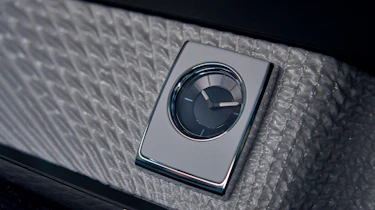
Hold the automatic door close button (available for each of the four doors) and it whirs to a soft clunk, sealing you in from the outside world. Nothing clatters or creaks in here, with every single touch point carefully considered for feel – the most distinct sound will be the ‘ding’ of cold-touch chrome on the hefty air vents, climate control pushers and bottle stoppers in the door cards.
Luxurious deep-pile carpet is a Rolls-Royce stereotype and while it may seem a little old fashioned, it brings another level of comfort to the experience. The pile is so deep that you don’t need to take your shoes off to notice it, subconsciously reminding you of the excess and luxury around you. The same goes for elements like the famous starlight headliner, replicating a real, fully accurate constellation (animated shooting stars included), and the ‘art piece’ installed behind the glass panel on the passenger side of the dash – the latter can be configured to the buyer’s liking, at a cost.
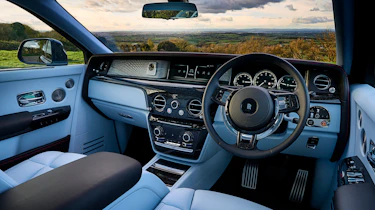
There’s no central touch screen in the Phantom, with the primary infotainment hidden away behind a glass panel, lifted into place on startup by a motorised mechanism. The only way to interact with it is via a rotary dial (which itself can be hidden away for minimal clutter), and while this works well enough, it does feel a little outdated for a car of this stature. The lack of a touch display for minimal fingerprints is understandable, but the system behind it all is of a previous generation.
While Apple CarPlay makes the age of the software a non-issue for the driver, rear-seat passengers rely on it more. Here each rear seat passenger has access to a display mounted to the back of the front seats, controlled via a central control panel or touch screen. The user interface is not very intuitive to say the least, and without spending the time to manually connect your own devices, there’s very little in the way of entertainment to be had from them. The optional, exquisitely engineered champagne cooler between the seats will make up for this for some, though.
The way in which passengers access these rear-seat displays reveals another quirk with the Phantom. Just about everything in the cabin has some level of motorisation, with even the tray tables and the displays behind them requiring you to press and hold a discrete button and wait for the action to complete. Having a satisfying manual mechanism would feel more in-line with the character of the car, but then perhaps buyers of it feel otherwise.
Price, specs and rivals
The Rolls-Royce Phantom VIII is a prime example of ‘if you need to ask.’ Prices start from £433,745, but given the vast configurability, this can quickly rise to the half-million mark – Rolls-Royce says each and every Phantom built is made to order, with our particular car optioned to £475,000. As a result, there are no direct rivals, with Bentley’s closest alternative coming in the form of the Flying Spur saloon at over half the cost – this is a much more driver-focused alternative in comparison though, with a duality to its character. The Phantom is an all-out luxury limousine.
We can’t imagine any buyer will be too concerned about the price, and besides, they needn’t be. It’s just as good at consuming unleaded as it is transporting its occupants in comfort, with 13mpg our average on a completely ordinary drive – Rolls-Royce quotes 18mpg WLTP.
Rolls-Royce Phantom Series II specs
| Engine | 6.75-litre twin-turbocharged V12 |
| Power | 563bhp |
| Torque | 664lb ft @ 1750rpm |
| Weight | 2670kg DIN |
| 0-62mph | 5.5sec |
| Top speed | 155mph |
| Price as tested | £475,000 |
For the very latest news, reviews and opinions, sign up to the evo newsletter