Bentley Flying Spur review – the ultimate driver’s limousine
Bentley flagship saloon deftly balances the roles of luxury limo and super saloon, compromising very little in each
It seemed sacrilegious, but we preferred the Continental GT with a V8. The W12 was an icon and a class-leading powerhouse in Bentley’s earlier days, but modern engineering (and less weight on the nose) made fewer cylinders the way to go if the driving experience was a priority. The Flying Spur is a different beast, though, especially in its role as Bentley’s de facto limousine now the Mulsanne is gone. It has to be cossetting and refined, yet responsive, potent and balanced. It has to ensconce, yet be spacious; be purposeful yet sumptuous.
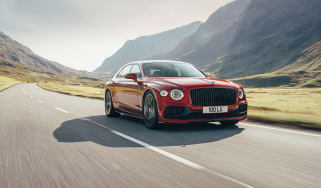
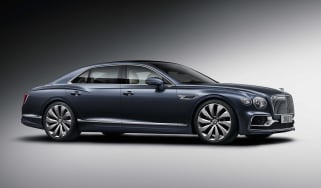
And on the outside, it has to trade some of the Continental GT’s elegance for imperiousness. Job done on the latter, even with minimal changes (new styles of grille primarily) but does the new plug-in hybrid V8 powertrain make for the ideal modern Bentley limo? Has enough changed from the previous model besides that powertrain?
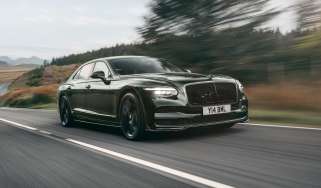
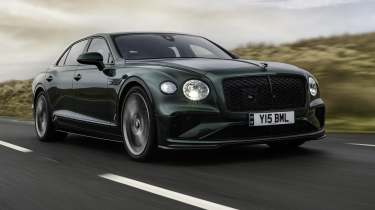
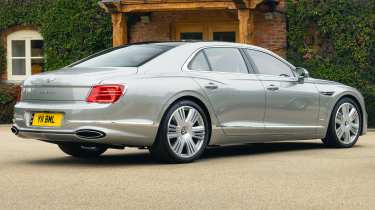
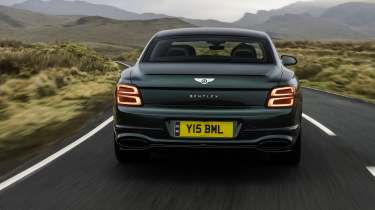
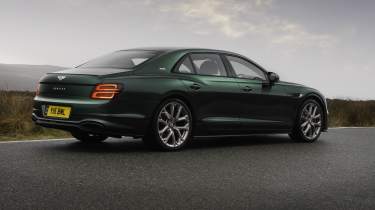
This new car is undoubtedly Bentley, with the same exquisite detailing and stately presence we’ve come to expect from its flagships. Whether your car is a more subtle specification like the chrome-covered Shell Grey Flying Spur Azure we tried, or the stunning £24,990 dual-tone paint of the Mulliner test car we had before it, a Spur draws eyes like you’re royalty.
Engine, gearbox and technical highlights
- One powertrain, two states of tune
- 671bhp is the entry point, 771bhp in the Speed
- All Spurs get the two-chamber air suspension and rear limited-slip diff
More reviews
The new Flying Spur is a Bentley through-and-through, but slide into its cosseting seats and the first thing you’ll see is an electric-only range estimate, front and centre on the digital dash. Just over 40 miles is what we saw with its 25.9kWh battery full (Bentley quotes 50), but while silent running is great for economy (we saw over 35mpg on longer runs) and refined low-speed running, that’s not the only benefit electrification provides.
This hybrid V8 powertrain is the only one available in the lineup, albeit in a couple of states of tune– there’s no V6 hybrid here.
Rather, a 4-litre twin-turbocharged V8 with an electric motor mounted within the eight-speed automatic transmission. If that V8 is the 592bhp unit you get a headline 771bhp combined power figure in the ‘Ultra Performance Hybrid’ state of tune, found in the Speed and Mulliner. If it’s the 512bhp ‘High Performance Hybrid’ version, you get 671bhp combined, found in the base and Azure specifications of Flying Spur.
For reference, the Bentley Batur took the W12 to its absolute limit as a £1.65m run-out special, and still falls short of the Ultra Performance Hybrid’s number. Meanwhile the base Spur now has more power than the 650bhp of the last W12 Speed.
The all-important torque figure is just as impressive in both. The Speed and Mulliner have a thumping 738lb ft – a good chunk ahead of the 664lb ft of the most potent W12 Flying Spurs. At 686lb ft, the lower-spec Spurs still pip them too.
While the exclusivity of a hand-built W12 gave Bentley’s flagships an edge, there’s a reason VAG has the confidence to apply this new hybrid V8 to so many models. This powertrain’s fundamentals are the same as you’ll find at the heart of the latest Porsche Panamera Turbo, Lamborghini Urus SE and Bentley Continental, and will soon make its way into even more models such as the next-generation Audi RS6.
New also for the latest Continental GT and Flying Spur are the two-chamber air springs working in concert with two-valve dampers – a system described by Bentley’s engineers as the ‘secret weapon’ of this new generation of hybrid Bentleys.
It also features rear-wheel steering and crucially, retains the limited-slip differential that not so long ago, was the preserve of Speed models. Mechanically (if not perhaps in calibration and tuning) there’s little to separate any new Flying Spur. And that’s a good thing.
Performance, ride and handling
- 3.8sec to 62mph is as ‘slow’ as Spurs get now
- Twin-chamber, twin-valve air suspension is enormously capable
- Top speed is lower than the W12s, not that it matters
Pull away silently in electric drive and the quality heft of the steering immediately becomes apparent. In all-electric mode it’s not quick, but there’s still plenty of pull to haul you up to the speed limit promptly, and in near silence.
While some luxury cars opt for an ultra-light rack, the Flying Spur goes for more weight, giving you some clue as to the driving experience on offer. Rear-wheel steering is also much less disorientating at low speed than in some cars, seamlessly improving manoeuvrability and stability at speed.
While it won’t make much difference to most buyers (especially in the UK), it is worth noting that despite its substantial increase in output, the top speed of the new Flying Spur has taken a knock. The fastest W12-powered Flying Spur managed 207mph flat-out, making it one of the fastest saloons on the market, but the new car tops out at a comparatively modest 177mph.
Where it matters, at speeds you’ll regularly be travelling at and transitioning between, the lopped top speed matters not a jot. The new cars could convince you the speedometer is improperly calibrated, masking pace like you’re doing half the indicated speed.
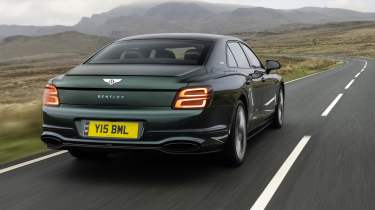
Having experienced just how well this powertrain executes a standing start in the Porsche Panamera Turbo, this was the first port of call. Feet flat and the revs rise to a hard limiter, before it catapults towards the horizon in a manner that seems completely at odds with its dimensions. A quoted 3.5sec 0-62mph seems modest, with the traction and pull it musters more akin to a Porsche 911 Turbo than anything else. You ought to secure those champagne glasses if you need to make progress.
For what it’s worth, you really don’t feel short-changed in the 671bhp models versus the 771bhp models either. The instant electric punch low-down is the same and while the relentlessness of the Speed’s pace is knocked back a perceptible tenth, you’ve still got more performance potential underfoot than just about anything else you’ll come across on the road.
While some big cars shrink around you, the Flying Spur certainly does not – the bonnet stands tall and proud, with the retractable, illuminated ‘Flying B’ guiding the way. It’s a big car – not one that even the rear-steering can shrink when it comes to threading through London’s urban sprawl or on the tightest country lanes. At speed, sweeping down A-roads or even larger B-roads, the Spur really does fly, with agility and pace in equal measure.
Ride is supple and luxurious in its standard ‘Bentley’ mode. It’s not quite a magic carpet – a Mercedes S-class offers near total isolation and perceptively better ride quality by comparison, but conversely lacks anything like the Bentley's sense of connection and control. It can shrug off harsh, unsettling impacts seemingly no matter how extreme the conditions get but they're still telegraphed, however mildly. There is nonetheless a constant level of refinement making you feel as if you’re in your own bubble, detached from the outside world.
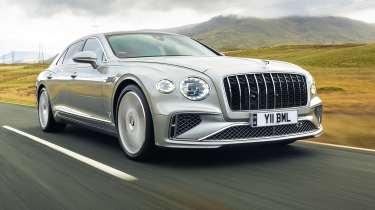
Knock the central dial to Sport and that V8 bursts into life with a purposeful burble. Synthetic interior sound is absent, but valves in the exhaust system open in this most focused mode, making it surprisingly loud on the outside. This effect is less pronounced in the milder 671bhp Azure model but there’s still a notable woofle. The cabin remains refined and calm regardless, and in alternative modes, closed valves make the engine all but silent.
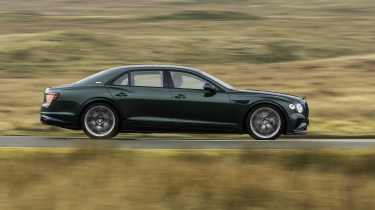
In Sport mode the chassis lowers and stiffens noticeably, minimising roll and maintaining a level of body control that doesn’t feel possible given the impressively luxurious ride. You repeatedly spot dips in the road ahead and prepare for a jolt and momentary upset that just never comes. The way in which the Flying Spur manages its 2646kg mass makes you reassess your understanding of physics.
Brakes are strong, thankfully, but the top of the pedal is a little soft and takes some time to get used to – this does make it very easy to slow to a seamless ‘chauffeur stop’, though, and is also perhaps a byproduct of the blend of friction and regenerative braking – something even Porsche still struggles with.
Knock it back to a more ordinary mode and the Flying Spur switches to its second personality, slackening the two-chamber air suspension and throttle response to make it a pleasure to cover miles quickly.
One of the most disappointing elements of the experience is unusually invasive assistance systems, with lane keep assist on by default and constantly nagging at the wheel – the weight of the steering exacerbates this, with more input required to fight it.
There is a dedicated button on the end of the indicator stalk to disengage the system, but having to do this each time you start the car doesn’t feel very Bentley. The speed limit warning tone is equally irritating. These are the kinds of everyday annoyances Bentley drivers will wish they were shielded from for their £200,000-plus.
MPG and running costs
- 50 miles claimed range means c40 miles in real life
- Recharging on the move is swift but thirsty work
- 35mpg average possible across a varied trip
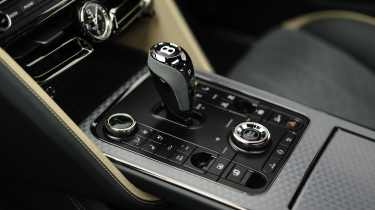
Fiddle with the hybrid modes via the dedicated button in the centre console and you’ll find ‘Hold’ and ‘Recharge’ modes, capable of maintaining the battery level or adding charge, making tethered charging a choice rather than a necessity.
Should you decide to top the battery up in this way, though, prepare to see economy drop – the 35mpg you can manage in full ‘Hybrid’ mode will drop to 20mpg during charging, where you’ll gain around one per cent of charge per mile covered at motorway speeds.
In Hybrid mode it uses its electric power reserves until you command more output than it can manage, when it employs the V8 to do the heavy lifting – the calibration of the hybrid system is good and once you understand the purpose of the charging modes (Hybrid, Hold and Charge), it adds real benefit. It could perhaps do with being a bit cleverer when it comes to saving electric power for slower-speed areas where it’s most effective – cities and rural villages – rather than defaulting to burning through the battery power even with the cruise control set to 70mph+.
Interior and tech
- Sumptuous interior feels like a safe haven
- Rotating screen and driver’s display go unchanged…
- … which could make it feel out of date to some
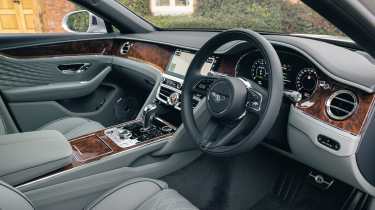
The inside is all still very Bentley, with those satisfying, tactile climate control pushers, the party-piece three-sided rotating display and a focus on comfort that makes a high end Mercedes feel ordinary. Every surface is treated to the finest materials, with everything from the cruise control stalk to the reverse of the detachable rear seat tablet featuring the same knurled chrome finish – even the insides of the cold-touch internal door handles feel expensive.
The 19-speaker, 2200w Naim sound system (a £7350 option) also remains the best of its kind, and is a reason to head out for a drive on its own.
Where many modern luxury cars opt for garish ambient lighting akin to a cheap nightclub, the Flying Spur’s is modest and reserved, in-line with the rest of the interior. Just about everything in the cabin is well considered, from the tasteful Bentley ‘B’ on the brake pedal to the satisfying damping on the central cubby door, and even the use of (more) chrome trim on the seat belt plugs. The central analogue clock is tasteful too, but is no longer Breitling-branded with this partnership having come to a close in 2021.
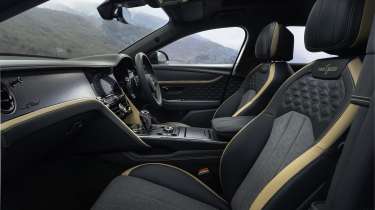
The cabin isn’t perfect, though, with the (heated) central armrest a little high and lacking any internal storage. We praise physical buttons for their ease of use, and while they’re great to have in this case, their placement low on the centre console does make them difficult to use while on the move before their placement becomes muscle memory.
A few minor rattles also surfaced in our particular test car when utilising all 2200w of its sound system, with the steering wheel developing a slight squeak at low speeds – a Bentley dealership would likely rectify such issues quickly and without questions, but they’re niggles you’d rather not have to deal with should you have just spent a quarter of a million pounds. Worth remembering too for what is supposed to be a relatively practical saloon car: that big battery has eaten a chunk of boot space.
Then there's another, slightly sacrilegious question: is the cabin of the Flying Spur and indeed the Continental range feeling its age in 2026? The tech has gone largely unchanged since 2018 and some who don’t get Bentley might find that odd, veer off and buy an S-class. Indeed these will be buyers who don’t remember how Bentley would go a couple of Parliaments rather than model years, between touching the cabins of its flagship saloons.
Price and rivals
As standard the Bentley Flying Spur costs from £190,365, before upping to Azure, Mulliner or Speed specifications. Our Azure was priced from £228,900, while Speed and Mulliner start from over £239,000 and £258,000 respectively.
There are very few direct rivals to the new Bentley Flying Spur. You could look to the Fatherland and Mercedes' S680 Maybach if no fewer than 12 cylinders will do, or the six-cylinder S580e Maybach if performance isn't a priority. Likewise the Rolls-Royce Ghost, though both are significantly less engaging to drive and more expensive – the Mybach starts from over £226k if you want the V12, while the Rolls will cost you closer to £300,000 before options. Our Flying Spur Mulliner test car was optioned with £24,990 paint, a £7350 sound system and £3215 bespoke interior. Our Azure sported similar options, plus an £18,475 ‘Mulliner Personal Specification’ Shell Grey interior, but in neither case did they approach what you’d easily spend on Goodwood’s alternative.
A more ordinary alternative is the new Porsche Panamera Turbo S E-Hybrid, featuring the exact same powertrain as the Flying Spur Speed (771bhp output and all) for a lower £168,700 price tag – cabin space, luxury and refinement all take a hit, but if you’re looking for the Flying Spur’s outstanding powertrain in a more compact, affordable package that’s arguably even more dynamic, the Porsche is a good alternative.
While the W12 injected personality into Bentley’s lineup, the new Flying Spur feels truly next generation, with electrification failing to detract from the class-leading luxury the firm has honed over the last century. The new Flying Spur isn’t a car you’re likely to take on a drive for the sake of it, but if you’re after flagship luxury that also caters to the driver, few do it better.
Bentley Flying Spur specs
| Flying Spur | Flying Spur Speed | |
|---|---|---|
| Engine | 4-litre twin-turbocharged V8 & electric motor | 4-litre twin-turbocharged V8 & electric motor |
| Power | 671bhp | 771bhp |
| Torque | 686lb ft | 738lb ft |
| 0-62mph | 3.8sec | 3.5sec |
| Top speed | 177mph | 177mph |
| Weight | 2646kg | 2646kg |
| Power-to-weight | 258bhp/ton | 291bhp/ton |
| Price | £190,365 | £258,265 |